 Laisha
AI Operating System for Agriculture
Ask Laisha
Laisha
AI Operating System for Agriculture
Ask Laisha
Bipolaris oryzae (Breda de Haan) Shoemaker, 1959 (sexual stage Cochliobolus miyabeanus) · formerly or also: Cochliobolus miyabeanus, Helminthosporium oryzae, Drechslera oryzae
Brown spot covers rice leaves and grains with oval brown spots with grey centres. It is a disease of poor and stressed rice: it is worst on nutrient-poor soils, in drought-prone rainfed rice and where potassium, silicon or nitrogen are short. Historically it contributed to the Bengal famine of 1943, and it remains a common cause of yield and grain-quality loss in rainfed rice. Because it reflects crop stress, the best control is good crop nutrition and water management rather than repeated spraying.
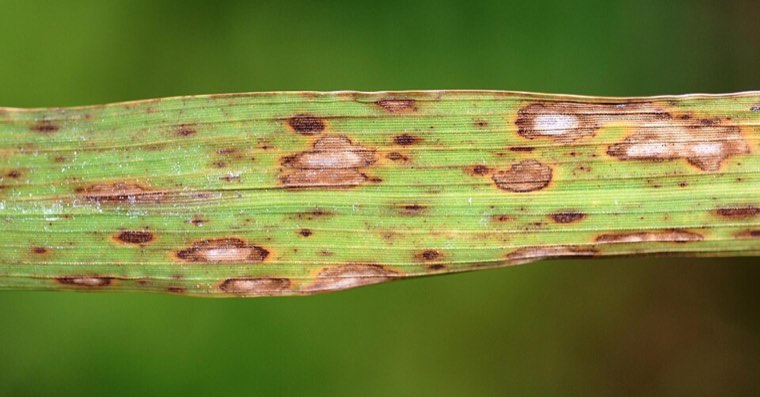
Brown spot of rice is caused by Bipolaris oryzae (Breda de Haan) Shoemaker, 1959 (sexual stage Cochliobolus miyabeanus), a fungus (ascomycete) (order Pleosporales, family Pleosporaceae).
Older or alternative scientific names: Cochliobolus miyabeanus, Helminthosporium oryzae, Drechslera oryzae.
Present in all rice-growing regions, and most damaging in rainfed lowland and upland rice on poor soils in South and Southeast Asia and Africa.
| Region | Status |
|---|---|
| South Asia | Widespread; historic epidemics |
| Southeast Asia | Widespread in rainfed rice |
| Africa | Widespread |
| Americas and other regions | Present |
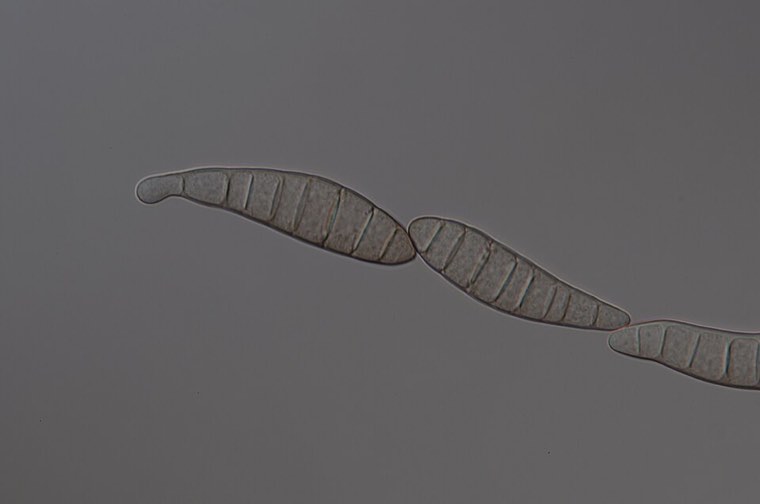
The fungus produces long, dark, curved conidia with several cross-walls on dark conidiophores in lesions. It is seed-borne and survives on infected seed, straw and grass hosts.
| Crop stage | What you see |
|---|---|
| Seedling | Small brown lesions on coleoptiles and leaves; seedling blight from infected seed. |
| Tillering to booting | Oval, eye-shaped brown spots with grey or whitish centres and often a yellow halo, scattered evenly over the leaves; many spots cause leaves to dry. |
| Heading to maturity | Dark brown to black spots on glumes and grain ('grain discoloration'); light, chalky or broken grain. |
Infected seed and straw carry the fungus into the next crop. Airborne conidia from lesions infect leaves and grains when they are wet, and many cycles occur during the season. Stressed plants are much more susceptible. Seed-borne infection leads to seedling blight and early lesions in the nursery; the disease then builds up through the season, often becoming conspicuous after flowering when plants are under nutrient stress.
| Stage | Duration | Notes |
|---|---|---|
| Survival | Between seasons | Seed, straw, grass hosts. |
| Infection | About 8-24 hours of leaf wetness | Favoured at 25-30 °C. |
| Lesions and sporulation | About 1 week | Repeated cycles. |
| Grain infection | Heading to maturity | Seed carries the fungus forward. |
Infection is favoured by about 25-30 °C with long leaf wetness or humidity above about 90%.
Several cycles per crop.
Nutrient-poor soils (low potassium, silicon, nitrogen or manganese), drought stress in rainfed rice, infected seed, and long dew periods. Soils that are sandy, acidic, leached or low in organic matter are typical settings, as are crops grown with little or no fertiliser.
There is no widely used numeric economic threshold; correcting soil fertility and using clean seed is the main approach, with fungicides considered for seed crops or severe outbreaks.
Thresholds are local. They depend on crop price, control cost, variety and natural-enemy activity, so use the figure your local extension service publishes where one exists.
Yield losses commonly range from a few per cent to 30-40% in rainfed rice on poor soils, with quality losses from discoloured, light grain; epidemics in 1942-43 contributed to the Bengal famine. Seed from infected crops germinates poorly and carries the fungus into nurseries, so quality losses continue into the next season.
Control works best as a sequence: prevent, monitor, then act only when a threshold or a risk forecast says so, using the least disruptive option that works.
Seed treatment reduces seed-borne infection; foliar sprays are considered for seed crops or severe outbreaks. What is registered differs by country and changes over time; follow the label and your local plant-protection authority.
| Scheme | Group | Mode of action | Notes |
|---|---|---|---|
| FRAC | 3 | Demethylation inhibitors (DMI) | Foliar and seed uses. |
| FRAC | M03 | Dithiocarbamates and relatives (multi-site) | Protectant; seed treatment. |
| FRAC | 11 | Quinone outside inhibitors (QoI) | In mixtures. |
Rice is the main host; wild rice and several grasses (for example Leersia, Digitaria and Echinochloa species) are also infected.
How to grow the crop well is the first line of defence. Laisha's free grow guides cover each crop from sowing to harvest:
Written by Laisha from the sources above, in its own words. This page is general reference, not a prescription: confirm identification locally and follow the label and your plant-protection authority.