 Laisha
AI Operating System for Agriculture
Ask Laisha
Laisha
AI Operating System for Agriculture
Ask Laisha
Cnaphalocrocis medinalis (Guenée, 1854) · formerly or also: Salbia medinalis
The rice leaf folder's caterpillar rolls a rice leaf lengthwise into a tube with silk and feeds inside, scraping away the green tissue so the leaf shows long white streaks. Fields can look badly damaged, but rice tolerates a lot of leaf loss during tillering; damage to the flag leaf at heading matters more. In East Asia the moths migrate long distances each year on monsoon winds.
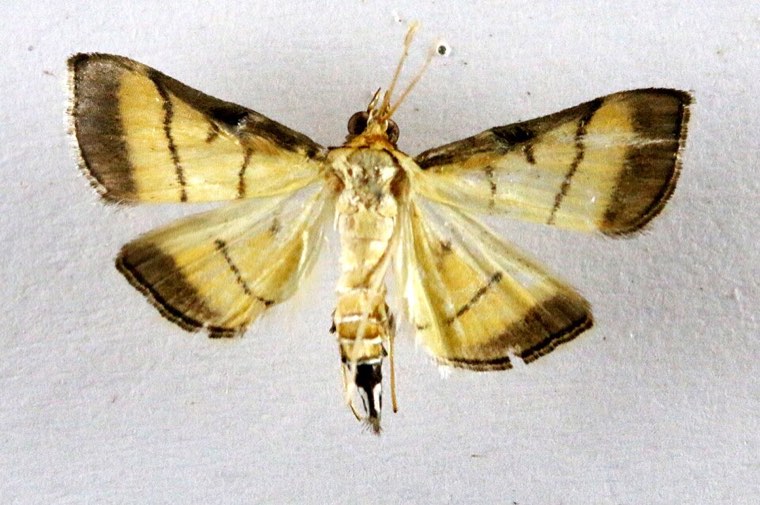
The scientific name of rice leaf folder is Cnaphalocrocis medinalis (Guenée, 1854), in the order Lepidoptera, family Crambidae.
Older or alternative scientific names: Salbia medinalis.
Found throughout rice-growing Asia, from Pakistan to Japan, and in northern Australia, Oceania and parts of Africa. In temperate East Asia it cannot overwinter and arrives each year by long-distance migration from the south.
| Region | Status |
|---|---|
| South Asia | Widespread; outbreaks in high-input rice |
| Southeast Asia | Widespread |
| East Asia | Annual migrant; major pest in China, Korea and Japan |
| Oceania and Africa | Present |
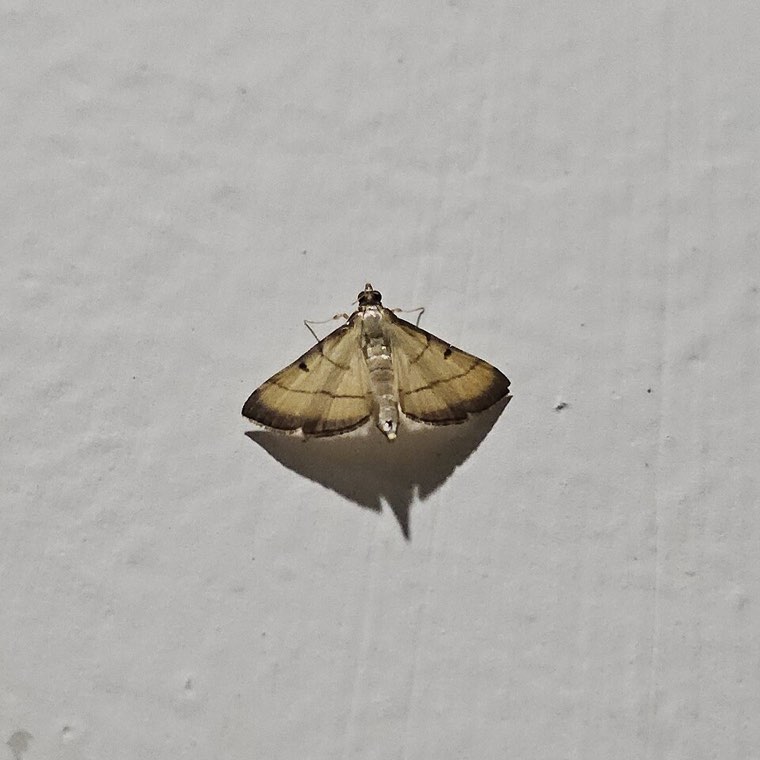
Moths are about 8-10 mm long, yellowish brown, with two or three dark wavy lines across the wings and a dark band along the outer margin; they rest on the underside of leaves by day. Eggs are flat, oval and laid singly along the leaf midrib. Larvae are green to yellowish green, up to about 20-25 mm, and live inside folded leaves.
| Crop stage | What you see |
|---|---|
| Tillering | Leaves folded lengthwise and tied with silk; long white or transparent streaks where the green tissue has been scraped; larvae and droppings inside the fold. |
| Booting to heading | Folded and scraped flag and upper leaves; in heavy attack whole fields look whitish and scorched. |
| Grain filling | Reduced grain filling where flag leaves were heavily damaged. |
Females lay eggs singly on young leaves. Each larva folds one leaf after another as it grows through five instars, and pupates inside a folded leaf or leaf sheath. Moths are attracted to light, and in East Asia large migrations bring the pest into northern regions in early summer.
| Stage | Duration | Notes |
|---|---|---|
| Egg | About 4-6 days | On young leaves, along the midrib. |
| Larva (5 instars) | About 15-26 days | Inside folded leaves; each larva damages several leaves. |
| Pupa | About 6-9 days | Inside a folded leaf or sheath. |
| Adult moth | About 1 week | Nocturnal; migratory. |
Development is fastest at about 25-29 °C with high humidity; a generation takes roughly a month in warm conditions.
Several overlapping generations a year in the tropics; 2-6 in temperate East Asia after migrants arrive.
High nitrogen and lush crops, shade, high humidity, grassy bunds, and early-season insecticide sprays that kill parasitoids and spiders.
Thresholds are expressed as the percentage of leaves (or of hills with freshly damaged leaves), and are lower at reproductive stages because the flag leaf contributes most to grain filling. Published values differ by region.
| Crop | Threshold | Unit | Crop stage | Region | Source |
|---|---|---|---|---|---|
| Rice | 10% damaged leaves (vegetative); 5% damaged leaves (flowering) | % of leaves with fresh damage | Vegetative; flowering | South Asia | Kerala Agricultural University rice pest management guidance (celkau) |
| Rice | 2 freshly damaged leaves | per hill | Planting to mid-tillering | South Asia | Indian rice extension tables (Kerala Agricultural University) |
Thresholds are local. They depend on crop price, control cost, variety and natural-enemy activity, so use the figure your local extension service publishes where one exists.
Leaf damage during tillering seldom reduces yield much because rice compensates; damage to the flag leaf and the two leaves below it during booting and heading reduces grain filling, with losses reported from a few per cent to over 30% in outbreaks.
Control works best as a sequence: prevent, monitor, then act only when a threshold or a risk forecast says so, using the least disruptive option that works.
Spray only when counts of fresh damage exceed the local threshold, especially around booting and heading. What is registered differs by country and changes over time; follow the label and your local plant-protection authority.
| Scheme | Group | Mode of action | Notes |
|---|---|---|---|
| IRAC | 28 | Ryanodine receptor modulators (diamides) | Reduced susceptibility reported in East Asia. |
| IRAC | 6 | Glutamate-gated chloride channel allosteric modulators (avermectins) | Larvicide. |
| IRAC | 11A | Bacillus thuringiensis | Biological; young larvae. |
Mainly rice; also maize, sorghum, wheat, sugarcane and grasses such as barnyard grass and other weeds near paddies.
How to grow the crop well is the first line of defence. Laisha's free grow guides cover each crop from sowing to harvest:
Written by Laisha from the sources above, in its own words. This page is general reference, not a prescription: confirm identification locally and follow the label and your plant-protection authority.