 Laisha
AI Operating System for Agriculture
Ask Laisha
Laisha
AI Operating System for Agriculture
Ask Laisha
Colletotrichum gloeosporioides species complex (Penz.) Penz. & Sacc., 1884 (species complex; on mango mainly C. asianum, C. fructicola and C. siamense) · formerly or also: Glomerella cingulata (sexual stage, in the broad sense)
Anthracnose is the most important disease of mango wherever the crop meets rain at flowering or fruiting. It blackens flower panicles so fruit never sets, spots leaves and twigs, and above all rots ripening fruit after harvest - often fruit that looked perfect when it was picked, because the fungus infects green fruit and waits. The same group of fungi causes anthracnose of papaya, avocado, guava and many other tropical fruits.
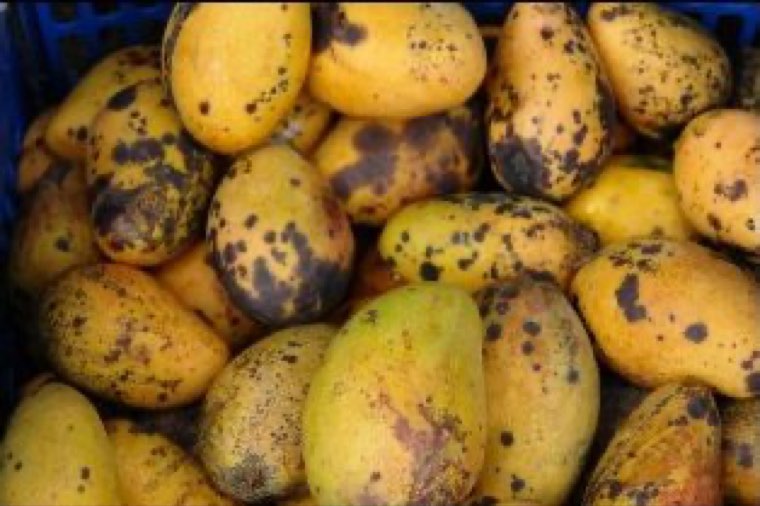
Anthracnose of mango is caused by Colletotrichum gloeosporioides species complex (Penz.) Penz. & Sacc., 1884 (species complex; on mango mainly C. asianum, C. fructicola and C. siamense), a fungus (ascomycete) (order Glomerellales, family Glomerellaceae).
Older or alternative scientific names: Glomerella cingulata (sexual stage, in the broad sense).
Present in every mango-growing region, and most damaging in humid tropical lowlands and where rain falls during flowering and fruit development. Dry-season flowering, as in some arid production zones, greatly reduces it.
| Region | Status |
|---|---|
| South and Southeast Asia | Widespread; major pre- and post-harvest disease |
| Sub-Saharan Africa | Widespread; a key constraint to fruit quality |
| Latin America and the Caribbean | Widespread |
| Oceania | Present in northern Australia and the Pacific |
| Middle East and North Africa | Present where humidity allows |
The fungus forms small cushion-like fruiting bodies (acervuli) in lesions that release slimy, salmon-pink to orange spore masses in wet weather; spores are spread mainly by rain splash. It survives in infected twigs, dead leaves, old panicles and mummified fruit in the canopy.
| Crop stage | What you see |
|---|---|
| Flushing (young leaves and twigs) | Small dark brown to black spots on young leaves that merge and may fall out, leaving holes; twig dieback. |
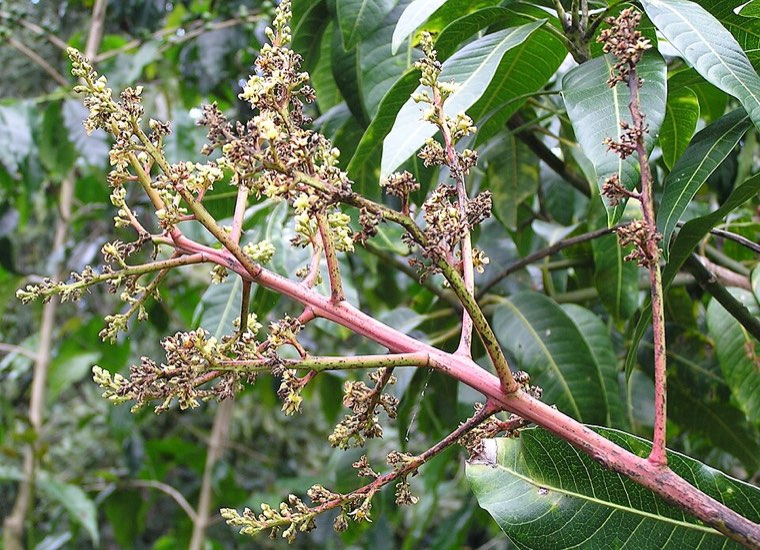
| Flowering | Blossom blight: black spots on flowers and panicle stalks; flowers drop and few fruit set. |
| Young and developing fruit | Small dark spots, or 'tear-stain' streaks running down from the stem end where spores washed over the fruit; most infections stay invisible (latent). |
| Ripening and after harvest | Round, sunken black lesions that enlarge quickly and merge, with pink-orange spore masses in humid storage; the flesh beneath rots. |
Rain splashes spores from infected twigs, old panicles and leaves onto new flushes, flowers and young fruit. On green fruit the fungus penetrates and then stops, staying quiescent until ripening softens the skin and lowers natural defences; this is why rot appears in the market or kitchen. New lesions produce spores that continue the cycle in the canopy.
| Stage | Duration | Notes |
|---|---|---|
| Survival in canopy debris | Between seasons | Dead twigs, leaves, old panicles, mummified fruit. |
| Spore dispersal by rain splash | During wet periods | Needs free water. |
| Infection | About 12 hours of wetness at 25-30 °C | Flowers, young leaves and green fruit. |
| Latent phase on fruit | Weeks to months until ripening | No visible symptoms. |
| Lesions and sporulation | Days after ripening begins | Black sunken rot; new spores. |
Infection is favoured by about 25-30 °C with relative humidity above about 95% or free water; dry weather during flowering is the best natural protection.
Many cycles during rainy periods; one season's fruit carries latent infections into storage.
Rain, fog or heavy dew during flowering and fruit set; dense, unpruned canopies; dead twigs and old panicles left in trees; susceptible cultivars; and harvesting in wet weather or bruising fruit.
There is no numeric economic threshold based on disease counts. Protection is timed to risk: from panicle emergence through fruit set in wet weather, and with post-harvest treatment of fruit destined for storage or distant markets.
Thresholds are local. They depend on crop price, control cost, variety and natural-enemy activity, so use the figure your local extension service publishes where one exists.
Blossom blight can greatly reduce fruit set in wet flowering seasons, and post-harvest anthracnose commonly affects 30-60% of fruit in humid regions without control, rising to near-total loss of stored fruit in some seasons. Spotted fruit is downgraded or rejected for export.
Control works best as a sequence: prevent, monitor, then act only when a threshold or a risk forecast says so, using the least disruptive option that works.
Protective sprays are applied from panicle emergence to fruit set in wet weather, and some post-harvest treatments are permitted in some markets. What is registered differs by country and changes over time; follow the label and your local plant-protection authority, and respect export residue limits.
| Scheme | Group | Mode of action | Notes |
|---|---|---|---|
| FRAC | M01 | Inorganic (copper) - multi-site | Protectant on flushes and panicles. |
| FRAC | M03 | Dithiocarbamates and relatives (multi-site) | Protectant. |
| FRAC | 11 | Quinone outside inhibitors (QoI) | Use in mixtures; resistance risk. |
| FRAC | 3 | Demethylation inhibitors (DMI) | Systemic; pre- and post-harvest uses where registered. |
Fungi of the Colletotrichum gloeosporioides complex attack a very wide range of tropical and subtropical fruit and other crops: mango, papaya, avocado, guava, citrus, banana, passion fruit, yam and coffee, among others. Strains differ in their preferred hosts.
How to grow the crop well is the first line of defence. Laisha's free grow guides cover each crop from sowing to harvest:
Written by Laisha from the sources above, in its own words. This page is general reference, not a prescription: confirm identification locally and follow the label and your plant-protection authority.