 Laisha
AI Operating System for Agriculture
Ask Laisha
Laisha
AI Operating System for Agriculture
Ask Laisha
Erysiphe alphitoides (syn. Oidium mangiferae) (Griffon & Maubl.) U. Braun & S. Takam., 2000; asexual stage described as Oidium mangiferae Berthet, 1914 · formerly or also: Oidium mangiferae, Erysiphe quercicola (some mango isolates)
Powdery mildew covers mango flower panicles, young leaves and tiny fruits with a white, flour-like growth. Flowers and fruitlets drop, and in bad years a tree that flowered heavily sets almost no fruit. It strikes during flowering in cool, dry weather with dewy nights, so protection is timed to panicle emergence.
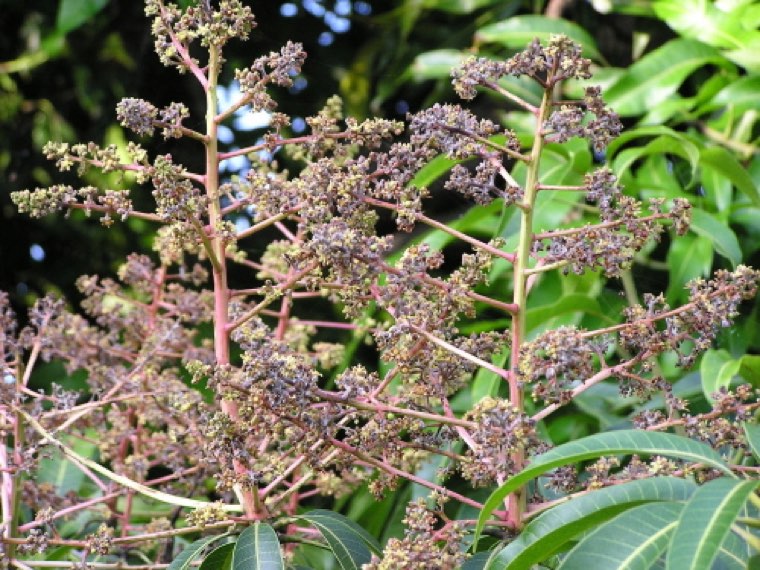
Powdery mildew of mango is caused by Erysiphe alphitoides (syn. Oidium mangiferae) (Griffon & Maubl.) U. Braun & S. Takam., 2000; asexual stage described as Oidium mangiferae Berthet, 1914, a fungus (powdery mildew, an obligate parasite) (order Erysiphales, family Erysiphaceae).
Older or alternative scientific names: Oidium mangiferae, Erysiphe quercicola (some mango isolates).
Present in nearly every mango-growing region and most severe where flowering coincides with cool nights, dew or fog and moderate humidity, as in many parts of South Asia, East Africa, the Middle East and highland areas of the Americas.
| Region | Status |
|---|---|
| South and Southeast Asia | Widespread; major flowering disease |
| Africa and the Middle East | Widespread |
| Americas | Widespread |
| Oceania | Present |
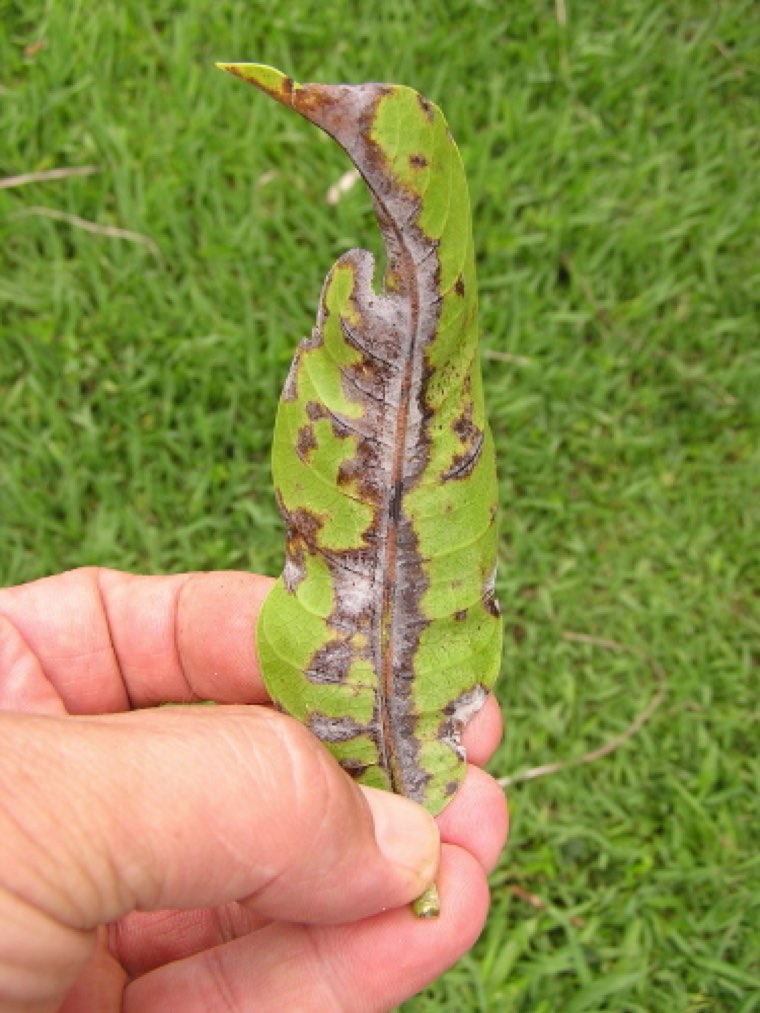
The fungus grows on the surface of young tissue as white mycelium bearing chains of barrel-shaped conidia, which are carried by wind. It survives between flowering seasons as mycelium in old leaves and dormant buds on the tree; sexual fruiting bodies are rarely found on mango.
| Crop stage | What you see |
|---|---|
| Panicle emergence and flowering | White powdery patches on flower stalks and flowers, spreading over the whole panicle; flowers turn brown and drop. |
| Fruit set | Powdery coating on tiny fruitlets, which shrivel and fall; panicles left bare. |
| Young leaves and developing fruit | Powdery patches on undersides of young leaves, which become purplish-brown and distorted; russeted, cracked skin on surviving fruit. |
Mycelium surviving in dormant buds and old leaves produces conidia when new flushes and panicles appear. Wind carries conidia to young tissue, where they germinate without free water and form new colonies in a few days, giving several cycles during the flowering period.
| Stage | Duration | Notes |
|---|---|---|
| Survival on the tree | Between flowering seasons | In buds and old leaves. |
| Conidia dispersal | During flowering | Wind-borne; free water not needed. |
| Infection and colony growth | About 5-7 days to new spores | Young tissue only. |
| Repeated cycles | Through flowering and fruit set | Panicles most susceptible. |
Favoured by about 10-31 °C (optimum in the low 20s) with moderate humidity, cool nights and dew; heavy rain washes spores away and reduces spread.
Several cycles during each flowering period.
Cool nights and dew or fog at flowering, moderate humidity, dense canopies, susceptible cultivars and infected old leaves and buds left on trees.
There is no numeric economic threshold; protection starts at panicle emergence in areas and seasons where the disease is known to occur, because infection of flowers is rapid and irreversible.
Thresholds are local. They depend on crop price, control cost, variety and natural-enemy activity, so use the figure your local extension service publishes where one exists.
Losses of fruit set of 20-90% are reported in susceptible cultivars in favourable seasons, and the disease is one of the main reasons for poor fruit set in many mango regions. Fruit that survives infection at the fruitlet stage may be russeted and cracked, lowering its market grade.
Control works best as a sequence: prevent, monitor, then act only when a threshold or a risk forecast says so, using the least disruptive option that works.
Protective sprays at panicle emergence, full bloom and fruit set are standard where the disease is regular; applications during open bloom must consider pollinators. What is registered differs by country and changes over time; follow the label and your local plant-protection authority.
| Scheme | Group | Mode of action | Notes |
|---|---|---|---|
| FRAC | M02 | Inorganic (sulfur) - multi-site | Protectant; can scorch in heat. |
| FRAC | 3 | Demethylation inhibitors (DMI) | Systemic. |
| FRAC | 11 | Quinone outside inhibitors (QoI) | In mixtures; resistance risk. |
Mango is the important crop host. Molecular studies indicate that the mango pathogen belongs to the same species group as oak powdery mildew and attacks some other trees.
How to grow the crop well is the first line of defence. Laisha's free grow guides cover each crop from sowing to harvest:
Written by Laisha from the sources above, in its own words. This page is general reference, not a prescription: confirm identification locally and follow the label and your plant-protection authority.