 Laisha
AI Operating System for Agriculture
Ask Laisha
Laisha
AI Operating System for Agriculture
Ask Laisha
Ceratitis capitata (Wiedemann, 1824) · formerly or also: Tephritis capitata
A small, brightly patterned fly whose maggots develop inside citrus, stone fruit, figs, coffee berries and more than 300 other fruits. Originally African, it has spread to almost every warm region except most of Asia, and is one of the most important quarantine pests in world fruit trade. Large area-wide programmes releasing sterile males keep it out of some fruit-exporting regions.
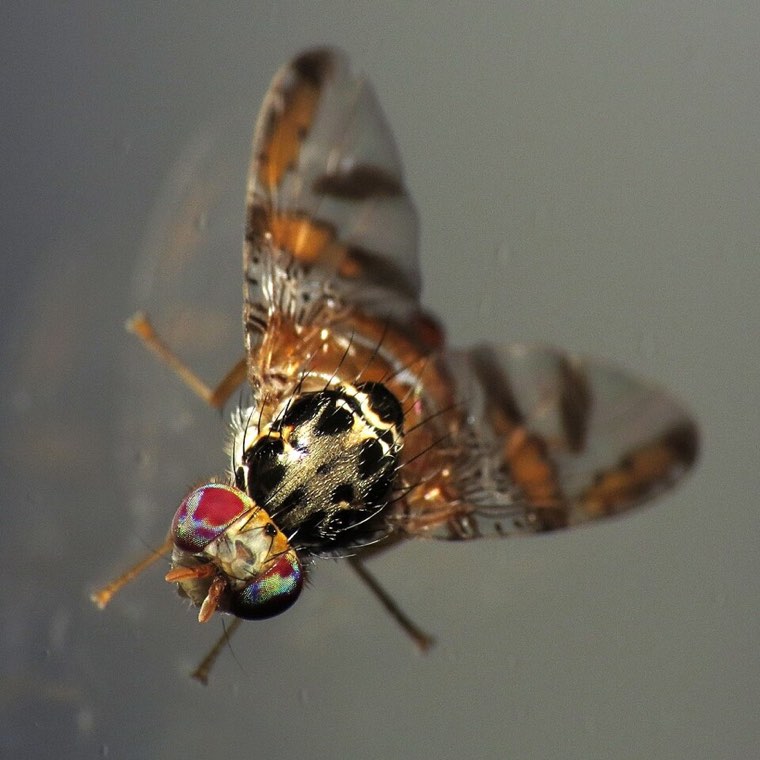
The scientific name of Mediterranean fruit fly is Ceratitis capitata (Wiedemann, 1824), in the order Diptera, family Tephritidae.
Older or alternative scientific names: Tephritis capitata.
Native to sub-Saharan Africa. It spread around the Mediterranean in the nineteenth century and then to the Middle East, Latin America, Western Australia and Hawaii. It is absent from most of Asia and from much of North America, where detections are eradicated; Mexico and Central America maintain a sterile-fly barrier to stop its northward spread.
| Region | Status |
|---|---|
| Sub-Saharan Africa | Native; widespread |
| Mediterranean basin and Near East | Established for over a century; key citrus and stone-fruit pest |
| Latin America | Established in much of South America and parts of Central America |
| Oceania | Established in Western Australia; absent from eastern Australia and New Zealand |
| North America | Not established; outbreaks eradicated; quarantine pest |
| Asia | Largely absent; quarantine pest |
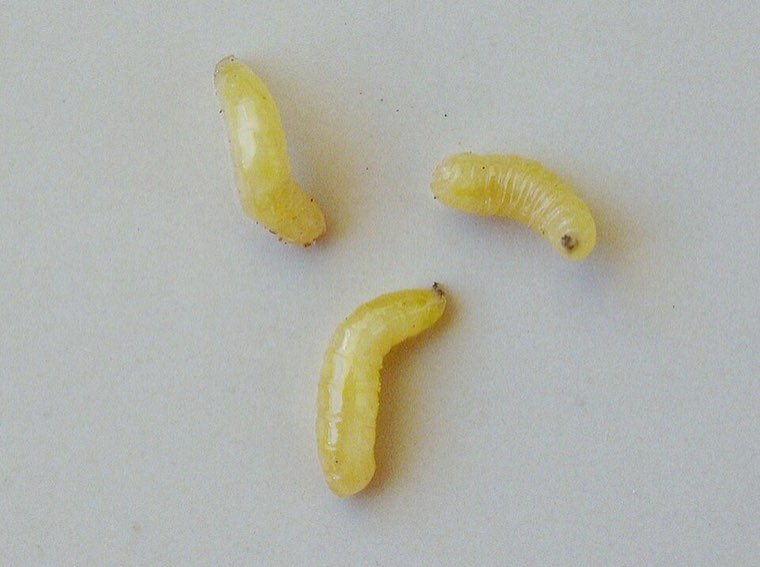
Adults are 3.5-5 mm long, smaller than a house fly. The thorax is shiny black with a pattern of silvery-white and yellow markings; the abdomen is yellowish with two pale cross-bands; the wings carry bold yellow-brown bands and spots. Males have a pair of distinctive diamond-tipped bristles on the head. Larvae are cream-coloured, legless maggots up to about 8 mm.
| Crop stage | What you see |
|---|---|
| Fruit colour break and ripening | Small puncture marks ('stings') on the skin; in citrus a hard, discoloured halo around the sting; in stone fruit oozing gum. |
| Ripe fruit | Soft, sunken, discoloured patches over tunnels; maggots inside; fruit drop. |
| Post-harvest | Rapid rotting in storage and transit; fruit rejected at inspection. |
Females lay groups of a few eggs under the fruit skin, up to several hundred in a life of one to two months. Larvae feed for about a week in warm weather, leave the fruit and pupate in the soil. In cooler Mediterranean climates populations build up in late summer and autumn on a sequence of hosts, from stone fruit to figs, persimmon and citrus.
| Stage | Duration | Notes |
|---|---|---|
| Egg | About 2-4 days at 25 °C | Under the fruit skin. |
| Larva (3 instars) | About 6-10 days at 25 °C | Feeds inside the fruit. |
| Pupa in soil | About 6-13 days at 25 °C | In the top few centimetres of soil. |
| Adult | 1-2 months; begins laying after about 4-6 days | Males attracted to a male lure; females to protein and ammonia-based food baits. |
Development stops below about 10-12 °C and is fastest near 25-30 °C, where a generation takes 3-4 weeks. Cold winters kill most adults and larvae; populations survive winters in mild coastal areas and in fruit stored indoors.
From 2-4 generations in cooler Mediterranean areas to 10 or more in the tropics.
Mild winters, a succession of ripening hosts, backyard and abandoned fruit trees, fallen fruit left under trees, and movement of infested fruit by travellers and trade.
There is no numeric economic threshold in practice: a single larva makes a fruit unsaleable and export protocols have zero tolerance. Action is triggered by trap catches rising (expressed as flies per trap per day) as fruit approaches colour break, and in free areas any detection triggers emergency measures under official programmes.
Thresholds are local. They depend on crop price, control cost, variety and natural-enemy activity, so use the figure your local extension service publishes where one exists.
Unprotected stone fruit and mandarins in Mediterranean climates can suffer infestation of 30-100% of fruit late in the season. The greater economic effect is through trade: an outbreak in a free area closes export markets for the duration of eradication.
Control works best as a sequence: prevent, monitor, then act only when a threshold or a risk forecast says so, using the least disruptive option that works.
Insecticides are used mainly in bait sprays applied to part of the canopy and in attract-and-kill devices rather than full-cover sprays; export fruit is often given cold or heat treatments. What is registered differs by country and changes over time; follow the label and your local plant-protection authority.
| Scheme | Group | Mode of action | Notes |
|---|---|---|---|
| IRAC | 5 | Nicotinic acetylcholine receptor allosteric modulators, site I (spinosyns) | Used in protein bait formulations. |
| IRAC | 3A | Sodium channel modulators (pyrethroids) | Used in attract-and-kill devices. |
| IRAC | 1B | Acetylcholinesterase inhibitors (organophosphates) | Historically used in baits; widely restricted. |
Recorded from more than 300 cultivated and wild fruits. Important hosts include citrus (especially mandarins and sweet orange), peach, nectarine, apricot, plum, fig, persimmon, apple, pear, quince, guava, mango, coffee berries, prickly pear, loquat, kiwifruit, tomato and pepper.
How to grow the crop well is the first line of defence. Laisha's free grow guides cover each crop from sowing to harvest:
Written by Laisha from the sources above, in its own words. This page is general reference, not a prescription: confirm identification locally and follow the label and your plant-protection authority.