 Laisha
AI Operating System for Agriculture
Ask Laisha
Laisha
AI Operating System for Agriculture
Ask Laisha
Pomacea canaliculata (Lamarck, 1822) (with Pomacea maculata in parts of Asia) · formerly or also: Ampullaria canaliculata
A large freshwater snail from South America that was brought to Asia in the 1980s as food and escaped into rice fields, where it eats young rice seedlings down to the water line. A few snails per square metre can wipe out a newly direct-seeded field in days. It lays conspicuous bright pink egg clusters on stems above water. It is one of the world's worst invasive species and also carries the rat lungworm parasite, which can infect people who eat undercooked snails.
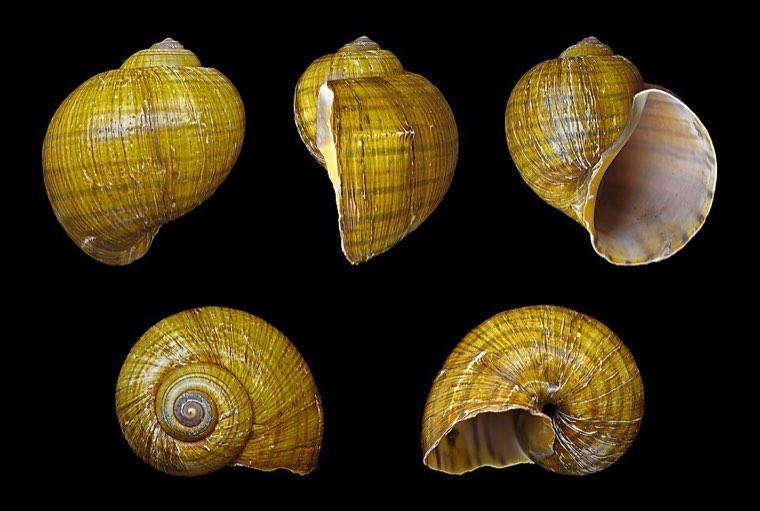
The scientific name of golden apple snail is Pomacea canaliculata (Lamarck, 1822) (with Pomacea maculata in parts of Asia), in the order Architaenioglossa, family Ampullariidae.
Older or alternative scientific names: Ampullaria canaliculata.
Native to South America (the Río de la Plata basin). Introduced to Taiwan around 1980 and then spread through East and Southeast Asia (the Philippines, Vietnam, Thailand, southern China, Japan and others), to Hawaii and other Pacific islands, and to Europe (the Ebro delta in Spain since 2009). It is regulated in the European Union and other regions.
| Region | Status |
|---|---|
| Southeast Asia | Invasive; major rice pest |
| East Asia | Invasive in southern China, Taiwan, Japan and Korea |
| Pacific | Invasive in Hawaii and some islands |
| Europe | Invasive in the Ebro delta (Spain); regulated |
| South America | Native |
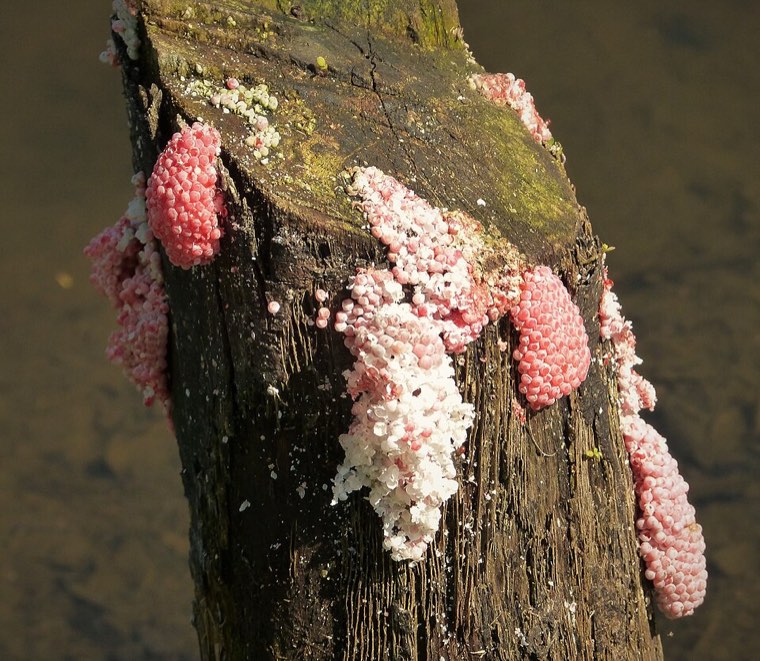
Shells are globular, yellowish to greenish-brown, often with darker bands, up to about 4-7 cm across, with a deep suture ('channel') between the whorls. Snails breathe air through a siphon. Eggs are laid in clusters of a few hundred, bright pink, on stems, posts and canal walls above the water line, turning pale before hatching.
| Crop stage | What you see |
|---|---|
| Direct seeding and transplanting (first 2-3 weeks) | Missing seedlings and cut stems at the water surface in patches; floating leaf pieces; snails and pink egg masses visible. |
| Tillering | Older plants mostly tolerate attack, but gaps from early losses remain; damage continues in deeper water. |
| Canals and margins | Pink egg masses on rice stems, weeds, posts and walls; snails in drains and canals. |
Females climb above the water at night to lay pink egg clusters. Hatchlings drop into the water and grow fast, reaching maturity in about two to three months in warm water. Snails survive drying by burying themselves in mud for months, and are spread through irrigation canals, floods and deliberate movement.
| Stage | Duration | Notes |
|---|---|---|
| Egg cluster | About 1-2 weeks to hatch | Above water; several hundred eggs. |
| Juvenile | About 2-3 months to maturity | Feeds on soft plants. |
| Adult | Two to four years | Lays eggs repeatedly; survives drought in mud. |
Growth and reproduction are fastest in warm water (about 25-30 °C); cold winters limit spread into temperate regions.
Two or more generations a year in the tropics.
Standing water during the first weeks after crop establishment, direct seeding, poorly levelled fields with deep patches, connected irrigation canals and drains, and the absence of predators such as ducks.
There is no internationally agreed numeric threshold; recommendations focus on reducing snail numbers before planting and protecting seedlings for the first two to three weeks. Some national programmes publish action levels in snails per square metre for direct-seeded rice.
Thresholds are local. They depend on crop price, control cost, variety and natural-enemy activity, so use the figure your local extension service publishes where one exists.
Uncontrolled snails can destroy most of a direct-seeded crop within days and force replanting; losses across infested areas of Southeast Asia have been estimated in the hundreds of millions of US dollars a year at the height of the invasion.
Control works best as a sequence: prevent, monitor, then act only when a threshold or a risk forecast says so, using the least disruptive option that works.
Molluscicides are not classified by IRAC and many are highly toxic to fish and other aquatic life; their use is restricted in many countries. Where any are registered, use them only as the label allows and never in water used by fish or people. What is registered differs by country and changes over time; follow the label and your local plant-protection authority.
Young rice is the main crop victim; it also eats taro, lotus, water spinach, water chestnut and many aquatic plants, and older rice when food is scarce.
How to grow the crop well is the first line of defence. Laisha's free grow guides cover each crop from sowing to harvest:
Written by Laisha from the sources above, in its own words. This page is general reference, not a prescription: confirm identification locally and follow the label and your plant-protection authority.