 Laisha
AI Operating System for Agriculture
Ask Laisha
Laisha
AI Operating System for Agriculture
Ask Laisha
Ustilaginoidea virens (Cooke) Takah., 1896 (sexual stage Villosiclava virens) · formerly or also: Villosiclava virens, Claviceps oryzae-sativae
False smut turns individual rice grains into velvety balls of spores, first orange-yellow and later olive-green to black. A few balls per panicle look harmless, but the disease has become much more common with high-yielding hybrids and heavy nitrogen use, it lowers yield and grain quality, and the spore balls contain toxins (ustiloxins) that make grain unfit for food or feed if contamination is high. Farmers in some regions have traditionally regarded a few spore balls as a sign of a good harvest, but the toxins they contain are a food-safety concern.
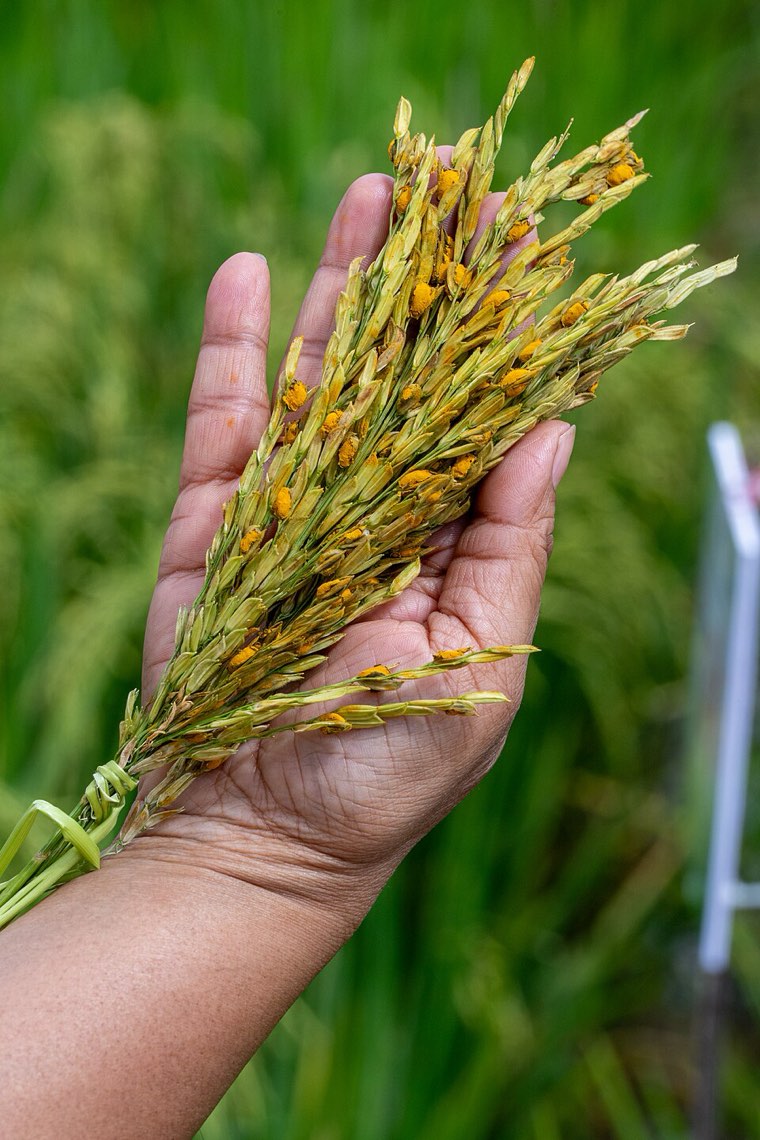
False smut of rice is caused by Ustilaginoidea virens (Cooke) Takah., 1896 (sexual stage Villosiclava virens), a fungus (ascomycete) (order Hypocreales, family Clavicipitaceae).
Older or alternative scientific names: Villosiclava virens, Claviceps oryzae-sativae.
Present in most rice-growing regions of Asia, Africa, the Americas and Europe, and increasingly important in China, South and Southeast Asia and the southern United States.
| Region | Status |
|---|---|
| East Asia | Widespread; a major disease of hybrid rice in China |
| South and Southeast Asia | Widespread; increasing |
| Americas | Present; important in the southern US |
| Africa and Europe | Present in irrigated rice |
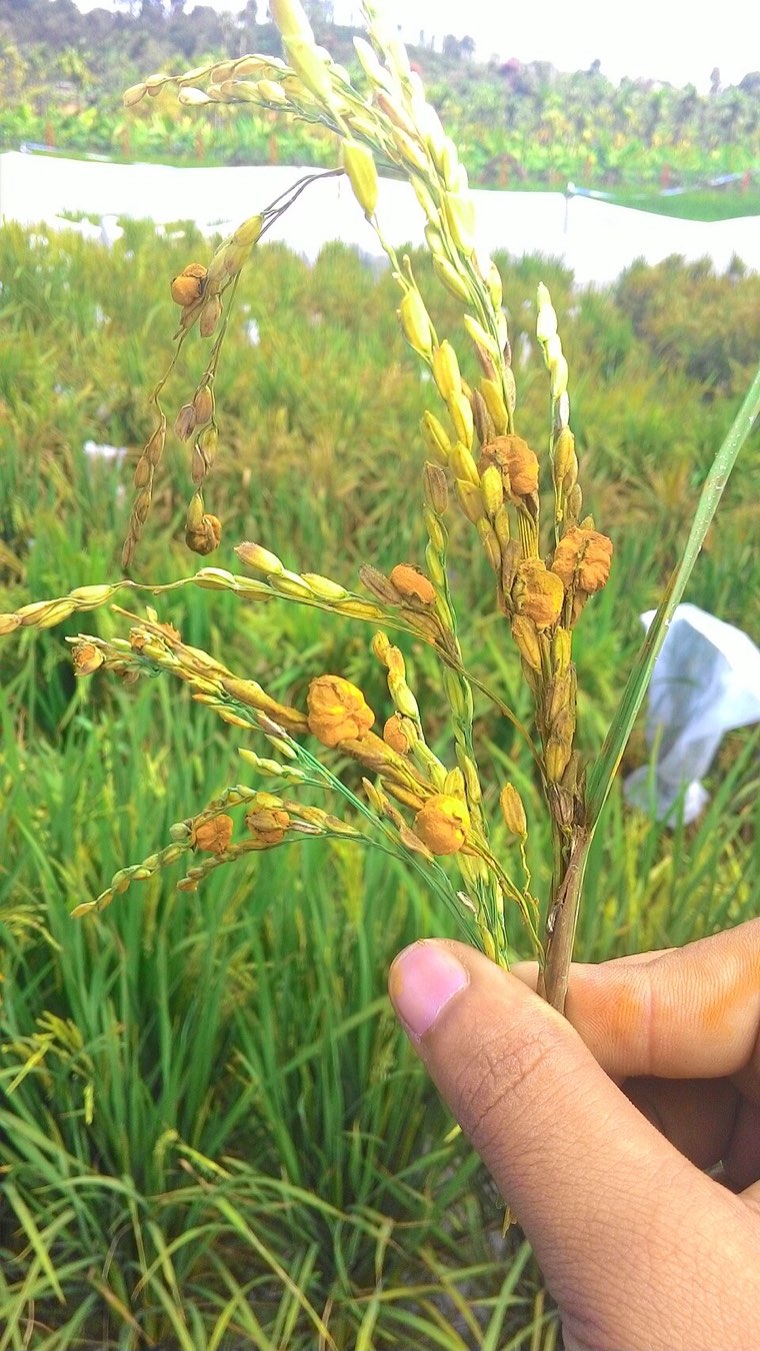
Infected grains become spore balls up to about 1 cm across, covered first by a thin membrane, then by powdery orange-yellow chlamydospores that turn olive-green and black. Some spore balls form hard black sclerotia that survive in soil. Spores contain ustiloxins and other mycotoxins.
| Crop stage | What you see |
|---|---|
| Booting to flowering | No visible symptoms; infection happens at booting through the developing flower. |
| Grain filling | Individual spikelets swell into small, smooth, yellowish balls that burst through the glumes. |
| Maturity | Velvety orange then olive-green to black spore balls scattered on the panicle; neighbouring grains may be partly filled; spores dust hands and machinery at harvest. |
The fungus survives as sclerotia and chlamydospores in soil and on seed. In wet weather around booting, spores reach the developing panicle and infect the flowers, replacing the grain with a spore ball. Spores from the current crop add to soil inoculum for the next season. Airborne ascospores from germinating sclerotia and conidia from chlamydospores both contribute, and more infections occur when panicles stay wet for long periods during booting.
| Stage | Duration | Notes |
|---|---|---|
| Sclerotia and chlamydospores | Survive in soil and on seed for months | Primary inoculum. |
| Infection at booting | During rain and high humidity | Flowers infected before heading. |
| Spore-ball formation | Grain filling | Replaces individual grains. |
| Survival | Between crops | Sclerotia and spores return to soil. |
Rain, high humidity and moderate temperatures (about 25-30 °C) around booting and heading favour infection; dry weather at that stage greatly reduces it.
One infection cycle per crop.
Rain or cloudy, humid weather at booting; high and late nitrogen; dense, high-yielding hybrid crops; infected seed; and fields with a history of the disease. Fields previously affected carry more sclerotia and spores in the soil.
There is no numeric economic threshold based on spore balls, because infection happens before symptoms show. Protective action is taken at late booting in fields and seasons at risk.
Thresholds are local. They depend on crop price, control cost, variety and natural-enemy activity, so use the figure your local extension service publishes where one exists.
Yield losses are usually a few per cent but can reach 10-40% in severe seasons on susceptible hybrids; mycotoxins and spore contamination lower grain quality and price. Infected panicles also have more unfilled grains and lower grain weight near the spore balls, and spore dust contaminates harvested grain.
Control works best as a sequence: prevent, monitor, then act only when a threshold or a risk forecast says so, using the least disruptive option that works.
Fungicides are effective only when applied before heading, at late booting; sprays after symptoms appear do not help. What is registered differs by country and changes over time; follow the label and your local plant-protection authority.
| Scheme | Group | Mode of action | Notes |
|---|---|---|---|
| FRAC | 3 | Demethylation inhibitors (DMI) | Late booting. |
| FRAC | 11 | Quinone outside inhibitors (QoI) | Late booting; in mixtures. |
| FRAC | M01 | Inorganic (copper) - multi-site | Protectant in some programmes. |
Rice is the main host; the fungus has also been found on maize and some grasses.
How to grow the crop well is the first line of defence. Laisha's free grow guides cover each crop from sowing to harvest:
Written by Laisha from the sources above, in its own words. This page is general reference, not a prescription: confirm identification locally and follow the label and your plant-protection authority.