 Laisha
AI Operating System for Agriculture
Ask Laisha
Laisha
AI Operating System for Agriculture
Ask Laisha
Hypothenemus hampei (Ferrari, 1867) · formerly or also: Stephanoderes hampei
A black beetle smaller than a sesame seed that drills into coffee berries and raises its young inside the bean. It is the most damaging insect pest of coffee worldwide, lowering both the weight and the quality of the harvest. Because almost its whole life is spent hidden inside berries, control depends on picking every ripe and fallen berry, traps and biological control.
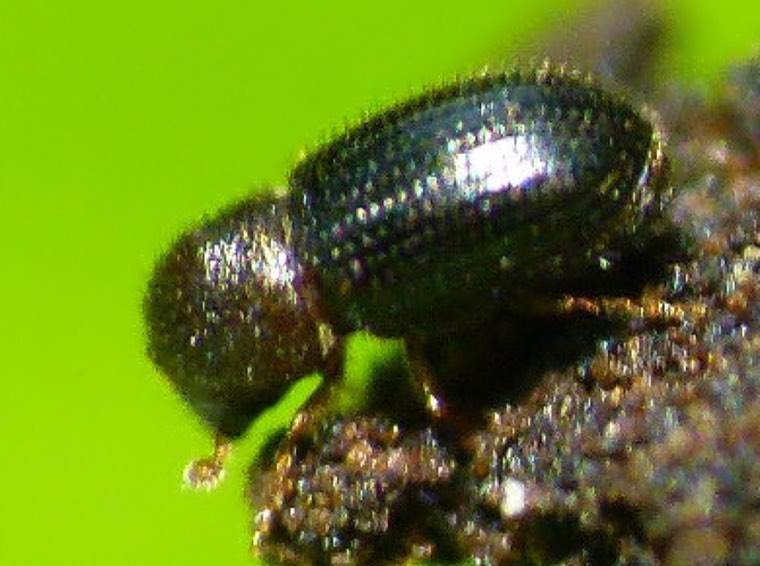
The scientific name of coffee berry borer is Hypothenemus hampei (Ferrari, 1867), in the order Coleoptera, family Curculionidae (Scolytinae).
Older or alternative scientific names: Stephanoderes hampei.
Native to Central Africa. It spread with coffee to almost every producing country: Brazil by the 1910s, much of Latin America and Asia during the twentieth century, Puerto Rico in 2007 and Hawaii in 2010.
| Region | Status |
|---|---|
| Sub-Saharan Africa | Native; widespread in coffee zones |
| Latin America and the Caribbean | Established in nearly all coffee countries |
| South and Southeast Asia | Established |
| Pacific | Established in Hawaii and some islands |
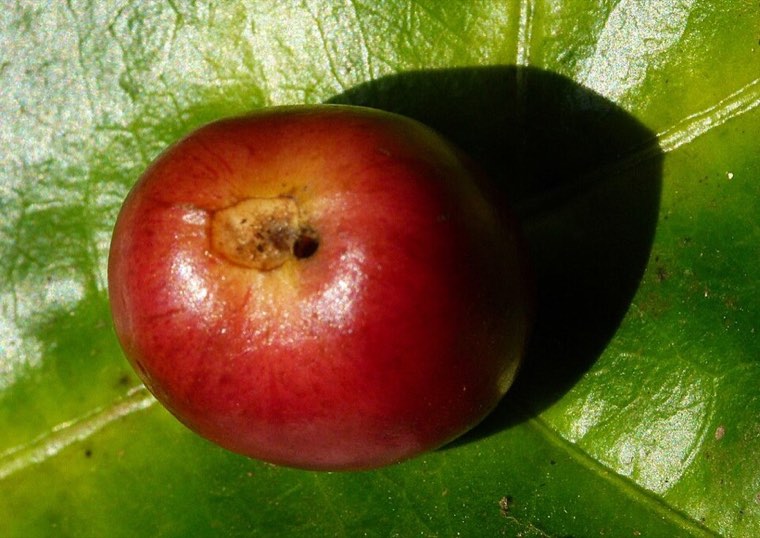
Females are about 1.5-2 mm long, shiny black, cylindrical, with a head hidden under the thorax; males are smaller (about 1.2 mm) and cannot fly. Eggs, white legless larvae and pupae are found only inside berries. A tiny round hole (about 1 mm) in the 'navel' (disc) at the tip of the berry is the typical sign.
| Crop stage | What you see |
|---|---|
| Young green berries | Entry holes at the berry tip; females wait in the hole until the seed hardens; very young berries may fall. |
| Mature green to ripe berries | Tunnels and fine dust inside the bean; several stages of the beetle in one seed; premature ripening and fruit drop. |
| Harvest, drying and storage | Perforated, lighter beans that are downgraded or rejected; beetles continue breeding in berries left on trees, on the ground and in poorly dried coffee. |
A mated female bores into a berry and lays eggs in galleries in the seed. Her offspring develop inside, where brothers mate with sisters before the young females leave to find new berries; there are roughly ten females for each male. Berries left on trees or on the ground after harvest carry the population over to the next flowering.
| Stage | Duration | Notes |
|---|---|---|
| Egg | About 5-9 days at 24-27 °C | Inside the bean. |
| Larva | About 10-26 days | Feeds on the seed tissue. |
| Pupa | About 4-9 days | Inside the bean. |
| Adult | Females several months | Females fly to new berries; males stay in the berry. |
Egg to adult takes about 4 weeks at 24-27 °C and longer at lower temperatures; the lower developmental threshold is around 14-15 °C. Warming at higher altitudes has extended the beetle's range into coffee zones that used to be too cool for it.
Several overlapping generations a year; numbers depend on the availability of berries at the right stage.
Berries left on trees and on the ground after harvest; long or multiple flowering seasons; shaded, humid plantations at warmer, lower altitudes; slow or poor drying of harvested coffee.
There is no internationally agreed numeric threshold. Several coffee industries set local action levels expressed as a small percentage of infested berries in a sample, measured at the time females are entering berries and still exposed in the entry hole. Use the figure published by your national coffee research body.
Thresholds are local. They depend on crop price, control cost, variety and natural-enemy activity, so use the figure your local extension service publishes where one exists.
Infested beans lose weight and quality and may be rejected for export. Uncontrolled infestation can affect most of the berries in a plantation; losses are commonly reported at 20-50% of yield or value in affected areas, with worse damage at lower, warmer altitudes. Estimates of global losses run to hundreds of millions of US dollars a year.
Control works best as a sequence: prevent, monitor, then act only when a threshold or a risk forecast says so, using the least disruptive option that works.
Insecticides reach the beetle only while the female is in the entry hole; timing on monitoring is essential and most programmes now rely mainly on sanitation and fungal biocontrol. What is registered differs by country and changes over time; follow the label and your local plant-protection authority.
| Scheme | Group | Mode of action | Notes |
|---|---|---|---|
| IRAC | UNF | Fungal agents of unknown or uncertain mode of action (for example Beauveria bassiana) | Biological; most widely used option. |
| IRAC | 28 | Ryanodine receptor modulators (diamides) | Used in some countries where registered. |
Coffee (Coffea arabica, C. canephora and other Coffea species) is the only host on which it reproduces; adults occasionally bore into seeds of a few other plants without breeding.
How to grow the crop well is the first line of defence. Laisha's free grow guides cover each crop from sowing to harvest:
Written by Laisha from the sources above, in its own words. This page is general reference, not a prescription: confirm identification locally and follow the label and your plant-protection authority.