 Laisha
AI Operating System for Agriculture
Ask Laisha
Laisha
AI Operating System for Agriculture
Ask Laisha
Hemileia vastatrix Berk. & Broome, 1869
The most damaging disease of arabica coffee. Orange powdery spots on the undersides of leaves make trees drop their foliage, so the next year's crop is small and trees can die back. It ended coffee growing in Sri Lanka in the 1870s, spread to every coffee region by the 1980s, and a major epidemic in Central America from 2012 hit most farms and cost hundreds of thousands of jobs.
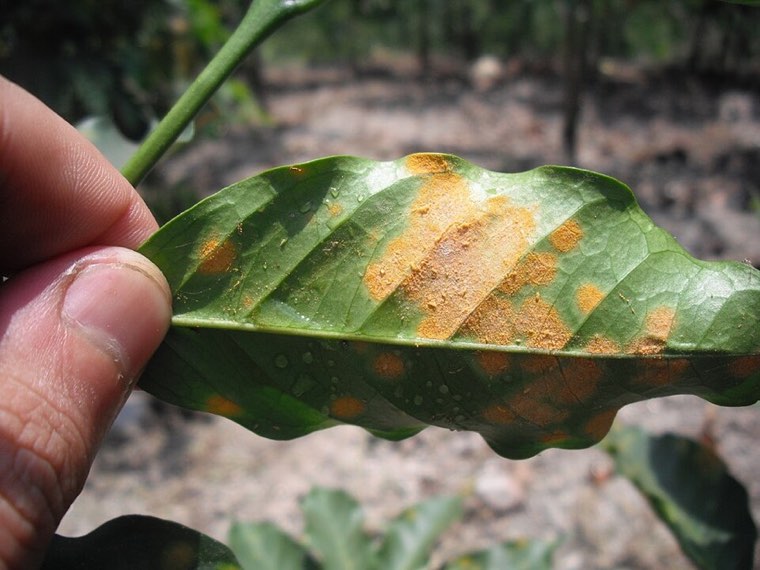
Coffee leaf rust is caused by Hemileia vastatrix Berk. & Broome, 1869, a fungus (rust fungus, a basidiomycete) (order Pucciniales, family Chaconiaceae).
Originating in East Africa, it reached Sri Lanka by 1869, then spread through Asia and Africa, arrived in Brazil in 1970 and Central America in the 1970s-1980s; it is now present in nearly all coffee-producing countries, including Hawaii since 2020.
| Region | Status |
|---|---|
| East and Central Africa | Native; widespread |
| South and Southeast Asia | Widespread since the nineteenth century |
| Latin America and the Caribbean | Widespread; severe epidemic 2012-2014 in Central America |
| Pacific | Present, including Hawaii since 2020 |
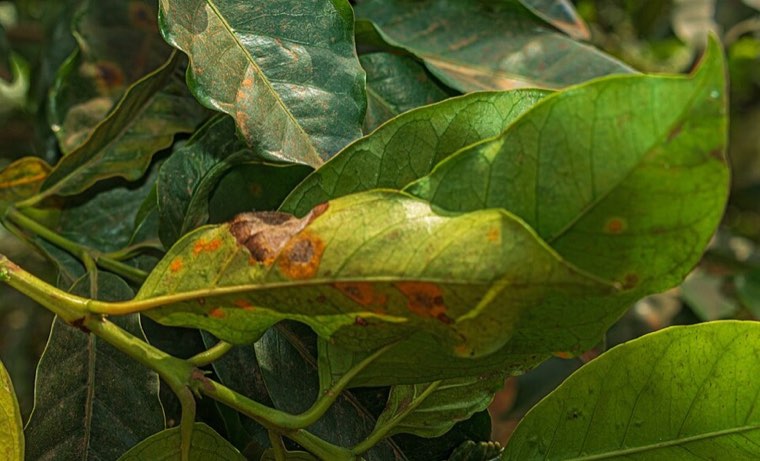
The fungus forms powdery yellow-orange masses of kidney-shaped urediniospores that emerge through the pores on the underside of leaves. It survives only on living coffee leaves.
| Crop stage | What you see |
|---|---|
| Young infection (any season) | Small pale yellow spots on the upper leaf surface; on the underside, matching spots with orange powder. |
| Advanced infection | Spots enlarge and merge into irregular orange patches; the centres become brown and dry; severely infected leaves fall. |
| Tree level, after a severe season | Heavy defoliation, dieback of branches, poor flowering and a much smaller crop the following year. |
Urediniospores spread by rain splash, wind, people and insects. They germinate only in liquid water on the underside of leaves, preferably in darkness, and enter through the leaf pores. Symptoms appear and new spores are produced after several weeks, so the disease builds up through the rainy season and peaks around harvest, when trees with heavy crops are weakest.
| Stage | Duration | Notes |
|---|---|---|
| Spore lands on the leaf underside | Needs liquid water for at least several hours | Germination best in darkness at about 21-25 °C. |
| Penetration and latent period | About 2-6 weeks depending on temperature | Shorter in warm lowlands. |
| Sporulation | Several weeks per lesion | Repeated cycles during the rains. |
| Survival in the dry season | On remaining infected leaves | Leaf retention carries the epidemic over. |
Germination and infection are optimal at about 21-25 °C and fail below about 15 °C and above about 30 °C. Rising temperatures have allowed the disease to become severe at higher altitudes than in the past.
Several cycles per rainy season.
Rainy seasons with warm temperatures, high crop loads that weaken trees, poor nutrition, old or unpruned trees, low-altitude or warming high-altitude farms, and susceptible arabica varieties. Shade has complex effects: it can increase leaf wetness but reduce crop load.
There is no internationally agreed numeric threshold. Several national coffee research bodies set local action levels based on the percentage of leaves with rust (incidence) at particular times in the rainy season, with protective sprays starting before incidence rises; use the figure published for your region and variety.
Thresholds are local. They depend on crop price, control cost, variety and natural-enemy activity, so use the figure your local extension service publishes where one exists.
Defoliation reduces the following year's yield, often by 30-50% or more on susceptible varieties in severe years, and repeated epidemics kill branches and trees. The 2012-2014 Central American epidemic affected about 70% of farms and reduced regional production substantially.
Control works best as a sequence: prevent, monitor, then act only when a threshold or a risk forecast says so, using the least disruptive option that works.
Protective sprays are timed before and early in the rainy season, and systemic groups are used when incidence rises. What is registered differs by country and changes over time; follow the label and your local plant-protection authority.
| Scheme | Group | Mode of action | Notes |
|---|---|---|---|
| FRAC | M01 | Inorganic (copper) - multi-site contact | Main protectant; widely used. |
| FRAC | 3 | Demethylation inhibitors (DMI) | Systemic; curative activity. |
| FRAC | 11 | Quinone outside inhibitors (QoI) | Preventive; in mixtures. |
Coffee (Coffea species). Arabica coffee (C. arabica) is generally susceptible; robusta (C. canephora) and some other species are more resistant. No alternate host is known.
How to grow the crop well is the first line of defence. Laisha's free grow guides cover each crop from sowing to harvest:
Written by Laisha from the sources above, in its own words. This page is general reference, not a prescription: confirm identification locally and follow the label and your plant-protection authority.