 Laisha
AI Operating System for Agriculture
Ask Laisha
Laisha
AI Operating System for Agriculture
Ask Laisha
Alternaria solani Sorauer, 1896 · formerly or also: Alternaria linariae (name used by some authors for the tomato pathogen)
Early blight is a common leaf disease of potato and tomato that makes dark brown spots with rings like a target, starting on the oldest leaves. It is worst on stressed or ageing plants in warm weather with alternating wet and dry periods. It is usually less explosive than late blight, but in many warm regions it causes more steady yield loss year after year, and on tomato it also rots stems and fruit.
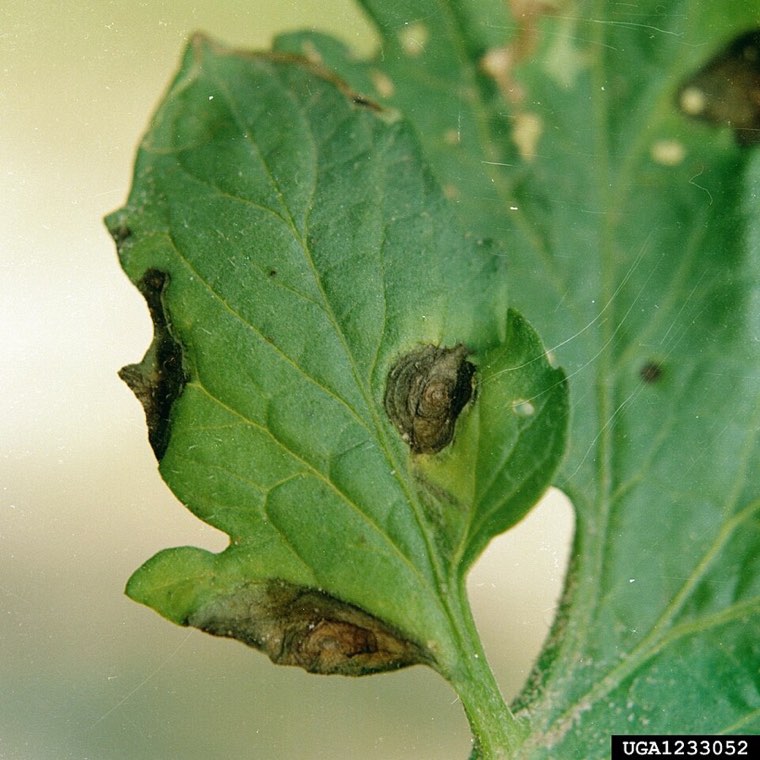
Early blight of potato and tomato is caused by Alternaria solani Sorauer, 1896, a fungus (ascomycete) (order Pleosporales, family Pleosporaceae).
Older or alternative scientific names: Alternaria linariae (name used by some authors for the tomato pathogen).
Present wherever potatoes and tomatoes are grown, and most damaging in warm temperate, subtropical and tropical regions.
| Region | Status |
|---|---|
| South Asia | Widespread; important in plains potato and tomato |
| Africa and the Middle East | Widespread |
| Americas | Widespread |
| Europe | Widespread; increasing in warmer summers |
| East Asia and Oceania | Widespread |
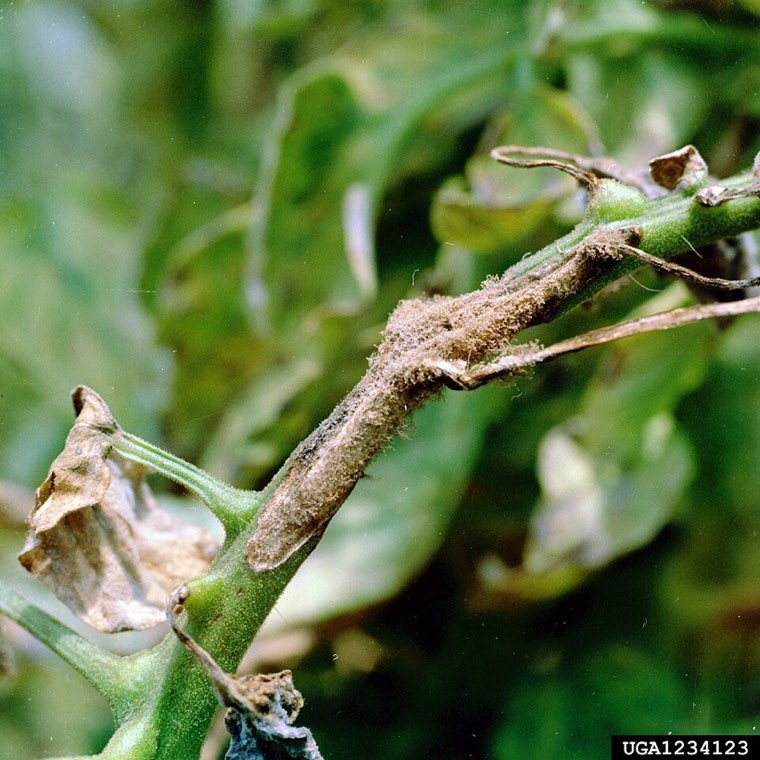
The fungus produces large, dark, club-shaped spores with a long beak and several cross-walls, borne singly or in short chains on dark stalks in the lesions. It survives in plant debris, on volunteers and weeds, and on seed of tomato.
| Crop stage | What you see |
|---|---|
| Seedling (tomato) | Dark lesions at the soil line that girdle the stem ('collar rot'); damping-off of seedlings. |
| Vegetative growth to flowering | Small dark brown spots on the oldest leaves that enlarge to about 1 cm, with concentric rings (a 'target' pattern), often surrounded by yellowing and limited by veins; leaves yellow and fall. |
| Tuber bulking and fruiting | Lesions move up the plant; dark sunken lesions with rings on tomato stems and at the stem end of fruit; on potato tubers, dark, slightly sunken, dry lesions with a leathery rot just below. |
Spores from infected debris, volunteers and nearby crops are carried by wind and rain splash to lower leaves. They infect leaves when wet; lesions produce new spores, especially when nights are humid and days dry. Older, nutrient-stressed leaves are much more susceptible, which is why symptoms climb the plant as the crop ages.
| Stage | Duration | Notes |
|---|---|---|
| Survival | Between seasons | In debris, soil surface, volunteers, weeds and tomato seed. |
| Infection | Needs a few hours of leaf wetness | Older leaves most susceptible. |
| Lesion development | About 2-3 days to visible spots | Faster in warm weather. |
| Sporulation and spread | Repeated cycles | Spores released as leaves dry after dew. |
The disease develops fastest at about 24-29 °C with alternating wet nights (dew) and dry days; it is favoured by warmer conditions than late blight.
Repeated cycles within each season.
Warm weather with heavy dew or frequent short rains, plant stress (low nitrogen, drought, heavy fruit or tuber load, other diseases or pests), long-season varieties, overhead irrigation and short rotations.
Numeric thresholds for early blight are based on forecasting models rather than lesion counts. Examples are physiological days (P-days) accumulated from crop emergence for potato and disease severity values (DSV) from leaf wetness and temperature for tomato; values differ by region and model.
| Crop | Threshold | Unit | Crop stage | Region | Source |
|---|---|---|---|---|---|
| Potato | About 300 P-days from crop emergence (first spray) | physiological days (temperature-based) | From emergence | North America (Upper Midwest) | University of Wisconsin potato early blight forecasting guidance |
| Tomato | Spray when cumulative disease severity values reach about 15-20 since the last spray | DSV units (TOMCAST model) | Transplanting to harvest | North America (Great Lakes region) | Ohio State University / Ontario TOMCAST forecasting programmes |
Thresholds are local. They depend on crop price, control cost, variety and natural-enemy activity, so use the figure your local extension service publishes where one exists.
Defoliation reduces tuber and fruit yield, typically by 5-30% and more where the disease starts early on susceptible varieties; on tomato, stem and fruit rots add direct losses and sun-scalded fruit.
Control works best as a sequence: prevent, monitor, then act only when a threshold or a risk forecast says so, using the least disruptive option that works.
Protectant programmes start at the forecast threshold or first symptoms; alternate single-site groups and mix with multi-site protectants. What is registered differs by country and changes over time; follow the label and your local plant-protection authority.
| Scheme | Group | Mode of action | Notes |
|---|---|---|---|
| FRAC | M03 | Dithiocarbamates and relatives (multi-site) | Protectant. |
| FRAC | M05 | Chloronitriles (multi-site) | Protectant. |
| FRAC | 11 | Quinone outside inhibitors (QoI) | Resistance (F129L) widespread in some regions. |
| FRAC | 7 | Succinate dehydrogenase inhibitors (SDHI) | Resistance reported. |
| FRAC | 3 | Demethylation inhibitors (DMI) | Systemic. |
| FRAC | 9 | Anilinopyrimidines | Used in mixtures. |
Potato and tomato are the main hosts; eggplant, pepper and solanaceous weeds such as nightshades are also infected. A related small-spored species, Alternaria alternata, often occurs alongside it.
How to grow the crop well is the first line of defence. Laisha's free grow guides cover each crop from sowing to harvest:
Written by Laisha from the sources above, in its own words. This page is general reference, not a prescription: confirm identification locally and follow the label and your plant-protection authority.