 Laisha
AI Operating System for Agriculture
Ask Laisha
Laisha
AI Operating System for Agriculture
Ask Laisha
Phakopsora pachyrhizi Syd. & P. Syd., 1914
A rust fungus that can strip soybean plants of their leaves within weeks of first appearing, before the pods have filled. Native to Asia, it reached Africa in the 1990s and South America in 2001, where it became the most costly soybean disease, and it reached North America in 2004. In Brazil alone, control costs and losses together have been estimated at more than two billion US dollars in some seasons.
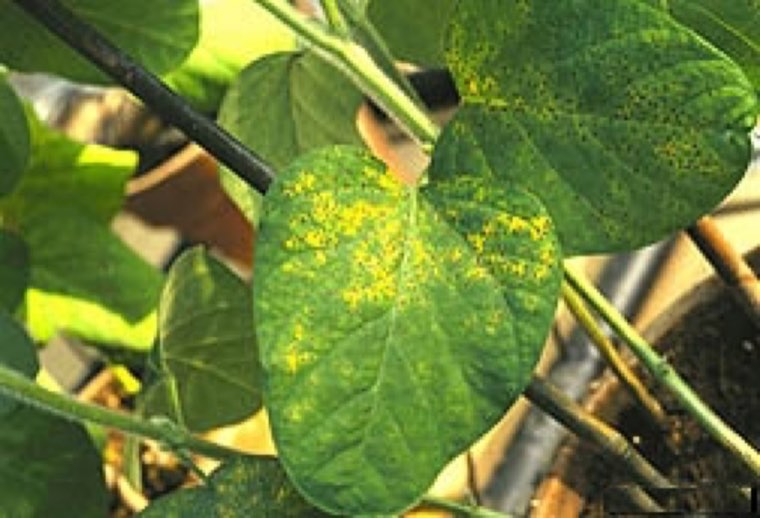
Asian soybean rust is caused by Phakopsora pachyrhizi Syd. & P. Syd., 1914, a fungus (rust fungus, a basidiomycete) (order Pucciniales, family Phakopsoraceae).
Found in Asia and Oceania for many decades, then in Africa (from 1996), South America (from 2001) and the southern United States (from 2004). It is most damaging in humid tropical and subtropical soybean regions.
| Region | Status |
|---|---|
| South America | Widespread since 2001; the key soybean disease |
| East and Southeast Asia | Native; widespread |
| South Asia | Present; important in humid soybean areas |
| Sub-Saharan Africa | Widespread since the late 1990s |
| North America and Oceania | Present; usually late-season in the US |
On the underside of leaves the fungus forms tiny, raised, volcano-shaped pustules (uredinia) with a central pore, from which pale tan urediniospores are released; a hand lens (20x) is needed to see them. Dark telia form late in the season but play little role in spread.
| Crop stage | What you see |
|---|---|
| Vegetative to early flowering | Small grey-green to tan spots on lower leaves; pustules visible on the underside with a lens. |
| Flowering to pod fill | Lesions turn tan (TAN type) or reddish-brown (RB type, on partly resistant plants) and multiply up the canopy; leaves yellow. |
| Pod fill to maturity | Premature defoliation; fewer and smaller pods and seeds; early maturity. |
Urediniospores are carried long distances by wind from volunteer soybean, kudzu and other legumes. They infect leaves after several hours of wetness, and new pustules release spores within about 9-10 days, so the disease builds rapidly through repeated cycles once the canopy closes.
| Stage | Duration | Notes |
|---|---|---|
| Urediniospore lands on a wet leaf | Needs about 6-12 hours of leaf wetness | Wind-dispersed. |
| Latent period | About 9-10 days at 20-25 °C | Shorter at optimum temperature. |
| Sporulation | Each pustule for about 3 weeks | Repeated cycles through the season. |
| Survival | Between seasons | On living legume hosts; no survival on dead tissue. |
Infection is favoured by about 15-28 °C with long dew periods or frequent rain; hot, dry weather above about 30 °C slows it.
Many asexual cycles during a season.
Frequent rain and long dew periods during flowering and pod fill, late sowing, soybean grown continuously or in succession (including second crops), volunteer soybean and kudzu between seasons.
There is no numeric economic threshold based on lesion counts. In high-risk regions fungicides are applied preventively from about the beginning of flowering, or at first detection of rust in the region or field, guided by regional monitoring networks; in low-risk regions they are applied only once rust is found nearby before pod fill.
Thresholds are local. They depend on crop price, control cost, variety and natural-enemy activity, so use the figure your local extension service publishes where one exists.
Yield losses of 10-80% have been reported in susceptible varieties without control, depending on when the disease starts. In South America it caused the largest losses of any soybean disease in the 2000s and 2010s.
Control works best as a sequence: prevent, monitor, then act only when a threshold or a risk forecast says so, using the least disruptive option that works.
Fungicides are the main control in South America, applied preventively or at first detection with repeated applications; programmes combine single-site groups with multi-site protectants because of resistance. What is registered differs by country and changes over time; follow the label and your local plant-protection authority.
| Scheme | Group | Mode of action | Notes |
|---|---|---|---|
| FRAC | 3 | Demethylation inhibitors (DMI) | Reduced sensitivity widespread in South America. |
| FRAC | 11 | Quinone outside inhibitors (QoI) | Partial resistance (F129L mutation). |
| FRAC | 7 | Succinate dehydrogenase inhibitors (SDHI) | Resistance reported in Brazil. |
| FRAC | M03 | Dithiocarbamates and relatives (multi-site) | Added to programmes for resistance management. |
| FRAC | M05 | Chloronitriles (multi-site) | Multi-site partner. |
| FRAC | M01 | Inorganic (copper) - multi-site | Multi-site partner. |
Soybean is the main crop host, but the fungus infects more than 150 species of legumes, including common bean, cowpea, lablab, pigeon pea and the weed kudzu, which keeps it alive between soybean seasons in warm regions.
How to grow the crop well is the first line of defence. Laisha's free grow guides cover each crop from sowing to harvest:
Written by Laisha from the sources above, in its own words. This page is general reference, not a prescription: confirm identification locally and follow the label and your plant-protection authority.