 Laisha
AI Operating System for Agriculture
Ask Laisha
Laisha
AI Operating System for Agriculture
Ask Laisha
Anthonomus grandis Anthonomus grandis Boheman, 1843 · formerly or also: Mexican cotton boll weevil
The boll weevil is a small grey-brown weevil whose larvae develop inside cotton flower buds (squares) and young bolls, causing them to drop or rot. After entering Texas from Mexico in 1892 it spread across the US Cotton Belt and changed Southern agriculture. A coordinated eradication programme has since removed it from almost all US cotton and northern Mexico, but it remains the most serious cotton pest in Brazil and other parts of South America.
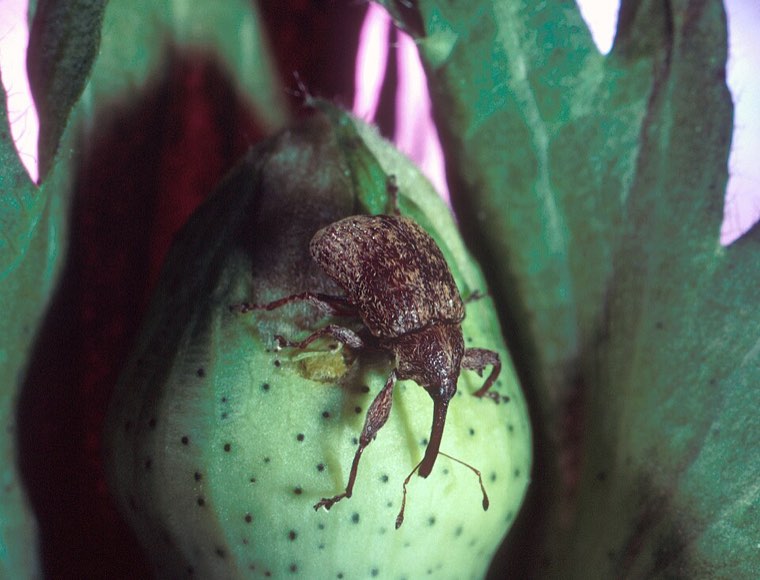
The scientific name of cotton boll weevil is Anthonomus grandis Anthonomus grandis Boheman, 1843, in the order Coleoptera, family Curculionidae.
Older or alternative scientific names: Mexican cotton boll weevil.
Native to Mexico and Central America. It reached Texas in 1892 and the whole US Cotton Belt by about 1922; it was detected in Brazil in 1983 and is present in Paraguay, Argentina, Colombia and Venezuela. It has been eradicated from the US except for the Lower Rio Grande Valley of Texas, and from northern Mexico. It is a quarantine pest elsewhere.
| Region | Status |
|---|---|
| Mexico and Central America | Native; eradicated from northern Mexico |
| United States | Eradicated except southern Texas |
| South America | Widespread; major pest in Brazil |
| Caribbean | Present on some islands |
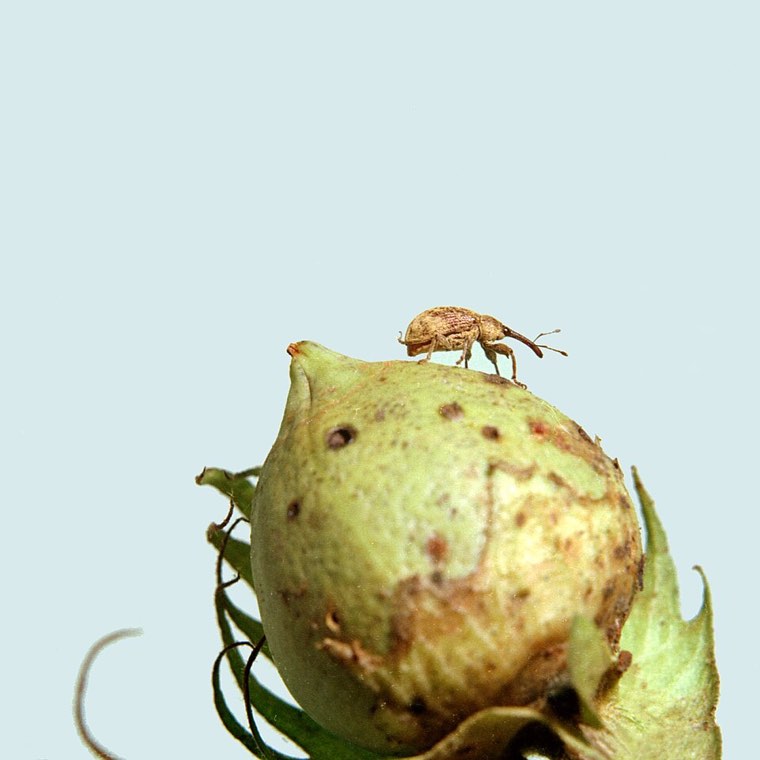
Adults are about 4-8 mm long, grey to reddish-brown, with a long, slender snout about half the length of the body and two small spurs on the thigh of each front leg. Larvae are white, legless and C-shaped with a brown head, and live inside squares and bolls.
| Crop stage | What you see |
|---|---|
| Squares (flower buds) | Small feeding and egg-laying punctures sealed with a wax-like plug; bracts flare open ('flared squares') and squares turn yellow and drop. |
| Young bolls | Punctures on bolls; larvae feed inside, destroying lint and seed; bolls rot or open poorly. |
| Field | Few squares retained on plants; adults on terminals and in squares, especially near field edges early in the season. |
Adults leave winter shelter in leaf litter and woodland edges and move into cotton when squares form. Females lay eggs singly in holes they chew in squares and young bolls. The larva feeds and pupates inside, and new adults emerge through a hole. As days shorten in autumn, adults enter diapause and move to overwintering sites.
| Stage | Duration | Notes |
|---|---|---|
| Egg (inside square or boll) | About 3-5 days | One per puncture. |
| Larva (3 instars) | About 7-12 days | Feeds inside. |
| Pupa (inside square or boll) | About 3-5 days | Protected from sprays. |
| Adult | Several weeks in summer; months in diapause | Females lay 100-300 eggs. |
Egg to adult takes about two to three weeks in summer; development stops in cold weather, and winter survival is higher after mild winters.
Several generations per season; more in long seasons and continuous cotton areas.
Long growing seasons, cotton stalks left standing after harvest, volunteer and regrowth cotton, nearby woodland and litter for overwintering, mild winters and staggered planting dates.
There is no single international threshold. Programmes set action levels based on the percentage of squares with egg-laying punctures and on trap catches, which differ between countries and regions; in eradication zones any detection triggers action.
Thresholds are local. They depend on crop price, control cost, variety and natural-enemy activity, so use the figure your local extension service publishes where one exists.
Without control, the boll weevil can destroy most of a cotton crop. Its spread across the southern US in the early twentieth century caused large losses and changes in farming; today, in Brazil, it requires many insecticide applications per season and greatly raises production costs.
Control works best as a sequence: prevent, monitor, then act only when a threshold or a risk forecast says so, using the least disruptive option that works.
Sprays target adults before and during early squaring, because eggs, larvae and pupae inside squares and bolls are protected. Area-wide eradication combines trapping, stalk destruction and timed sprays. What is registered differs by country and changes over time; follow the label and your local plant-protection authority.
| Scheme | Group | Mode of action | Notes |
|---|---|---|---|
| IRAC | 1B | Acetylcholinesterase inhibitors (organophosphates) | Used in eradication programmes; highly toxic. |
| IRAC | 3A | Sodium channel modulators (pyrethroids) | Harmful to natural enemies; can cause secondary pest outbreaks. |
Cotton (Gossypium species) is the only important host for reproduction; a few related wild Malvaceae (such as Hampea and Cienfuegosia species) also support it.
How to grow the crop well is the first line of defence. Laisha's free grow guides cover each crop from sowing to harvest:
Written by Laisha from the sources above, in its own words. This page is general reference, not a prescription: confirm identification locally and follow the label and your plant-protection authority.