 Laisha
AI Operating System for Agriculture
Ask Laisha
Laisha
AI Operating System for Agriculture
Ask Laisha
Pectinophora gossypiella (Saunders, 1844) · formerly or also: Gelechia gossypiella, Platyedra gossypiella
A small moth whose pink-banded caterpillars live hidden inside cotton bolls, eating the seeds and staining the lint. Because the larvae are inside the boll almost from hatching, damage goes unnoticed until bolls are opened. It is one of the most destructive cotton pests worldwide, and in South Asia it overcame two-protein Bt cotton within about a decade.
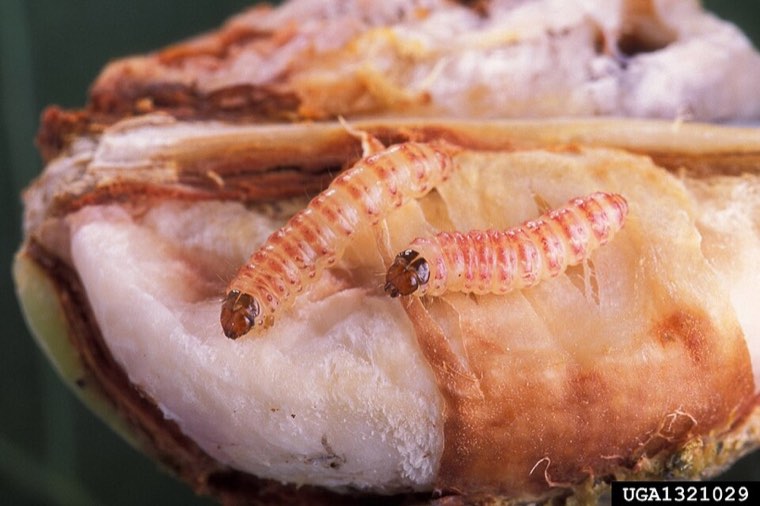
The scientific name of pink bollworm is Pectinophora gossypiella (Saunders, 1844), in the order Lepidoptera, family Gelechiidae.
Older or alternative scientific names: Gelechia gossypiella, Platyedra gossypiella.
Thought to originate in the Indian subcontinent or Australia, it spread with cotton seed to almost every cotton-growing region in the early twentieth century. An area-wide programme using sterile moths, transgenic cotton and pheromones eradicated it from the cotton belts of the United States and northern Mexico by 2018.
| Region | Status |
|---|---|
| South Asia | Widespread; resurgent since about 2014 because of resistance to Bt cotton |
| Africa and the Near East | Widespread in cotton zones, including the Nile valley and West Africa |
| East and Southeast Asia | Present in cotton regions |
| Latin America | Present in South America; eradicated from northern Mexico |
| North America | Declared eradicated from United States cotton in 2018 |
| Oceania | Present in Australia |
Eggs are tiny, flattened and pearly white, laid singly or in small groups under the calyx and bracts of bolls. Young larvae are white with a brown head; from the third instar they develop broad pink bands across each segment and reach about 12 mm. The adult is a slender grey-brown moth about 8-10 mm long, with narrow, pointed, heavily fringed wings, active at night.
| Crop stage | What you see |
|---|---|
| Squaring and flowering | 'Rosette flowers': petals held together by the larva's silk so the flower cannot open; damaged squares may shed. |
| Green boll | A pinhole entry mark that soon closes; inside, a tunnel in the boll wall, damaged locules and seeds, and the larva itself. |
| Boll opening and harvest | Bolls open badly or partly; lint is stained yellow-brown and weakened; 'double seeds' joined by silk contain resting larvae; exit holes on the boll wall. |
Newly hatched larvae enter flowers or bolls within hours, so they are protected from sprays and predators for most of their life. Mature larvae leave the boll to pupate in the soil or debris, or stay inside seeds. Late in the season many larvae enter diapause inside seeds or soil and survive until the next crop: carry-over in seed, gins and crop residues is how the pest bridges seasons.
| Stage | Duration | Notes |
|---|---|---|
| Egg | About 4-5 days at 25-30 °C | Under the calyx or on young bolls. |
| Larva (4 instars) | About 10-14 days inside the boll; months in diapause | Pink bands appear from the third instar. |
| Pupa | About 7-10 days | In soil, debris or inside the boll. |
| Adult moth | About 1-2 weeks | Nocturnal; females release a sex pheromone used in monitoring and mating disruption. |
A generation takes about 25-30 days in warm weather. Short days and cooler nights late in the season trigger larval diapause. Hot, dry soil and extremely high temperatures reduce survival of exposed pupae.
Usually 4-6 generations a season in irrigated cotton; more where cotton grows for long periods or is ratooned.
Long-duration cotton and late-season crops that keep bolls on the plant, early-sown 'pre-monsoon' cotton that receives moths from carry-over, cotton stalks and unginned seed stored near fields, and ginning mills that release moths. Resistance to Bt cotton and poor refuge compliance have greatly increased outbreaks.
Because larvae are hidden, thresholds are based on pheromone trap catches, rosette flowers and the percentage of green bolls with live larvae found by opening a sample. Values vary by region and with the cotton's Bt status.
| Crop | Threshold | Unit | Crop stage | Region | Source |
|---|---|---|---|---|---|
| Cotton | 8 moths per trap per night on 3 consecutive nights | male moths per pheromone trap | Flowering to boll development | South Asia | ICAR-Central Institute for Cotton Research pink bollworm management advisories |
| Cotton | 10% | % of flowers (rosettes) or green bolls infested | Flowering to boll development | South Asia | ICAR-Central Institute for Cotton Research pink bollworm management advisories |
Thresholds are local. They depend on crop price, control cost, variety and natural-enemy activity, so use the figure your local extension service publishes where one exists.
Larvae destroy seeds and stain and weaken lint; damaged bolls open poorly and are attacked by boll rots. Losses come from lower seed cotton yield, lower ginning out-turn, lower oil content of seed and downgraded lint. Without control, losses of 20-60% of seed cotton have been reported in outbreak seasons in South Asia, and the pest was historically one of the main yield constraints in the Nile valley.
Control works best as a sequence: prevent, monitor, then act only when a threshold or a risk forecast says so, using the least disruptive option that works.
Sprays can kill eggs, newly hatched larvae and adults but not larvae inside bolls, so timing against moth peaks matters more than the number of sprays. What is registered differs by country and changes over time; follow the label and your local plant-protection authority.
| Scheme | Group | Mode of action | Notes |
|---|---|---|---|
| IRAC | 3A | Sodium channel modulators (pyrethroids) | Historically used late season; harmful to natural enemies. |
| IRAC | 1B | Acetylcholinesterase inhibitors (organophosphates) | Resistance reported in some regions. |
| IRAC | 5 | Nicotinic acetylcholine receptor allosteric modulators, site I (spinosyns) | Larvicide. |
| IRAC | 6 | Glutamate-gated chloride channel allosteric modulators (avermectins) | Larvicide. |
Cotton (all cultivated Gossypium species) is the main host. Okra, kenaf, roselle and other plants of the mallow family are minor hosts; they can carry populations between cotton seasons in some regions.
How to grow the crop well is the first line of defence. Laisha's free grow guides cover each crop from sowing to harvest:
Written by Laisha from the sources above, in its own words. This page is general reference, not a prescription: confirm identification locally and follow the label and your plant-protection authority.