 Laisha
AI Operating System for Agriculture
Ask Laisha
Laisha
AI Operating System for Agriculture
Ask Laisha
Aphis gossypii Glover, 1877
A small aphid, from pale yellow to almost black, that forms dense colonies under the leaves of cotton, cucurbits, okra, citrus and many other crops. It tolerates heat better than most aphids, multiplies extremely fast, coats plants with honeydew that makes cotton lint sticky, and spreads viruses such as cucumber mosaic and the potyviruses of melon and squash.
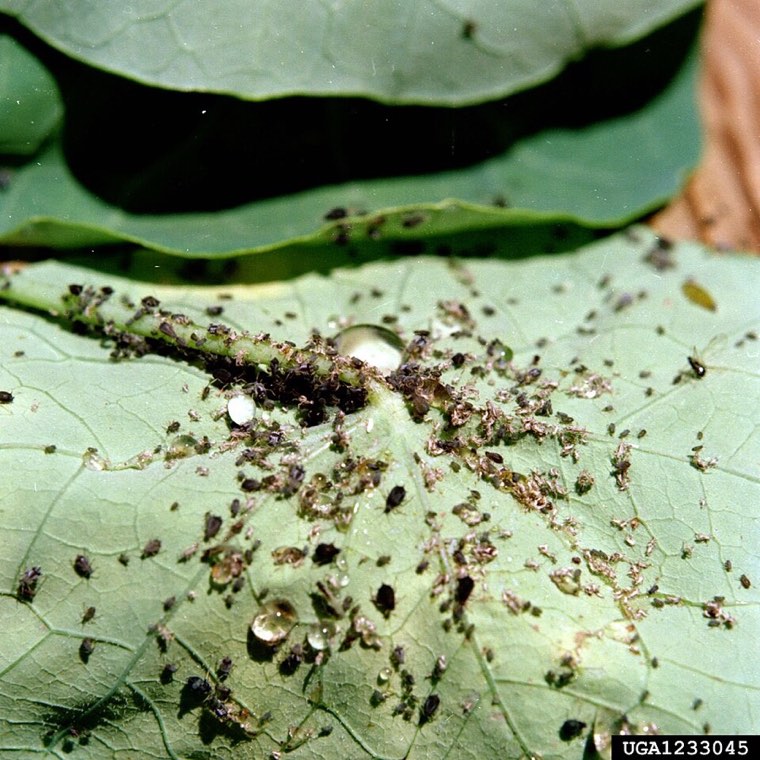
The scientific name of cotton aphid is Aphis gossypii Glover, 1877, in the order Hemiptera, family Aphididae.
Cosmopolitan in tropical, subtropical and warm temperate regions, and in greenhouses worldwide.
| Region | Status |
|---|---|
| Asia | Widespread; key pest of cotton and cucurbits |
| Africa and the Middle East | Widespread |
| Americas | Widespread; a key late-season cotton pest |
| Europe | Outdoors in the south; greenhouses everywhere |
| Oceania | Widespread |
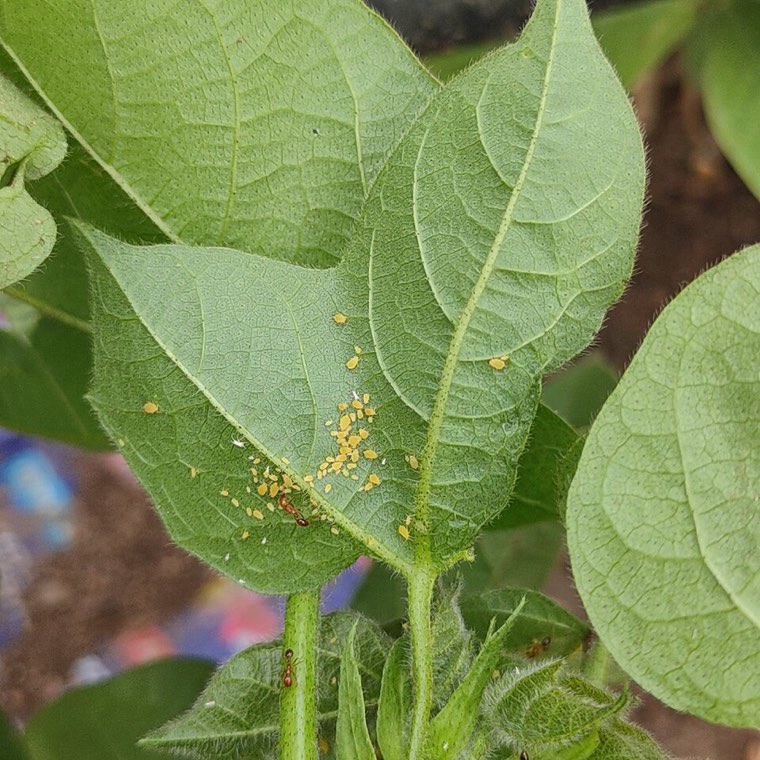
Wingless adults are small (1-2 mm), pear-shaped and very variable in colour: pale yellow forms appear in crowded colonies and hot weather, dark green to almost black forms in cool conditions. The cornicles are short, dark and tapering, and the tail (cauda) is pale or dusky; there are no prominent tubercles between the antennae. Winged forms have a black head and thorax.
| Crop stage | What you see |
|---|---|
| Seedling | Colonies under cotyledons and first leaves; cupped, crinkled leaves; slowed growth. |
| Vegetative growth | Downward-curled leaves, honeydew and sooty mould; in cucurbits, mosaic, mottling and distorted leaves from viruses. |
| Boll opening (cotton) / fruiting (cucurbits) | Sticky, sooty lint; deformed or mottled fruit when viruses are present. |
Mostly reproduces asexually all year, with females giving birth to live young. In some cold regions a sexual generation lays overwintering eggs on woody hosts such as Hibiscus syriacus or Catalpa. Winged forms develop when colonies are crowded or plants age and fly to new crops.
| Stage | Duration | Notes |
|---|---|---|
| Nymph (4 instars) | About 4-7 days at 25-30 °C | Born live. |
| Wingless adult | About 2-3 weeks | Produces up to about 80 nymphs. |
| Winged adult | About 2-3 weeks | Disperses; transmits non-persistent viruses in seconds of probing. |
Develops at temperatures from about 6 °C to over 30 °C, with fastest growth near 25-30 °C, so a generation may take under a week in summer. It is more heat-tolerant than most aphids, which is why it builds up in hot cotton and melon crops.
Up to several dozen overlapping generations a year in warm climates and greenhouses.
Warm weather with moderate humidity, high nitrogen, water stress followed by lush regrowth, and above all broad-spectrum sprays (for example for bollworms) that remove natural enemies and select resistance; aphid flare-ups after such sprays are well documented in cotton.
In cotton, thresholds are counts of aphids per main-stem leaf and drop sharply once bolls open, because honeydew on exposed lint is what costs money. In cucurbits where viruses are the problem, aphid numbers are not a useful threshold and prevention is needed from planting.
| Crop | Threshold | Unit | Crop stage | Region | Source |
|---|---|---|---|---|---|
| Cotton | 50 aphids, persisting or increasing over 5-7 days | aphids per 5th main-stem node leaf | First square to first open boll | North America (California) | UC IPM Cotton Pest Management Guidelines |
| Cotton | 5-10 | aphids per 5th main-stem node leaf | First open boll to harvest | North America (California) | UC IPM Cotton Pest Management Guidelines |
Thresholds are local. They depend on crop price, control cost, variety and natural-enemy activity, so use the figure your local extension service publishes where one exists.
Heavy colonies stunt seedlings and reduce yield; late-season infestations deposit honeydew on open cotton bolls, producing 'sticky cotton' that jams gins and spinning machines and is heavily discounted. In cucurbits the larger loss is from viruses such as cucumber mosaic, zucchini yellow mosaic and watermelon mosaic, which can destroy marketable yield.
Control works best as a sequence: prevent, monitor, then act only when a threshold or a risk forecast says so, using the least disruptive option that works.
Use selective groups and only when counts exceed the threshold after counting natural enemies. What is registered differs by country and changes over time; follow the label and your local plant-protection authority.
| Scheme | Group | Mode of action | Notes |
|---|---|---|---|
| IRAC | 29 | Chordotonal organ modulators, undefined target site | Feeding inhibitor; selective. |
| IRAC | 9B | Chordotonal organ TRPV channel modulators | Feeding inhibitor. |
| IRAC | 4C | Nicotinic acetylcholine receptor competitive modulators (sulfoximines) | Check cross-resistance with 4A. |
| IRAC | 23 | Inhibitors of acetyl CoA carboxylase | Systemic. |
| IRAC | 9D | Chordotonal organ TRPV channel modulators (pyropenes) | Selective. |
Recorded on several hundred plant species. Major hosts include cotton, all cucurbits, okra, eggplant, pepper, citrus, hibiscus and many ornamentals; host-adapted lineages exist (for example cucurbit-specialised and cotton-specialised forms).
How to grow the crop well is the first line of defence. Laisha's free grow guides cover each crop from sowing to harvest:
Written by Laisha from the sources above, in its own words. This page is general reference, not a prescription: confirm identification locally and follow the label and your plant-protection authority.