 Laisha
AI Operating System for Agriculture
Ask Laisha
Laisha
AI Operating System for Agriculture
Ask Laisha
Phenacoccus solenopsis Phenacoccus solenopsis Tinsley, 1898
The cotton mealybug is a small, white, waxy sap-sucking insect from North America that suddenly became a major pest of cotton in Pakistan and India around 2005-2007 and has since spread through Asia, Africa and South America. Colonies on stems, leaves and bolls stunt plants, make them bushy, and cover them with honeydew and sooty mould. It feeds on more than 200 plants, including okra, tomato, eggplant, hibiscus and many weeds.
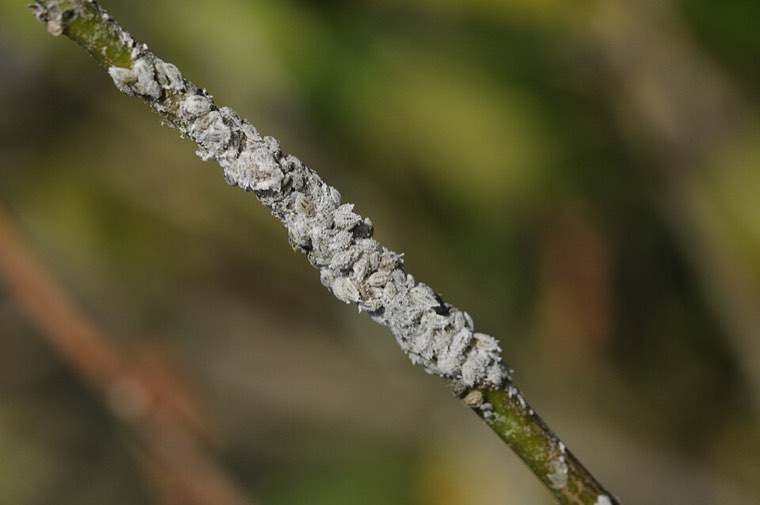
The scientific name of cotton mealybug is Phenacoccus solenopsis Phenacoccus solenopsis Tinsley, 1898, in the order Hemiptera, family Pseudococcidae.
Described from the United States; outbreaks on cotton in Pakistan and India were reported from 2005-2007, followed by records in China, South-East Asia, the Middle East, Africa and Brazil.
| Region | Status |
|---|---|
| Americas | Native range in North America; spread in South America |
| South Asia | Widespread since the mid-2000s |
| East and South-East Asia | Present since the late 2000s |
| Africa and the Middle East | Present and spreading |
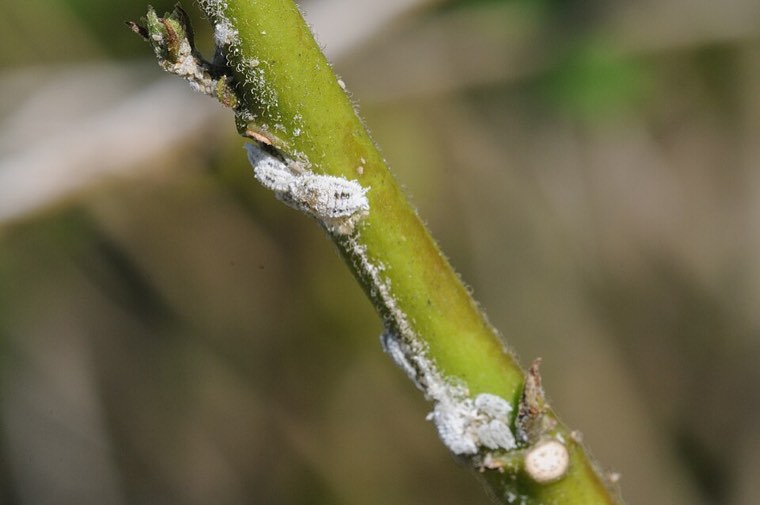
Adult females are oval, about 3-4 mm long, covered with white mealy wax, with pairs of dark bare spots in rows along the back and short wax filaments around the edge. Males are tiny and winged. Females usually produce eggs in a cottony sac beneath the body, and young crawlers spread over the plant. Crushed females have pale, not red, body fluid, which helps separate this species from the pink hibiscus mealybug.
| Crop stage | What you see |
|---|---|
| Early infestation | White waxy colonies on the undersides of leaves and on young shoots, often at field edges. |
| Heavy infestation | Stunted plants with shortened internodes and bunched, distorted shoots; honeydew, sooty mould and ants. |
| Fruiting stage | Colonies on squares and bolls; shedding of squares and bolls; small bolls that open poorly. |
Females lay 150-600 eggs in a cottony ovisac; the eggs hatch quickly into crawlers, which move over the plant and to neighbouring plants. Females pass through three nymphal instars and males through four, including non-feeding stages. Crawlers spread by wind, water, people, animals, farm tools and ants.
| Stage | Duration | Notes |
|---|---|---|
| Egg (in ovisac) | Hours to a few days | Hatching may happen almost immediately. |
| Crawler and nymphs | About 2-3 weeks | Dispersing stage. |
| Adult female | About 2-4 weeks | Lays 150-600 eggs. |
One generation takes about 25-30 days in warm weather; hot, dry conditions favour outbreaks.
Many generations per year in warm regions; populations survive on weeds between crops.
Hot, dry weather; weeds such as Parthenium around fields; movement of infested material, tools and workers; ants that protect colonies; and broad-spectrum sprays that kill parasitoids and predators.
There is no single international threshold. South Asian programmes use action levels based on the share of infested plants and the severity of colonies, which differ between countries; check with your local extension service.
Thresholds are local. They depend on crop price, control cost, variety and natural-enemy activity, so use the figure your local extension service publishes where one exists.
During the first outbreaks in Pakistan and India, heavily infested cotton fields suffered large yield losses; today, natural enemies keep it in check in many areas, but outbreaks still occur after broad-spectrum spraying, and it damages vegetables and ornamentals.
Control works best as a sequence: prevent, monitor, then act only when a threshold or a risk forecast says so, using the least disruptive option that works.
Waxy coating and hidden colonies make contact sprays less effective; spot treatment of infested patches is preferred. What is registered differs by country and changes over time; follow the label and your local plant-protection authority.
| Scheme | Group | Mode of action | Notes |
|---|---|---|---|
| IRAC | 23 | Inhibitors of acetyl CoA carboxylase | Systemic. |
| IRAC | 16 | Inhibitors of chitin biosynthesis, type 1 | Acts on nymphs. |
| IRAC | 4A | Nicotinic acetylcholine receptor competitive modulators (neonicotinoids) | Toxic to pollinators and parasitoids. |
More than 200 plant species, including cotton, okra, tomato, eggplant, pepper, sunflower, hibiscus and other ornamentals, and weeds such as Parthenium, which carry it between crops.
How to grow the crop well is the first line of defence. Laisha's free grow guides cover each crop from sowing to harvest:
Written by Laisha from the sources above, in its own words. This page is general reference, not a prescription: confirm identification locally and follow the label and your plant-protection authority.