 Laisha
AI Operating System for Agriculture
Ask Laisha
Laisha
AI Operating System for Agriculture
Ask Laisha
Plasmopara viticola (Berk. & M.A. Curtis) Berl. & De Toni, 1888 · formerly or also: Peronospora viticola
Downy mildew is the most damaging grapevine disease in regions with rain in spring and summer. It produces yellow 'oil spots' on leaves with white down beneath, and can destroy flower clusters and young bunches within days of a rainy spell. Brought from North America to Europe around 1878, it is the reason vineyards in wet climates need protection every season.
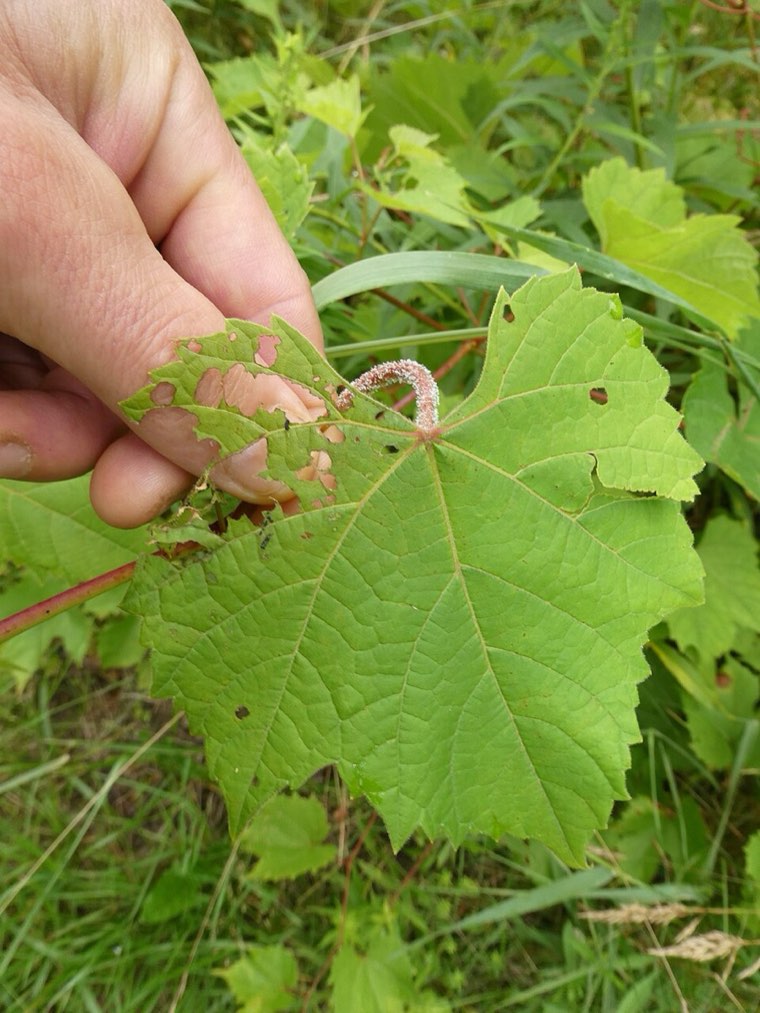
Downy mildew of grapevine is caused by Plasmopara viticola (Berk. & M.A. Curtis) Berl. & De Toni, 1888, an oomycete (water mould), not a true fungus (order Peronosporales, family Peronosporaceae).
Older or alternative scientific names: Peronospora viticola.
Native to eastern North America. It reached Europe around 1878 and is now present in nearly all grape regions with summer rainfall: Europe, the Americas, East and South Asia, southern and eastern Africa and Oceania. It is less important in very dry summer climates.
| Region | Status |
|---|---|
| Europe | Widespread; the main grape disease in wet seasons |
| Americas | Native to North America; widespread in humid areas |
| East and South Asia | Widespread in monsoon grape regions |
| Africa and Oceania | Present in humid grape regions |
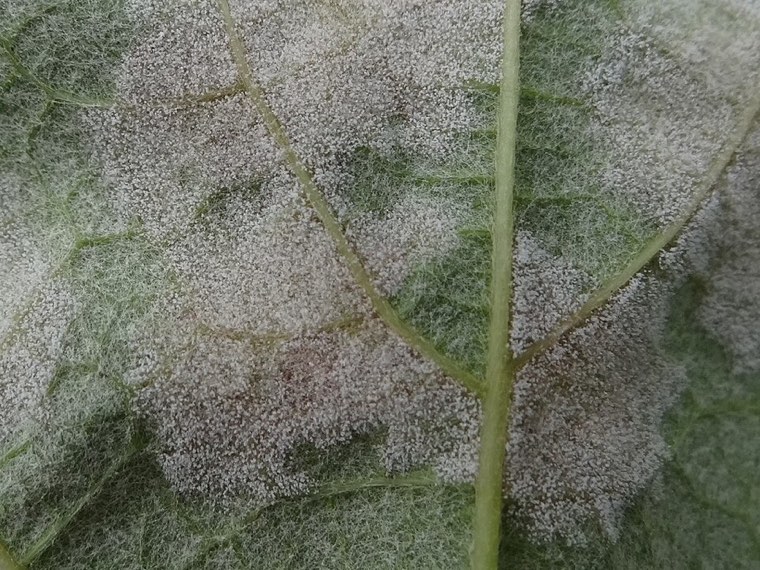
In humid nights the pathogen grows out through leaf pores on the underside as white, downy tufts of branched sporangiophores carrying sporangia, which release swimming zoospores in water. It overwinters as thick-walled oospores in fallen leaves.
| Crop stage | What you see |
|---|---|
| Shoot growth (before bloom) | Yellow, translucent 'oil spots' on the upper side of leaves; white downy growth beneath after a humid night. |
| Flowering and fruit set | Flower clusters and young bunches turn brown, curl into an S-shape and are covered in white down; they wither and drop. |
| Berry growth to veraison | Berries turn grey-brown, shrivel and stay firm ('leather berries') without obvious down; older leaves show angular mosaic lesions and fall early. |
In spring, oospores in leaf litter germinate after rain and their zoospores are splashed onto low leaves, where they swim into leaf pores. Lesions develop within one to two weeks and, after warm humid nights, produce sporangia that spread by wind and rain. Each new infection needs water on the leaves, so the disease moves in bursts after rainy periods.
| Stage | Duration | Notes |
|---|---|---|
| Oospores germinate in litter | Spring, after soaking rain at about 10 °C or warmer | Rule of thumb ('3-10 rule'): 10 °C, shoots 10 cm long, 10 mm of rain. |
| Zoospores infect through leaf pores | Needs a film of water for 1-3 hours or more | Only green tissue with pores is infected. |
| Incubation | About 4-12 days depending on temperature | Oil spots appear at the end. |
| Sporulation | Overnight at high humidity and above about 12-13 °C | White down on the leaf underside. |
| Oospore formation | Late season | Overwinter in fallen leaves. |
Infection occurs from about 10 to 28 °C with an optimum near 18-25 °C. Warm, humid nights followed by rain or dew produce epidemics; hot, dry weather halts spread.
Many secondary cycles in wet seasons.
Rain or overhead irrigation in spring and early summer, warm humid nights, poorly drained vineyards, dense canopies and susceptible cultivars.
There is no numeric economic threshold. Protection is triggered by infection-risk models based on rainfall, leaf wetness and temperature (for example rules derived from the '3-10' criteria and regional forecasting models) and by first oil spots in the region; the critical period is from shortly before flowering until berries are pea-sized.
Thresholds are local. They depend on crop price, control cost, variety and natural-enemy activity, so use the figure your local extension service publishes where one exists.
In wet seasons, unprotected susceptible vineyards can lose most of their crop through destruction of flower clusters and young bunches; early leaf loss also weakens vines and the next year's crop.
Control works best as a sequence: prevent, monitor, then act only when a threshold or a risk forecast says so, using the least disruptive option that works.
Protective sprays are applied before infection periods, especially from just before flowering until pea-sized berries. Copper-based products (FRAC M01) are central in organic viticulture but accumulate in soil, and their use is limited in some regions. What is registered differs by country and changes over time; follow the label and your local plant-protection authority.
| Scheme | Group | Mode of action | Notes |
|---|---|---|---|
| FRAC | M01 | Inorganic (copper) - multi-site contact | Protectant; soil accumulation limits. |
| FRAC | M03 | Dithiocarbamates and relatives (multi-site contact) | Protectant. |
| FRAC | M04 | Phthalimides (multi-site contact) | Protectant. |
| FRAC | 4 | Phenylamides | Systemic; resistance common. |
| FRAC | 40 | Carboxylic acid amides (CAA) | Resistance documented. |
| FRAC | 45 | Quinone outside inhibitor, stigmatellin binding type (QoSI) | In mixtures. |
| FRAC | 49 | Oxysterol binding protein inhibitors (OSBPI) | High resistance risk. |
| FRAC | P07 | Phosphonates (host defence and direct activity) | Systemic. |
Grapevines (Vitis species). European Vitis vinifera is highly susceptible; American and Asian Vitis species and their hybrids carry various degrees of resistance.
How to grow the crop well is the first line of defence. Laisha's free grow guides cover each crop from sowing to harvest:
Written by Laisha from the sources above, in its own words. This page is general reference, not a prescription: confirm identification locally and follow the label and your plant-protection authority.