 Laisha
AI Operating System for Agriculture
Ask Laisha
Laisha
AI Operating System for Agriculture
Ask Laisha
Drosophila suzukii (Matsumura, 1931)
A small vinegar fly that, unlike its relatives, lays eggs in sound, ripening fruit rather than rotting fruit, using a saw-like egg-laying organ to cut through the skin. Native to East Asia, it spread to the Americas and Europe from 2008 and is now the key pest of cherries, blueberries, raspberries, strawberries and other soft fruit in many regions. Its very short life cycle means populations rise quickly just as fruit ripens.
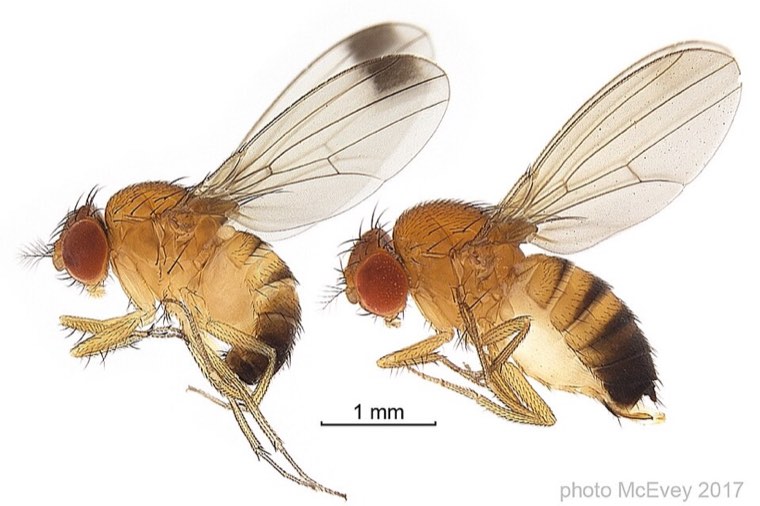
The scientific name of spotted wing drosophila is Drosophila suzukii (Matsumura, 1931), in the order Diptera, family Drosophilidae.
Native to East Asia. It was detected in California and in Spain and Italy in 2008, spread across North America and Europe within a few years, reached South America (from 2013), North Africa and the Middle East, and continues to spread. It is a quarantine concern where absent.
| Region | Status |
|---|---|
| East Asia | Native |
| North America | Invasive since 2008; widespread in fruit regions |
| Europe | Invasive since 2008; widespread |
| South America | Invasive since about 2013 |
| North Africa and the Middle East | Recorded in several countries |
| Oceania | Absent from Australia and New Zealand; regulated |
Adults are 2-3.5 mm long, yellowish-brown with red eyes. Males have a dark spot near the tip of each wing and two dark bands on each front leg. Females lack wing spots but have a large, dark, saw-toothed ovipositor visible under a hand lens - the feature that allows them to cut into intact fruit. Larvae are tiny white maggots (up to about 3.5 mm) inside fruit.
| Crop stage | What you see |
|---|---|
| Colour change to ripe fruit | Tiny scars or pinholes on the fruit surface where eggs were laid, sometimes with two thin breathing tubes protruding. |
| Ripe fruit | Soft, collapsing, juicy patches; small white larvae inside when fruit is crushed or soaked in salt water. |
| Harvest and shelf | Fruit that looked sound at picking softens and leaks within days; secondary rots and other vinegar flies follow. |
Each female can lay several hundred eggs, a few per fruit. Larvae feed inside the fruit for a few days to two weeks and usually pupate inside or on the fruit. Adults overwinter as a cold-tolerant 'winter morph' in sheltered vegetation and move into crops as fruit begins to colour.
| Stage | Duration | Notes |
|---|---|---|
| Egg (inside fruit) | About 1-3 days | Laid through the skin of ripening fruit. |
| Larva (3 instars) | About 3-13 days | Feeds inside the fruit. |
| Pupa | About 4-15 days | Inside or on the fruit, or in soil. |
| Adult | About 3-9 weeks; overwintering adults several months | Winter morph darker and more cold-tolerant. |
A generation takes about 10 days at 25 °C; activity and egg laying are greatest at moderate temperatures (about 20-25 °C) and fall sharply above about 30 °C, which is why hot summers reduce damage and mild, humid seasons increase it.
Up to about 10-13 generations a year in mild climates.
Mild temperatures and high humidity, woodland or hedgerows with wild fruit nearby, long harvest intervals that leave ripe fruit on plants, and fallen or culled fruit left in the field.
There is no numeric economic threshold: markets tolerate almost no larvae in fruit. The practical trigger is the first trap catches or detection in the area combined with fruit reaching colour change, after which the crop is protected until harvest.
Thresholds are local. They depend on crop price, control cost, variety and natural-enemy activity, so use the figure your local extension service publishes where one exists.
Losses in unprotected cherries, blueberries and raspberries have reached 30-80% in some seasons and regions; whole consignments can be rejected if larvae are found. Control costs and more frequent picking raise production costs substantially.
Control works best as a sequence: prevent, monitor, then act only when a threshold or a risk forecast says so, using the least disruptive option that works.
Sprays protect ripening fruit for only a few days and must respect very short pre-harvest intervals; rotate groups because many sprays may be needed. What is registered differs by country and changes over time; follow the label and your local plant-protection authority.
| Scheme | Group | Mode of action | Notes |
|---|---|---|---|
| IRAC | 5 | Nicotinic acetylcholine receptor allosteric modulators, site I (spinosyns) | Widely used; reduced susceptibility reported in some regions. |
| IRAC | 3A | Sodium channel modulators (pyrethroids) | Fast-acting; harmful to natural enemies. |
| IRAC | 28 | Ryanodine receptor modulators (diamides) | Used in some crops. |
| IRAC | 1B | Acetylcholinesterase inhibitors (organophosphates) | Restricted in many countries. |
Soft and thin-skinned fruit: cherry, blueberry, raspberry, blackberry, strawberry, grape (mainly damaged or thin-skinned cultivars), fig, plum, peach, apricot and persimmon, plus many wild fruits such as wild blackberry, elder and honeysuckle that sustain populations near farms.
How to grow the crop well is the first line of defence. Laisha's free grow guides cover each crop from sowing to harvest:
Written by Laisha from the sources above, in its own words. This page is general reference, not a prescription: confirm identification locally and follow the label and your plant-protection authority.