 Laisha
AI Operating System for Agriculture
Ask Laisha
Laisha
AI Operating System for Agriculture
Ask Laisha
Pseudoperonospora cubensis (Berk. & M.A. Curtis) Rostovzev, 1903 · formerly or also: Peronospora cubensis
Downy mildew is a fast-moving leaf disease of cucumber, melon, squash, watermelon and gourds. Angular yellow spots appear between the leaf veins, a grey-purple down grows beneath them after humid nights, and leaves die within days, exposing fruit to sunscald. Its spores travel long distances on wind, so regional forecasts and resistant varieties are key; it adapted to overcome long-used cucumber resistance in the 2000s.
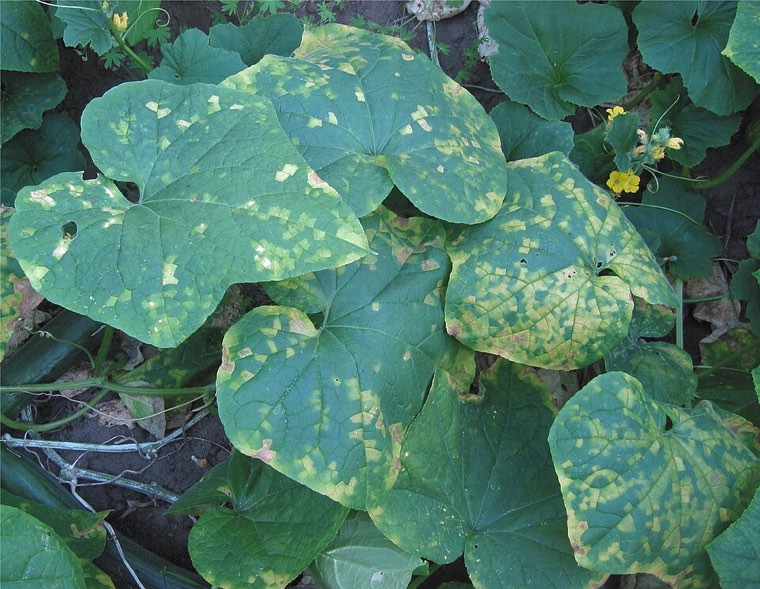
Downy mildew of cucurbits is caused by Pseudoperonospora cubensis (Berk. & M.A. Curtis) Rostovzev, 1903, an oomycete (downy mildew), not a true fungus (order Peronosporales, family Peronosporaceae).
Older or alternative scientific names: Peronospora cubensis.
Found in cucurbit-growing regions worldwide, in fields and greenhouses, from the humid tropics to temperate summers. In cold-winter regions it re-invades each year on wind from warmer areas.
| Region | Status |
|---|---|
| Asia | Widespread; major in cucumber |
| Americas | Widespread; re-emerged as a major problem from 2004 |
| Europe and the Mediterranean | Widespread; sexual reproduction reported |
| Africa and Oceania | Widespread |
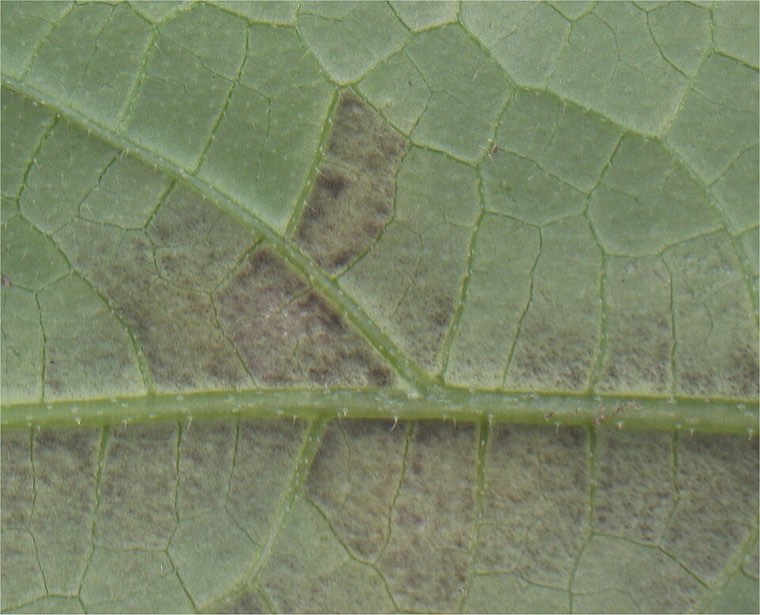
An obligate parasite that needs living cucurbit leaves. On humid nights it produces sporangiophores through the leaf pores of the underside, carrying lemon-shaped sporangia that give a grey to purplish-black down; sporangia release swimming zoospores in water. Two mating types allow thick-walled oospores in some regions.
| Crop stage | What you see |
|---|---|
| Early infection (any age) | Small pale green to yellow angular spots on the upper leaf surface, bounded by veins (in cucumber); grey-purple sporulation underneath on humid mornings. |
| Advanced | Spots turn brown and merge; leaves curl, dry and die, often within days in favourable weather; in melon and squash spots are less angular. |
| Fruiting | Defoliated plants with small, poorly flavoured and sunburnt fruit; yield stops early. |
Sporangia are carried by wind from infected crops, sometimes hundreds of kilometres. They release zoospores or germinate in water films on the leaf and infect through leaf pores. New lesions appear within about 4-12 days and sporulate on humid nights, so the disease can spread through a field in one to two weeks.
| Stage | Duration | Notes |
|---|---|---|
| Sporangia land on wet leaves | Infection needs about 2-6 hours of leaf wetness | Wind-dispersed. |
| Incubation | About 4-12 days | Shorter in warm weather. |
| Sporulation | Overnight at high humidity | Grey-purple down on leaf undersides. |
| Survival | Between seasons | On living cucurbits in warm regions and greenhouses; oospores in some regions. |
Infection occurs from about 5 to 30 °C, with an optimum around 15-20 °C for infection and moderate temperatures with high humidity, dew or rain for rapid spread.
Many cycles in each cucurbit season.
Dew, fog, frequent rain or overhead irrigation, cool to moderate nights, dense plantings, susceptible varieties, and nearby infected crops or greenhouses that release sporangia.
There is no numeric economic threshold based on disease levels, because the disease can destroy a crop within two weeks. Protection starts when regional forecasts or detections nearby show risk (for example the cucurbit downy mildew forecasting network in North America), or at the first sign in the field.
Thresholds are local. They depend on crop price, control cost, variety and natural-enemy activity, so use the figure your local extension service publishes where one exists.
Without control, yield losses of 40-100% are common in susceptible cucumber and melon crops in favourable weather; defoliation also reduces fruit quality.
Control works best as a sequence: prevent, monitor, then act only when a threshold or a risk forecast says so, using the least disruptive option that works.
Protective programmes alternate groups with documented activity against current populations and mix them with multi-site protectants; intervals are shortened in high-risk weather. What is registered differs by country and changes over time; follow the label and your local plant-protection authority.
| Scheme | Group | Mode of action | Notes |
|---|---|---|---|
| FRAC | M03 | Dithiocarbamates and relatives (multi-site) | Protectant partner. |
| FRAC | M05 | Chloronitriles (multi-site) | Protectant partner where registered. |
| FRAC | 43 | Pyridinylmethyl-benzamides | Reduced sensitivity reported in some regions. |
| FRAC | 21 | Quinone inside inhibitors (QiI) | Effective in many regions. |
| FRAC | 49 | Oxysterol binding protein inhibitors (OSBPI) | High resistance risk; limit uses. |
| FRAC | 28 | Carbamates | Used in mixtures. |
Cultivated and wild cucurbits: cucumber, melon, squash, pumpkin, watermelon, gourds and chayote. Pathogen populations differ in which cucurbits they attack most severely.
How to grow the crop well is the first line of defence. Laisha's free grow guides cover each crop from sowing to harvest:
Written by Laisha from the sources above, in its own words. This page is general reference, not a prescription: confirm identification locally and follow the label and your plant-protection authority.