 Laisha
AI Operating System for Agriculture
Ask Laisha
Laisha
AI Operating System for Agriculture
Ask Laisha
Maconellicoccus hirsutus (Green, 1908) · formerly or also: Phenacoccus hirsutus
A pink mealybug under a white waxy coat whose saliva is toxic to plants: new shoots twist and bunch, leaves crinkle and fruit is deformed or drops. It attacks more than 200 plants, from hibiscus, grape and cotton to mulberry, guava, citrus, soybean and teak. Spread from Asia to Africa, Australia and the Americas, it caused severe outbreaks in the Caribbean in the 1990s that were controlled by introducing a parasitic wasp and a predatory lady beetle.
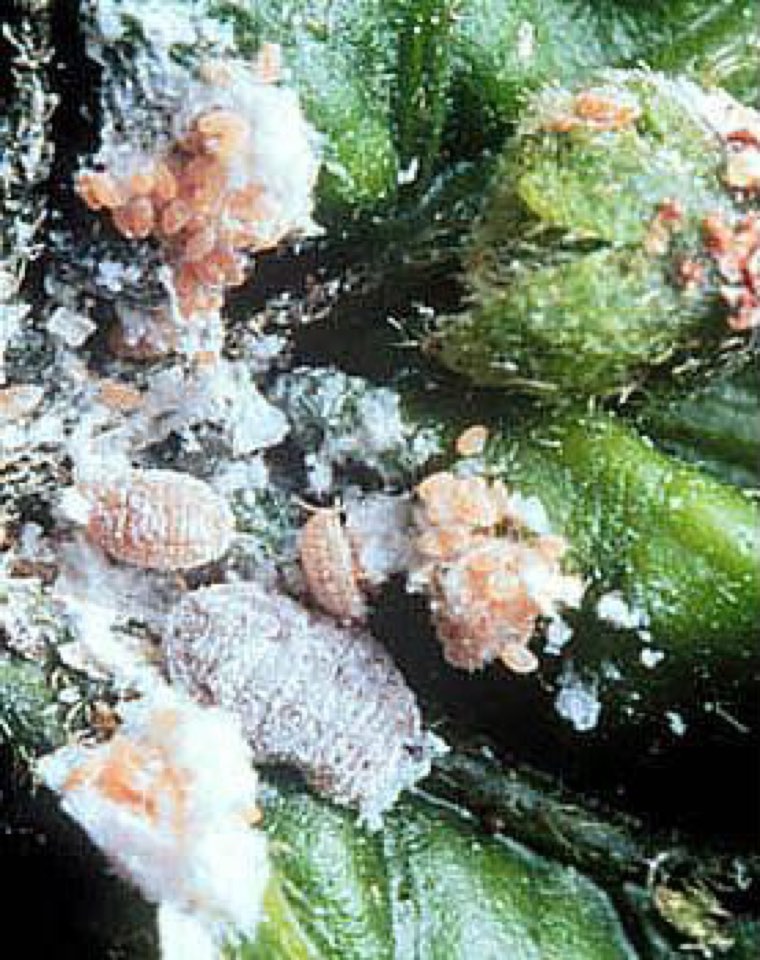
The scientific name of pink hibiscus mealybug is Maconellicoccus hirsutus (Green, 1908), in the order Hemiptera, family Pseudococcidae.
Older or alternative scientific names: Phenacoccus hirsutus.
Probably native to southern Asia. Long present in South and Southeast Asia, Africa, the Middle East and northern Australia; it reached the Caribbean in the early 1990s (first recorded in Grenada in 1994), spread to many islands, northern South America, Central America and the southern United States (California and Florida by 1999-2002). It is regulated in Europe.
| Region | Status |
|---|---|
| South and Southeast Asia | Native or long established; key pest of grape and mulberry |
| Africa and the Middle East | Present; a pest of cotton, hibiscus and fruit |
| Caribbean and Central America | Invasive since the 1990s; under biological control |
| North and South America | Present in the southern US and northern South America |
| Oceania | Present in northern Australia and Pacific islands |
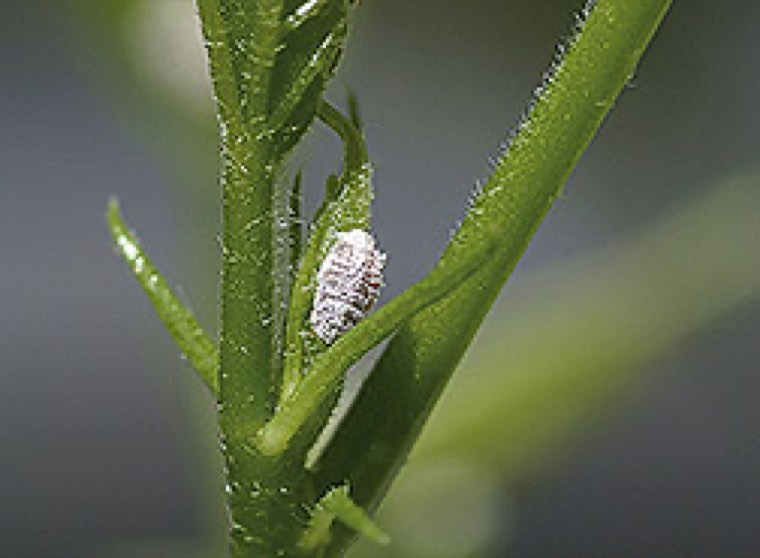
Adult females are about 3 mm long, oval, pink to reddish under a thin white wax coat without long filaments; when crushed they release reddish body fluid. Eggs are pink, laid in white cottony egg sacs of several hundred. Crawlers are pink and very mobile. Winged males are tiny and short-lived.
| Crop stage | What you see |
|---|---|
| New growth and shoot tips | Severe twisting, bunching and shortening of new shoots ('bunchy top'); crinkled, thickened leaves. |
| Established plants | White cottony masses in leaf axils, bark crevices and on stems; honeydew and sooty mould; stunting and dieback in heavy infestations. |
| Flowering and fruiting | Flowers and fruit malformed or dropped; in grapes, bunches covered with wax and sooty mould and unsaleable; in cotton, damaged bolls. |
Each female lays several hundred eggs in an egg sac. Crawlers spread by walking, wind, water, birds, people and on planting material, and settle in protected places such as buds, leaf axils and bark crevices. Toxic saliva injected during feeding causes the characteristic distortion. Populations survive the cool or dry season on bark and roots.
| Stage | Duration | Notes |
|---|---|---|
| Egg (in egg sac) | About 3-9 days | Several hundred per female. |
| Nymph (3 female instars) | About 10-22 days | Crawlers disperse widely. |
| Adult female | About 2-3 weeks | Produces the egg sac. |
| Adult male | A few days | Winged; does not feed. |
A generation takes about 4-5 weeks at 25-30 °C; populations build in warm, dry seasons.
About 10-15 generations a year in the tropics.
Warm, dry weather; ants that tend colonies; moving infested plants, cuttings and fruit; broad-spectrum sprays that kill natural enemies; and dense hedges of hibiscus and other hosts near crops.
There is no internationally agreed numeric threshold. In vineyards, some regional programmes act on the percentage of vines or bunches infested; elsewhere, prevention and biological control are the norm and chemical treatment is reserved for new outbreaks.
Thresholds are local. They depend on crop price, control cost, variety and natural-enemy activity, so use the figure your local extension service publishes where one exists.
Uncontrolled infestations cause large losses in grapes (bunches rejected), cotton, mulberry (and hence silk production) and fruit trees, and can kill hibiscus and young trees. Losses estimated in the Caribbean in the mid-1990s ran to many millions of US dollars a year before biological control.
Control works best as a sequence: prevent, monitor, then act only when a threshold or a risk forecast says so, using the least disruptive option that works.
Contact insecticides work poorly because of the waxy coat and the hidden places where the mealybug lives, and they disrupt biological control; systemic groups are used in some vineyards where registered. What is registered differs by country and changes over time; follow the label and your local plant-protection authority.
| Scheme | Group | Mode of action | Notes |
|---|---|---|---|
| IRAC | 4A | Nicotinic acetylcholine receptor competitive modulators (neonicotinoids) | Systemic; harmful to natural enemies. |
| IRAC | 23 | Inhibitors of acetyl CoA carboxylase | Systemic. |
| IRAC | 16 | Inhibitors of chitin biosynthesis, type 1 | Acts on nymphs. |
More than 200 plant genera. Important hosts include hibiscus, grape, cotton, mulberry, guava, citrus, custard apple, soursop, okra, soybean, groundnut, teak, sugarcane and many ornamentals and forest trees.
How to grow the crop well is the first line of defence. Laisha's free grow guides cover each crop from sowing to harvest:
Written by Laisha from the sources above, in its own words. This page is general reference, not a prescription: confirm identification locally and follow the label and your plant-protection authority.