 Laisha
AI Operating System for Agriculture
Ask Laisha
Laisha
AI Operating System for Agriculture
Ask Laisha
Tetranychus urticae Koch, 1836 · formerly or also: Tetranychus cinnabarinus (red form, often treated as the same species)
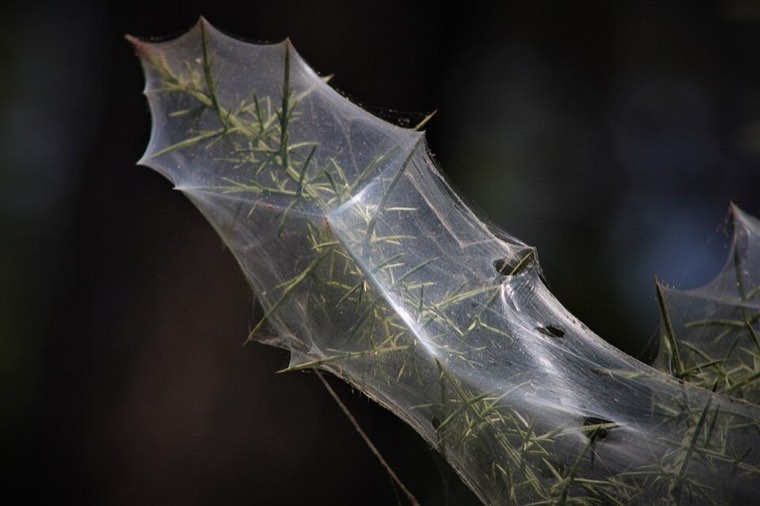
A mite smaller than a pinhead that sucks the contents of leaf cells, leaving pale speckles, bronzed leaves and fine webbing. It attacks more than a thousand plant species, from strawberry, cotton and beans to tomatoes, roses and fruit trees, and builds up explosively in hot, dry weather. It is the arthropod with resistance to the largest number of pesticides, so biological control with predatory mites is central to managing it.
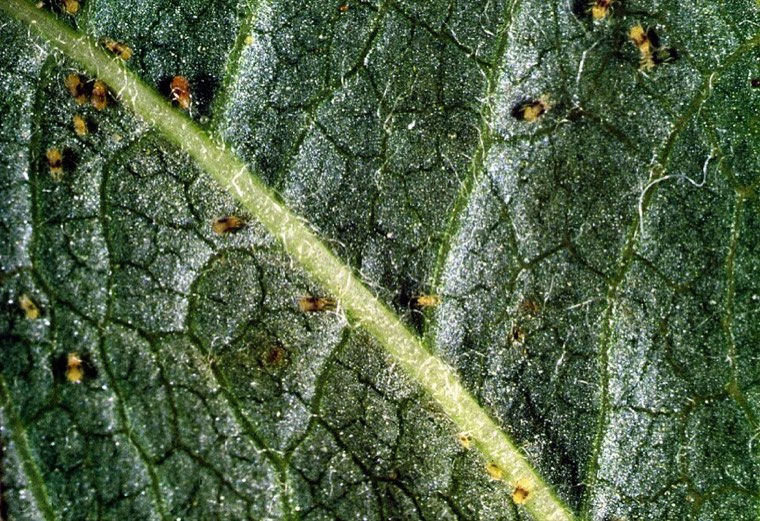
The scientific name of two-spotted spider mite is Tetranychus urticae Koch, 1836, in the order Trombidiformes, family Tetranychidae.
Older or alternative scientific names: Tetranychus cinnabarinus (red form, often treated as the same species).
Cosmopolitan: present in every agricultural region, outdoors in warm and temperate climates and in greenhouses everywhere. The red form (often called carmine spider mite) dominates in warmer regions.
| Region | Status |
|---|---|
| Europe | Widespread; key greenhouse pest |
| Asia | Widespread |
| Africa and the Middle East | Widespread in irrigated and protected crops |
| Americas | Widespread |
| Oceania | Widespread |
Adult females are about 0.5 mm, oval, greenish-yellow to reddish, with two dark spots on the body (one each side); overwintering females turn bright orange-red. Males are smaller with a pointed abdomen. Eggs are spherical and translucent. A hand lens (10x) is needed to see them; tapping a leaf over white paper shows moving specks.
| Crop stage | What you see |
|---|---|
| Early infestation | Fine pale stippling (tiny yellow-white dots) on the upper surface of leaves; mites and eggs on the underside along veins. |
| Heavy infestation | Leaves turn yellow, bronze or reddish and dry up; fine silk webbing covers leaves, shoots and fruit; leaves fall. |
| Fruiting | Reduced fruit size and quality; in strawberry, small, dry berries; in cotton, early leaf shedding and smaller bolls. |
Females lay up to about 100 eggs over two to four weeks. After hatching, the mite passes through a six-legged larva and two eight-legged nymphal stages, each followed by a resting stage. Unmated females produce only sons. Because the cycle can take a week in hot weather, populations can multiply tens of times in a month. Shortening days trigger diapause in orange females that overwinter in debris and bark.
| Stage | Duration | Notes |
|---|---|---|
| Egg | About 3 days at 25-30 °C | On leaf undersides. |
| Larva | About 1-2 days | Six legs. |
| Protonymph and deutonymph | About 2-4 days in total | Eight legs; resting stage after each. |
| Adult | About 2-4 weeks | Females lay most eggs in the first two weeks. |
Egg to adult takes about 7-8 days at 30 °C and about 2-3 weeks at 20 °C; development stops below about 12 °C. Hot, dry air (low humidity) speeds up reproduction and slows predatory mites, which is why outbreaks follow heat waves.
Up to 20 or more generations a year in greenhouses and warm climates.
Hot, dry weather; water-stressed plants; dusty roadsides; high nitrogen; and broad-spectrum insecticide sprays (for example pyrethroids and some neonicotinoids) that kill predators and can stimulate mite reproduction.
Thresholds count mites per leaflet or leaf, sampled from the middle of the canopy, and depend strongly on crop stage. Many programmes also count predatory mites and wait if the ratio of predators to pests is favourable.
| Crop | Threshold | Unit | Crop stage | Region | Source |
|---|---|---|---|---|---|
| Strawberry | 5 (autumn planting) to 10 (summer planting) | mites per mid-tier leaflet | First four months after planting | North America (California) | University of California Cooperative Extension strawberry mite guidelines |
| Strawberry | 5 mobile mites early; 15 after fruiting begins | mobile mites per leaflet | Early season; fruiting | North America (south-east) | North Carolina State Extension, sampling spider mites in strawberries |
Thresholds are local. They depend on crop price, control cost, variety and natural-enemy activity, so use the figure your local extension service publishes where one exists.
Feeding destroys chlorophyll-containing cells and reduces photosynthesis. In strawberry, substantial yield loss results from about 15-20 mites per leaflet after berry set; in cotton, beans and vegetables, heavy infestations cause early defoliation and yield losses of 20-50% in hot, dry seasons. Webbing also contaminates ornamentals and fruit.
Control works best as a sequence: prevent, monitor, then act only when a threshold or a risk forecast says so, using the least disruptive option that works.
Use acaricides that spare predatory mites, cover leaf undersides, and rotate groups; many products act only on certain life stages. What is registered differs by country and changes over time; follow the label and your local plant-protection authority.
| Scheme | Group | Mode of action | Notes |
|---|---|---|---|
| IRAC | 10A | Mite growth inhibitors affecting CHS1 | Act on eggs and young stages. |
| IRAC | 10B | Mite growth inhibitors affecting CHS1 (oxazolines) | Eggs and young stages. |
| IRAC | 20 | Mitochondrial complex III electron transport inhibitors (Qo site) | All stages. |
| IRAC | 21A | Mitochondrial complex I electron transport inhibitors (METI acaricides) | Resistance common. |
| IRAC | 23 | Inhibitors of acetyl CoA carboxylase (tetronic and tetramic acid derivatives) | Eggs and immatures. |
| IRAC | 25 | Mitochondrial complex II electron transport inhibitors | Newer acaricide group. |
| IRAC | 6 | Glutamate-gated chloride channel allosteric modulators (avermectins) | Resistance documented. |
Recorded on more than 1,100 plant species in over 140 families: vegetables (bean, tomato, cucumber, eggplant, pepper), strawberry, cotton, soybean, maize, hops, fruit trees and vines, and very many ornamentals and weeds.
How to grow the crop well is the first line of defence. Laisha's free grow guides cover each crop from sowing to harvest:
Written by Laisha from the sources above, in its own words. This page is general reference, not a prescription: confirm identification locally and follow the label and your plant-protection authority.