 Laisha
AI Operating System for Agriculture
Ask Laisha
Laisha
AI Operating System for Agriculture
Ask Laisha
Erysiphe necator Schwein., 1834 · formerly or also: Uncinula necator, Oidium tuckeri (asexual stage)
The most widespread disease of grapevines. It covers leaves, shoots and young bunches with a grey-white powder; infected berries crack, split and rot, and even light infection taints wine. Native to North America, it reached Europe in 1845 and nearly destroyed its vineyards. All European wine grapes are susceptible, so vineyards in almost every region need a protection programme each season.
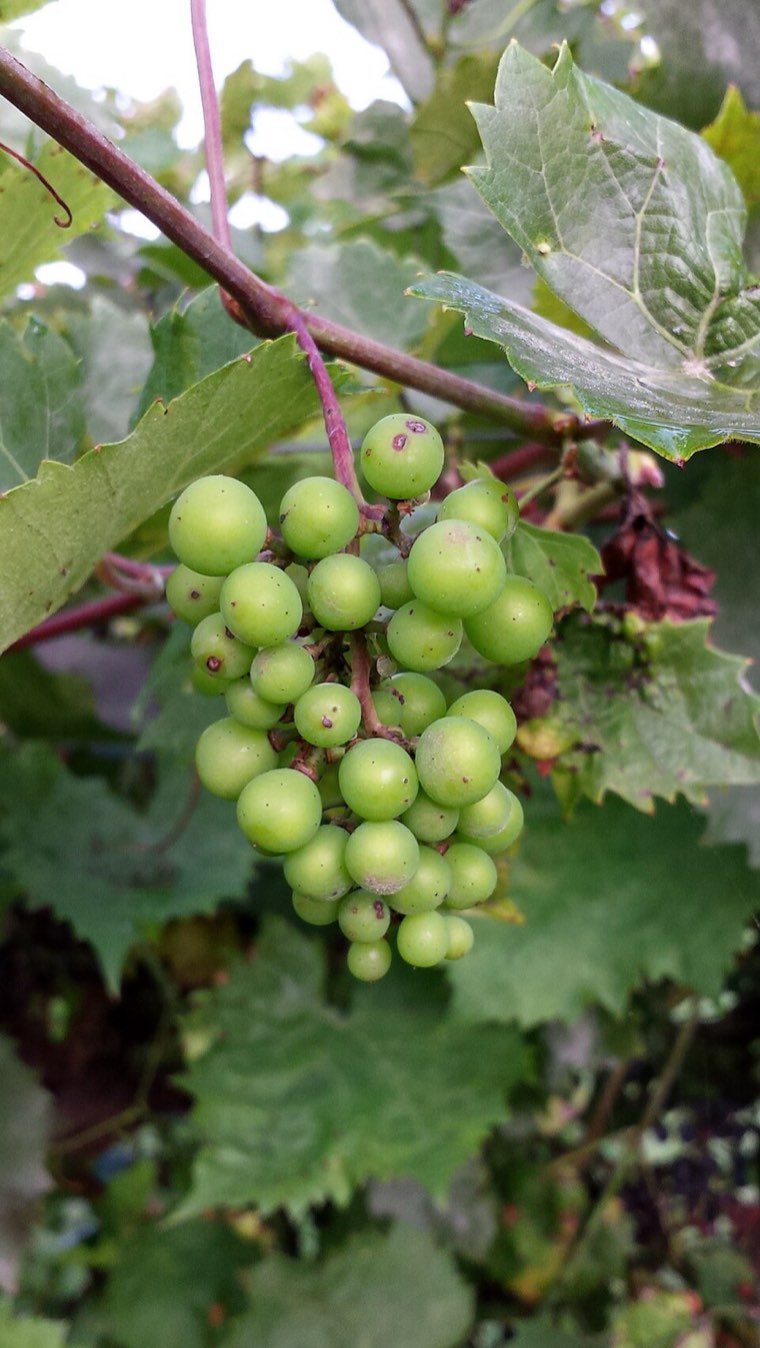
Powdery mildew of grapevine is caused by Erysiphe necator Schwein., 1834, a fungus (powdery mildew, an obligate parasite) (order Erysiphales, family Erysiphaceae).
Older or alternative scientific names: Uncinula necator, Oidium tuckeri (asexual stage).
Present in every grape-growing region, from cool climates to the tropics.
| Region | Status |
|---|---|
| Europe and the Mediterranean | Widespread since 1845 |
| Americas | Native to North America; widespread |
| Asia | Widespread |
| Africa and the Middle East | Widespread |
| Oceania | Widespread |
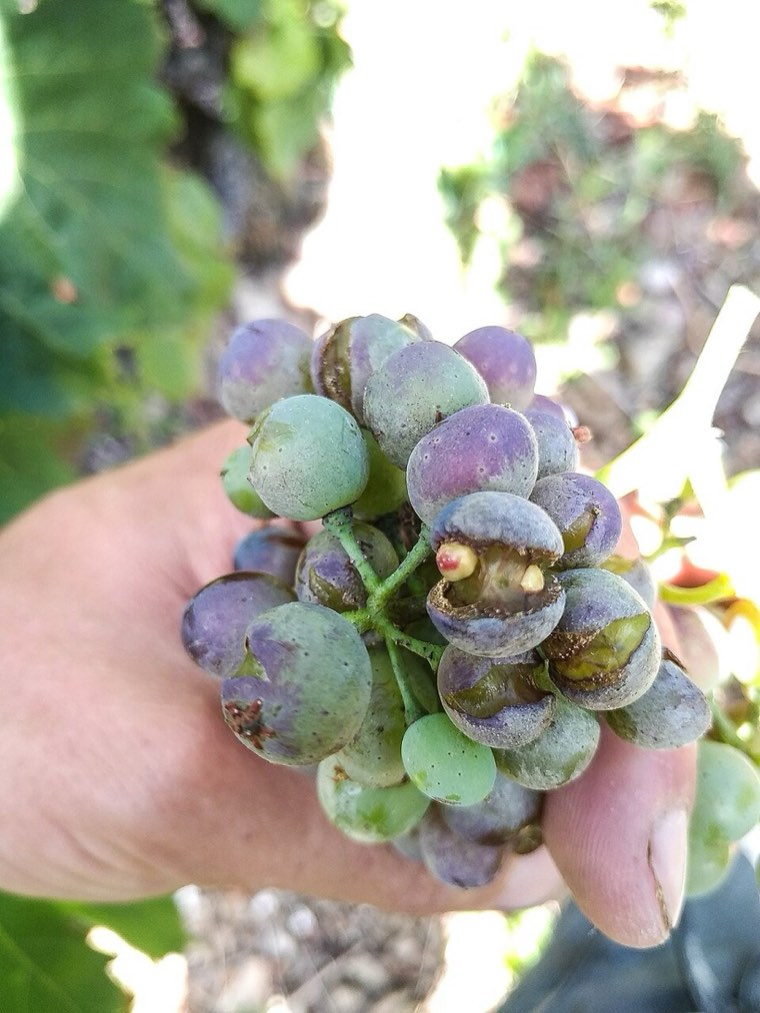
The fungus grows on the surface of green tissue as white mycelium with chains of spores. In late summer it forms tiny round fruiting bodies (chasmothecia), first yellow then black, which wash into bark crevices to overwinter. In some regions it also overwinters as mycelium inside buds, which produce whitened 'flag shoots' in spring.
| Crop stage | What you see |
|---|---|
| Bud break to pre-bloom | Flag shoots: stunted shoots covered in white powder (where bud infection occurs); small, chlorotic spots on the upper side of leaves. |
| Bloom to bunch closure | White powdery growth on berries, stems of bunches and leaves; berries are most susceptible from fruit set for about 3-4 weeks. |
| Veraison to harvest | Russeted, net-like scars on berries; berries split and are invaded by grey mould and sour rot; reddish-brown blotches on canes after they mature. |
In spring, rain releases ascospores from chasmothecia in the bark, starting primary infections on leaves near the trunk; flag shoots also release spores. After that the disease spreads by wind-borne conidia in repeated cycles of 5-7 days in favourable temperatures, without needing rain. Late in the season chasmothecia form and overwinter.
| Stage | Duration | Notes |
|---|---|---|
| Ascospore release from chasmothecia | After rain of about 2.5 mm or more at temperatures above about 10 °C | Primary infections near the trunk. |
| Colony growth (latent period) | About 5-7 days at 21-30 °C | Longer at lower temperatures. |
| Secondary cycles of conidia | Repeated through the season | Do not need rain; humid shade helps. |
| Chasmothecia formation | Late summer and autumn | Overwinter in bark. |
The disease develops fastest at about 21-30 °C; temperatures above about 35 °C for several hours kill colonies. Risk indices (for example the Gubler-Thomas model used in California) count consecutive days with at least six hours in the 21-30 °C range.
Many asexual cycles each season.
Mild temperatures, shaded and dense canopies, high humidity without much rain, susceptible cultivars, and inadequate protection of bunches during the critical weeks after fruit set.
There is no numeric economic threshold based on disease counts: the tolerance for infected bunches is low (wineries may reject fruit with a few per cent infection). Programmes are preventive, timed by growth stage (especially bloom to bunch closure) and by temperature-based risk models.
Thresholds are local. They depend on crop price, control cost, variety and natural-enemy activity, so use the figure your local extension service publishes where one exists.
Infected bunches lose yield and quality: berries split, rot, and make off-flavoured wine; crop loss can be total in unprotected susceptible vineyards. Infection also reduces vine vigour and wood maturity, affecting the next season.
Control works best as a sequence: prevent, monitor, then act only when a threshold or a risk forecast says so, using the least disruptive option that works.
Protection is most important from just before bloom to bunch closure; spray intervals are shortened in high-risk weather and good canopy coverage is essential. What is registered differs by country and changes over time; follow the label and your local plant-protection authority.
| Scheme | Group | Mode of action | Notes |
|---|---|---|---|
| FRAC | M02 | Inorganic (sulfur) - multi-site contact | Low resistance risk; can scorch in heat. |
| FRAC | 3 | Demethylation inhibitors (DMI) | Reduced sensitivity widespread. |
| FRAC | 7 | Succinate dehydrogenase inhibitors (SDHI) | In mixtures. |
| FRAC | 13 | Aryloxyquinolines and quinazolinones | Specific to powdery mildews; resistance reported. |
| FRAC | 50 | Aryl-phenyl-ketones | Specific to powdery mildews. |
| FRAC | 5 | Amines (morpholines and relatives) | Sterol biosynthesis inhibitors, class II. |
Grapevines (Vitis species). European wine and table grapes (Vitis vinifera) are highly susceptible; many North American and Asian Vitis species and the muscadine grape are more resistant.
How to grow the crop well is the first line of defence. Laisha's free grow guides cover each crop from sowing to harvest:
Written by Laisha from the sources above, in its own words. This page is general reference, not a prescription: confirm identification locally and follow the label and your plant-protection authority.