 Laisha
AI Operating System for Agriculture
Ask Laisha
Laisha
AI Operating System for Agriculture
Ask Laisha
Rhizoctonia solani AG1-IA J.G. Kühn, 1858 (sexual stage Thanatephorus cucumeris (A.B. Frank) Donk) · formerly or also: Thanatephorus cucumeris
Sheath blight is the second most important disease of rice after blast in many regions. Oval grey-green lesions start on the leaf sheaths near the water line and climb the plant, killing leaves and weakening stems. It has grown more serious as farmers have adopted high-yielding, densely planted, heavily fertilised rice.
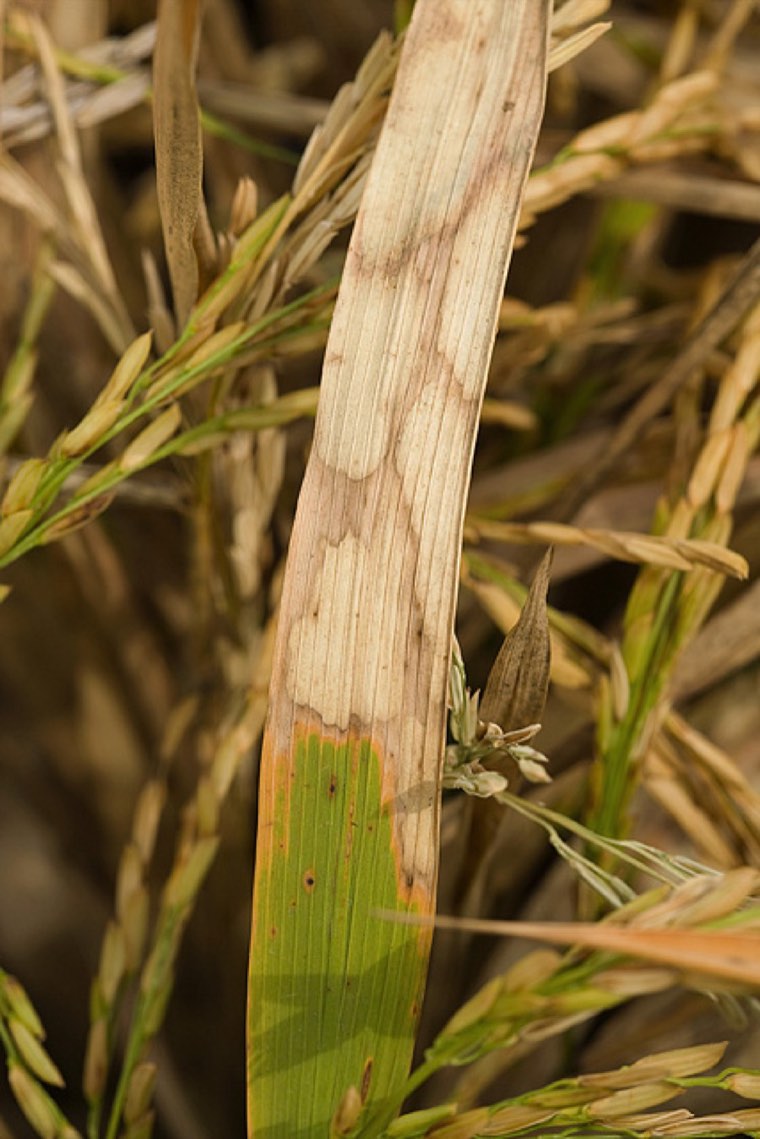
Sheath blight of rice is caused by Rhizoctonia solani AG1-IA J.G. Kühn, 1858 (sexual stage Thanatephorus cucumeris (A.B. Frank) Donk), a fungus (soil-borne basidiomycete) (order Cantharellales (Ceratobasidiales), family Ceratobasidiaceae).
Older or alternative scientific names: Thanatephorus cucumeris.
Found in all major rice-growing regions, from tropical Asia to temperate East Asia, the Americas and Africa, and most damaging in intensive irrigated systems.
| Region | Status |
|---|---|
| South and Southeast Asia | Widespread; major in intensive irrigated rice |
| East Asia | Widespread; one of the main rice diseases in China and Japan |
| Americas | Widespread in southern US and Latin American rice |
| Africa | Present in irrigated rice |
The fungus forms brown hyphae branching at right angles, and small, round to irregular brown sclerotia (1-5 mm) on and near lesions, which fall off and float. It produces no airborne asexual spores; spread is by sclerotia and hyphae.
| Crop stage | What you see |
|---|---|
| Maximum tillering | Oval or irregular greenish-grey, water-soaked lesions on leaf sheaths at or just above the water line. |
| Panicle initiation to booting | Lesions enlarge with grey-white centres and brown borders, merging into a 'snakeskin' pattern; hyphae spread to neighbouring tillers and upper sheaths and leaves; brown sclerotia on lesions. |
| Heading to grain filling | Upper leaves and flag leaf die; partly filled grains; weakened stems and lodging. |
Sclerotia and infected debris survive in soil for months to years. When the field is flooded, sclerotia float and lodge against the rice sheaths at the water line, where they germinate and infect. The fungus then grows upward and across to touching tillers and leaves; in a dense canopy it bridges from hill to hill.
| Stage | Duration | Notes |
|---|---|---|
| Sclerotia in soil and water | Survive months to years | Float on floodwater. |
| Infection of sheaths at water line | Within 1-3 days of contact in warm, humid conditions | Infection cushions form on the sheath. |
| Lesion spread upward and to neighbours | Through the season | Fast once the canopy closes. |
| New sclerotia form | Late season | Return to the soil. |
Most severe at about 28-32 °C with relative humidity above about 95% inside the canopy. It is a disease of warm, humid, dense crops.
One main epidemic per crop, with continuous spread within the canopy.
High nitrogen, dense planting, high-tillering varieties, warm humid weather, continuous rice cropping and rice-maize rotations that maintain inoculum, and weedy bunds.
There is no internationally agreed numeric economic threshold. Some programmes use the percentage of tillers with lesions or the relative height of lesions on the plant at maximum tillering to booting to decide on treatment; values are local and depend on variety and yield potential.
Thresholds are local. They depend on crop price, control cost, variety and natural-enemy activity, so use the figure your local extension service publishes where one exists.
Yield losses of 10-30% are common in affected fields and can reach 50% when infection reaches the flag leaf early in susceptible high-yielding crops.
Control works best as a sequence: prevent, monitor, then act only when a threshold or a risk forecast says so, using the least disruptive option that works.
Fungicides are applied when lesions are spreading upward around panicle initiation to booting, directed at the lower canopy. What is registered differs by country and changes over time; follow the label and your local plant-protection authority.
| Scheme | Group | Mode of action | Notes |
|---|---|---|---|
| FRAC | 7 | Succinate dehydrogenase inhibitors (SDHI) | Widely used for sheath blight. |
| FRAC | 3 | Demethylation inhibitors (DMI) | Systemic. |
| FRAC | 11 | Quinone outside inhibitors (QoI) | Resistance reported in some regions. |
| FRAC | 26 | Glucopyranosyl antibiotics (trehalase inhibition) | Used in Asian rice. |
The anastomosis group AG1-IA of Rhizoctonia solani has a very wide host range: rice, maize (banded leaf and sheath blight), sorghum, sugarcane, soybean (aerial blight), beans and many grass and broadleaf weeds that sustain it between crops.
How to grow the crop well is the first line of defence. Laisha's free grow guides cover each crop from sowing to harvest:
Written by Laisha from the sources above, in its own words. This page is general reference, not a prescription: confirm identification locally and follow the label and your plant-protection authority.