 Laisha
AI Operating System for Agriculture
Ask Laisha
Laisha
AI Operating System for Agriculture
Ask Laisha
Rice tungro bacilliform virus and rice tungro spherical virus ICTV species: Tungrovirus oryzae (RTBV) and Waikavirus oryzae (RTSV) · formerly or also: RTBV, RTSV
Tungro is the most destructive virus disease of rice in South and Southeast Asia. Infected plants are stunted, produce few tillers, and their leaves turn yellow to orange from the tips; plants infected young give little or no grain. Two viruses are involved: the bacilliform virus causes most of the symptoms, and the spherical virus lets green leafhoppers spread it. Synchronised planting, resistant varieties and a rice-free break manage it better than sprays.
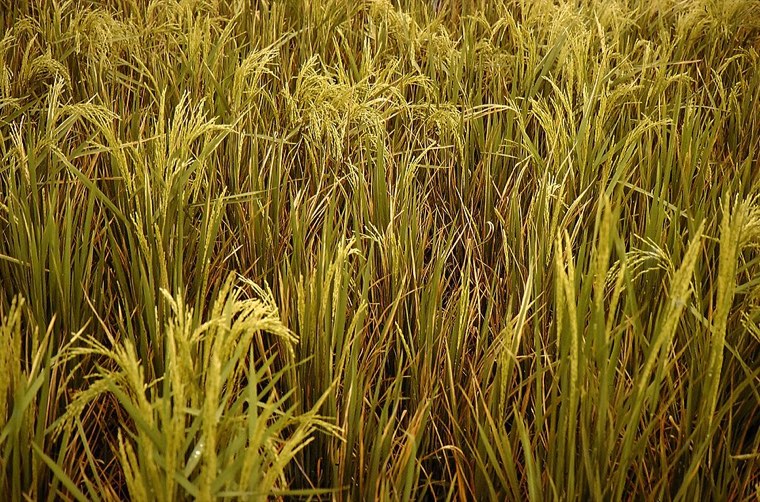
Rice tungro disease is caused by Rice tungro bacilliform virus and rice tungro spherical virus, a virus disease caused by two viruses together, spread by green leafhoppers (order Ortervirales (RTBV); Picornavirales (RTSV), family Caulimoviridae (RTBV); Secoviridae (RTSV)).
Older or alternative scientific names: RTBV, RTSV.
South and Southeast Asia: Bangladesh, India, Sri Lanka, Nepal, Thailand, Malaysia, Indonesia, the Philippines and Vietnam, and southern China. Epidemics recur where rice is grown continuously with staggered planting.
| Region | Status |
|---|---|
| Southeast Asia | Widespread; recurring epidemics |
| South Asia | Widespread; epidemics in some seasons |
| East Asia | Present in southern China |
The bacilliform virus (a reverse-transcribing DNA virus) and the spherical virus (an RNA virus) are detected by laboratory tests. Green leafhoppers - mainly Nephotettix virescens, also N. nigropictus and others - transmit them in a semi-persistent way: they acquire the viruses within about half an hour of feeding and lose them within a few days or when they moult. The bacilliform virus can be transmitted only if the spherical virus is present in the plant the leafhopper fed on.
| Crop stage | What you see |
|---|---|
| Seedling and early tillering | Young leaves turn yellow to orange-yellow starting from the tip; plants stunted with few tillers; slightly twisted young leaves. |
| Tillering to booting | Patches of stunted, discoloured plants scattered through the field; delayed flowering. |
| Heading | Small, incompletely emerged panicles with many unfilled grains; late infections cause milder symptoms. |
Green leafhoppers feeding on infected rice, ratoons or volunteers pick up the viruses and carry them to new plantings within days. Because the vector loses the virus quickly, spread depends on a continuous supply of infected plants nearby. Staggered planting across a landscape, with young and old crops side by side, keeps the cycle going.
| Stage | Duration | Notes |
|---|---|---|
| Acquisition by leafhopper | About 30 minutes of feeding | Semi-persistent. |
| Transmission | Leafhopper remains infective for about 2-5 days | Lost at moulting. |
| Symptom development | About 1-3 weeks | Earlier infection gives severe disease. |
| Survival | Between crops | Ratoons, volunteers, overlapping crops. |
Leafhopper populations and disease spread are greatest in warm, humid conditions; outbreaks are linked more to cropping pattern than to weather.
Spread continues as long as rice of different ages is grown side by side.
Asynchronous, staggered planting; continuous rice cropping with no fallow; infected ratoons and volunteers; susceptible varieties; and high leafhopper populations.
There is no economic threshold based on leafhopper counts alone, because a few infective leafhoppers can start an epidemic. Some programmes act when tungro-infected plants are found in the nursery or early crop together with leafhoppers; forecasting in Southeast Asia uses light-trap catches and the percentage of infective leafhoppers.
Thresholds are local. They depend on crop price, control cost, variety and natural-enemy activity, so use the figure your local extension service publishes where one exists.
Plants infected within the first month may yield almost nothing; field losses in epidemics range up to 100%, and tungro has caused regional losses in Southeast and South Asia repeatedly since the 1960s.
Control works best as a sequence: prevent, monitor, then act only when a threshold or a risk forecast says so, using the least disruptive option that works.
Insecticides against leafhoppers have limited value because transmission is fast and the leafhoppers move in from outside; nursery protection may help where tungro is endemic. What is registered differs by country and changes over time; follow the label and your local plant-protection authority.
| Scheme | Group | Mode of action | Notes |
|---|---|---|---|
| IRAC | 4A | Nicotinic acetylcholine receptor competitive modulators, against the leafhopper vector | Nursery use where registered. |
| IRAC | 16 | Inhibitors of chitin biosynthesis, type 1, against vector nymphs | Selective. |
Rice and some wild rices and grasses (for example Leersia and Echinochloa species) that act as minor reservoirs; ratoons and volunteer rice are the main sources between crops.
How to grow the crop well is the first line of defence. Laisha's free grow guides cover each crop from sowing to harvest:
Written by Laisha from the sources above, in its own words. This page is general reference, not a prescription: confirm identification locally and follow the label and your plant-protection authority.