 Laisha
AI Operating System for Agriculture
Ask Laisha
Laisha
AI Operating System for Agriculture
Ask Laisha
Diabrotica virgifera virgifera LeConte, 1868
The western corn rootworm is a small yellow-and-black striped beetle whose larvae tunnel in and eat maize roots, so plants topple over ('goose-necking') and yield falls. Adults chew silks and can interfere with pollination. It is the most costly maize pest in the US Corn Belt and has spread across Central and Eastern Europe since 1992. It has repeatedly adapted to control tactics - crop rotation, soil insecticides and transgenic Bt maize.
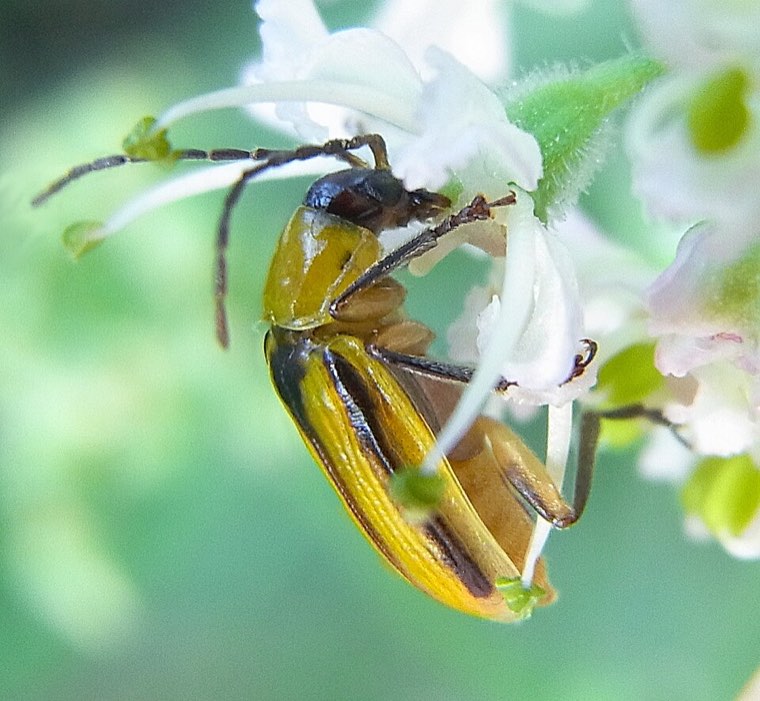
The scientific name of Western corn rootworm is Diabrotica virgifera virgifera LeConte, 1868, in the order Coleoptera, family Chrysomelidae.
Native to Mexico and Central America; spread across the US maize belt in the twentieth century. Detected in Serbia in 1992, it has spread through much of Central, Eastern and Southern Europe, with separate introductions to Italy, France and elsewhere. It is regulated or under containment in some regions.
| Region | Status |
|---|---|
| North America | Widespread; key maize pest |
| Mexico and Central America | Native |
| Europe | Invasive since 1992; widespread in central, eastern and southern countries |
| Other regions | Absent; quarantine concern |
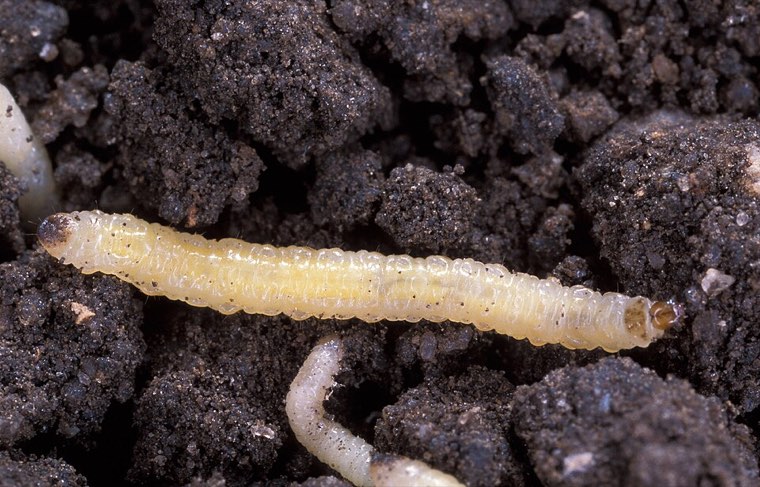
Adults are about 5-6 mm long, yellowish with black stripes on the wing covers (females with distinct stripes; males often darker). Larvae are slender, white, up to about 12 mm, with a brown head and a dark plate on the last segment, found in maize roots. Eggs are laid in soil in late summer.
| Crop stage | What you see |
|---|---|
| Early vegetative (larval feeding) | Roots chewed, tunnelled and pruned back to the stalk; brown scars on roots; plants wilt in hot afternoons. |
| Late vegetative | Plants lodge after wind and rain and then curve upward ('goose-necking'); root lodging in patches. |
| Silking (adults) | Silks clipped back to the ear tip, poor pollination and incomplete grain set when beetles are numerous; leaves with scraped 'windowpane' feeding. |
Eggs laid in maize fields in late summer overwinter in the soil and hatch in early summer, when larvae find the roots of the following crop. That is why rotating away from maize breaks the cycle - except where 'rotation-resistant' populations lay eggs in soybean and other crops. Larvae pass through three instars, pupate in soil, and adults emerge around tasselling.
| Stage | Duration | Notes |
|---|---|---|
| Egg (overwinters in soil) | About 9-10 months in diapause | Laid in late summer. |
| Larva (3 instars) | About 3-4 weeks | Feeds on maize roots. |
| Pupa (in soil) | About 1 week | Near the roots. |
| Adult beetle | About 4-8 weeks | Feeds on silks and pollen; flies between fields. |
Larval hatch is timed by soil temperature accumulation in spring; a degree-day model with a base of about 11 °C is used to predict hatch and adult emergence.
One generation a year.
Continuous maize; repeated use of the same Bt traits or soil insecticides; rotation-resistant variants where maize is rotated only with soybean; and dry soils where roots cannot regrow after feeding.
There is no single numeric threshold. Decisions for next season's maize are based on adult beetle counts on plants or yellow sticky traps in the current season, and on root injury ratings (the 0-3 node-injury scale) dug from this season's plants; action levels differ between regions and with crop rotation.
Thresholds are local. They depend on crop price, control cost, variety and natural-enemy activity, so use the figure your local extension service publishes where one exists.
Root injury reduces water and nutrient uptake and causes lodging, with yield losses of 10-30% or more in heavily infested continuous maize; silk clipping by adults reduces pollination. Combined losses and control costs in the United States have been estimated at around a billion US dollars a year.
Control works best as a sequence: prevent, monitor, then act only when a threshold or a risk forecast says so, using the least disruptive option that works.
Soil insecticides at planting and seed treatments protect roots; adult sprays to protect silks or reduce egg laying are used only above local thresholds. What is registered differs by country and changes over time; follow the label and your local plant-protection authority.
| Scheme | Group | Mode of action | Notes |
|---|---|---|---|
| IRAC | 3A | Sodium channel modulators (pyrethroids) | Soil and adult uses; resistance reported in adults in some areas. |
| IRAC | 1B | Acetylcholinesterase inhibitors (organophosphates) | Soil uses where registered; resistance reported. |
| IRAC | 4A | Nicotinic acetylcholine receptor competitive modulators (neonicotinoids) | Seed treatment; restricted in some regions. |
Larvae develop almost only on maize roots (a few grasses support limited development). Adults feed on maize silks, pollen and leaves, and on pollen and flowers of other plants such as squash and sunflower.
How to grow the crop well is the first line of defence. Laisha's free grow guides cover each crop from sowing to harvest:
Written by Laisha from the sources above, in its own words. This page is general reference, not a prescription: confirm identification locally and follow the label and your plant-protection authority.