 Laisha
AI Operating System for Agriculture
Ask Laisha
Laisha
AI Operating System for Agriculture
Ask Laisha
'Candidatus Liberibacter asiaticus' Jagoueix et al., 1994 (related forms: 'Ca. L. africanus' and 'Ca. L. americanus')
Huanglongbing, or citrus greening, is the most destructive citrus disease in the world. A bacterium carried by psyllid insects lives in the tree's sugar-conducting tissue, so leaves become blotchy yellow, fruit stays small, lopsided, green and bitter, and trees decline and die within a few years. There is no cure; prevention relies on clean nursery trees, area-wide control of the psyllid and removal of infected trees.
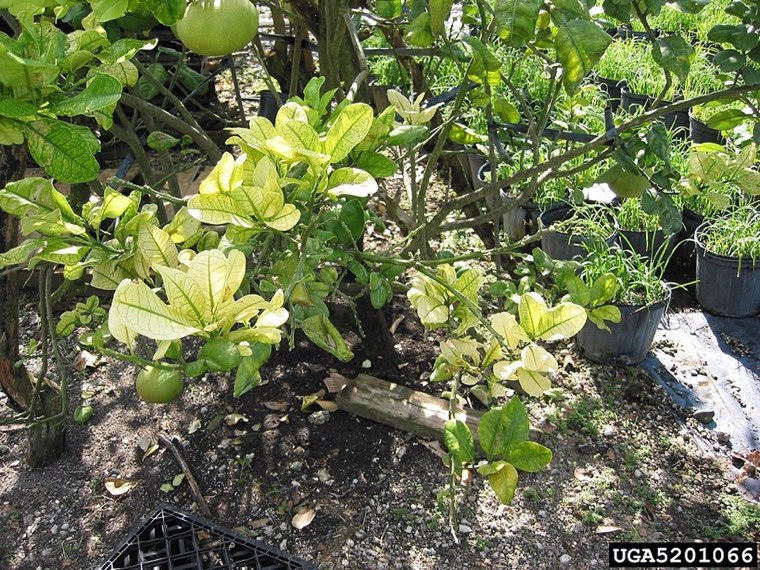
Citrus greening is caused by 'Candidatus Liberibacter asiaticus' Jagoueix et al., 1994 (related forms: 'Ca. L. africanus' and 'Ca. L. americanus'), a bacterium (phloem-limited, not yet cultured) (order Hyphomicrobiales (Rhizobiales), family Phyllobacteriaceae (Rhizobiaceae in some classifications)).
Known in southern China since the early twentieth century and widespread in tropical and subtropical Asia. The Asian form ('Ca. L. asiaticus') reached Brazil in 2004, Florida in 2005 and has spread through much of the Americas, while the African form occurs in Africa and the Arabian Peninsula. It is a quarantine disease in Europe, Australia and the Mediterranean, where the vectors are being monitored.
| Region | Status |
|---|---|
| South, Southeast and East Asia | Widespread |
| Latin America and the Caribbean | Widespread since the 2000s |
| North America | Widespread in Florida; present in other southern areas |
| Africa and the Arabian Peninsula | African form present; Asian form in some areas |
| Mediterranean, Europe and Oceania | Absent from most; quarantine disease |
The bacterium cannot be grown in culture and is detected by laboratory PCR tests on leaf midribs. It is transmitted by the Asian citrus psyllid (Diaphorina citri) and the African citrus psyllid (Trioza erytreae), and by grafting with infected budwood.
| Crop stage | What you see |
|---|---|
| Early infection (one branch or sector) | A 'yellow shoot' among green ones; blotchy mottle - irregular yellow-green patches that are not symmetrical on either side of the midrib (unlike nutrient deficiencies). |
| Developing | Small, upright, yellow leaves; corky, thickened veins; twig dieback; heavy fruit drop. |
| Fruit | Small, lopsided fruit that stay green at the stem end ('colour inversion'), with aborted seeds and bitter, salty juice. |
Psyllid nymphs and adults acquire the bacterium when feeding on infected trees, and adults then transmit it to new flush. Inside the tree, the bacterium moves slowly through the phloem and roots, and symptoms may take from several months to several years to appear, while the tree can already serve as a source for psyllids. Movement of infected nursery trees and budwood carries the disease over long distances.
| Stage | Duration | Notes |
|---|---|---|
| Acquisition by psyllids | Hours to days of feeding | Nymphs acquire most efficiently. |
| Transmission to new flush | During feeding by infective adults | Adults remain infective for life. |
| Latent period in the tree | Months to several years | Trees can spread disease before symptoms. |
| Decline | A few years | Root loss and phloem damage; no recovery. |
The Asian form tolerates heat better than the African form, which is limited to cooler, higher altitudes; transmission depends on psyllid flush cycles driven by rain and temperature.
Spread follows psyllid generations (many per year).
High psyllid populations, abandoned or backyard citrus and orange jasmine, uncertified nursery trees, and lack of coordinated area-wide management.
There is no economic threshold: any infected tree is a source of further spread. Where the disease is still rare, infected trees are removed promptly; where it is widespread, programmes aim to keep psyllids as low as possible and to keep trees productive for longer.
Infected trees lose yield and fruit quality and usually become unproductive within a few years. In Florida, orange production fell by more than 70% after the disease arrived; large losses have also occurred in Brazil, China, Southeast Asia and elsewhere.
Control works best as a sequence: prevent, monitor, then act only when a threshold or a risk forecast says so, using the least disruptive option that works.
Control of the vector is the main chemical tool (see Asian citrus psyllid). In a few regions, trunk injection of an antibiotic has been permitted to suppress the bacterium in trees; it does not eliminate the infection. What is registered differs by country and changes over time; follow the label and your local plant-protection authority.
| Scheme | Group | Mode of action | Notes |
|---|---|---|---|
| FRAC | 41 | Tetracycline antibiotics (protein synthesis) | Trunk injection where permitted; suppression only. |
| IRAC | 4A | Nicotinic acetylcholine receptor competitive modulators (neonicotinoids), against the vector | Systemic use on young trees. |
| IRAC | 3A | Sodium channel modulators (pyrethroids), against the vector | Dormant-season area-wide sprays. |
All commercial citrus species and hybrids and close relatives such as orange jasmine (Murraya paniculata), which also hosts the vector.
How to grow the crop well is the first line of defence. Laisha's free grow guides cover each crop from sowing to harvest:
Written by Laisha from the sources above, in its own words. This page is general reference, not a prescription: confirm identification locally and follow the label and your plant-protection authority.