 Laisha
AI Operating System for Agriculture
Ask Laisha
Laisha
AI Operating System for Agriculture
Ask Laisha
Rhizoctonia solani Rhizoctonia solani J.G. Kühn (sexual stage Thanatephorus cucumeris (A.B. Frank) Donk); on potato mainly anastomosis group AG-3 · formerly or also: Thanatephorus cucumeris (sexual stage)
Black scurf is the hard black crust of fungal resting bodies (sclerotia) that sticks to potato skins and will not wash off; it is a sign of Rhizoctonia solani, the same fungus that kills young sprouts and girdles underground stems and stolons with brown cankers. The sprout and stem damage early in the season is what reduces yield; the scurf itself is mainly a quality problem for seed and table potatoes.
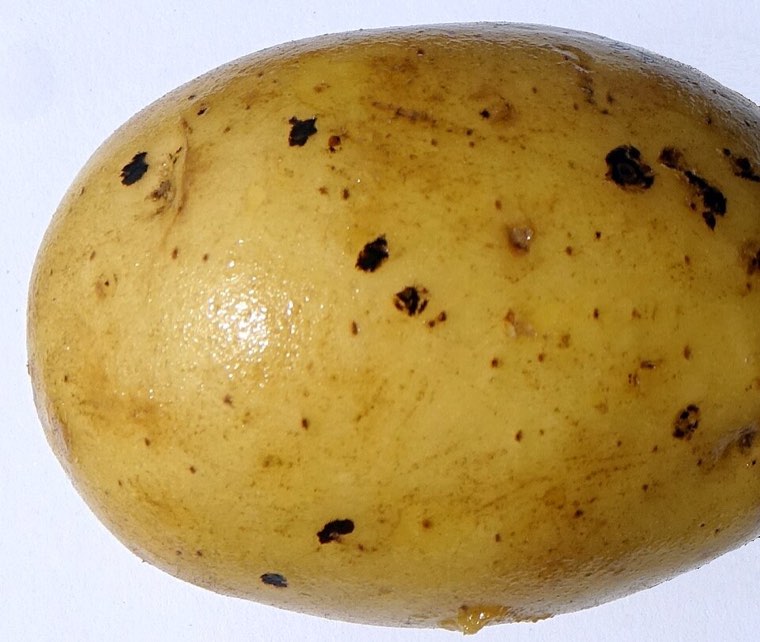
Black scurf and stem canker of potato is caused by Rhizoctonia solani Rhizoctonia solani J.G. Kühn (sexual stage Thanatephorus cucumeris (A.B. Frank) Donk); on potato mainly anastomosis group AG-3, a fungus (basidiomycete, soil-borne) (order Cantharellales, family Ceratobasidiaceae).
Older or alternative scientific names: Thanatephorus cucumeris (sexual stage).
Found in potato-growing soils worldwide; most damaging where potatoes are planted into cold, wet soils that slow emergence.
| Region | Status |
|---|---|
| Europe and North America | Widespread |
| Asia | Widespread, including the hills and plains of South Asia |
| Africa and Latin America | Widespread |
| Oceania | Widespread |
A soil fungus without spores in its usual form; it grows as brown threads that branch at right angles and forms small black sclerotia on tubers. The sexual stage appears as a white, powdery collar on stems just above the soil in humid weather.
| Crop stage | What you see |
|---|---|
| Sprouts (before emergence) | Brown, sunken lesions that girdle and kill sprout tips ('stem pruning'); gaps in rows and uneven, delayed emergence; several weak stems per plant. |
| Growing plants | Reddish-brown cankers on underground stems and stolons; upper leaves roll and turn purplish or yellow; small green or reddish aerial tubers in the leaf axils; white powdery collar at the stem base. |
| Tubers | Black, irregular sclerotia like specks of soil that do not wash off; misshapen, cracked or clustered small tubers; sometimes netted skin. |
Sclerotia on seed tubers and in soil germinate when a sprout grows nearby and infect it. Cold, wet soil slows the sprout and gives the fungus more time. Later in the season the fungus girdles stolons, and after the haulm dies sclerotia form on the tubers, increasing the longer tubers stay in the ground.
| Stage | Duration | Notes |
|---|---|---|
| Sclerotia on seed tubers or in soil | Survive for years | Main source of infection. |
| Sprout and stem infection | From planting to emergence | Worst in cold, wet soil. |
| Stolon cankers and aerial tubers | During the season | Reduces tuber number and size. |
| Sclerotia formation on tubers | After haulm death until harvest | Increases with delayed harvest. |
Sprout damage is greatest in cool soils of about 10-15 °C, because the sprout grows slowly while the fungus remains active.
One main cycle per potato crop.
Seed tubers carrying sclerotia, planting deep into cold, wet soil, short rotations with potato, and leaving tubers in the soil for a long time after haulm destruction.
There is no numeric economic threshold in the field. Seed certification schemes and buyers set tolerances for the share of tuber surface covered with black scurf, which differ between countries.
Thresholds are local. They depend on crop price, control cost, variety and natural-enemy activity, so use the figure your local extension service publishes where one exists.
Sprout and stolon damage can reduce marketable yield by 10-30% or more in cold springs; scurf, cracking and misshapen tubers lower the value of table and seed potatoes and can lead to seed lots being downgraded.
Control works best as a sequence: prevent, monitor, then act only when a threshold or a risk forecast says so, using the least disruptive option that works.
Seed-tuber treatments and in-furrow treatments reduce sprout and stem infection from seed-borne and soil-borne inoculum. What is registered differs by country and changes over time; follow the label and your local plant-protection authority.
| Scheme | Group | Mode of action | Notes |
|---|---|---|---|
| FRAC | 7 | Succinate dehydrogenase inhibitors (SDHI) | Seed-tuber and in-furrow uses. |
| FRAC | 12 | Phenylpyrroles | Seed-tuber treatment. |
| FRAC | 14 | Aromatic hydrocarbons | Seed-tuber treatment where registered. |
| FRAC | 11 | Quinone outside inhibitors (QoI) | In-furrow use; high resistance risk in other fungi. |
The AG-3 group found on potato is largely specific to potato and some other solanaceous plants; other groups of R. solani attack many crops, including rice, beans, sugar beet and cereals.
How to grow the crop well is the first line of defence. Laisha's free grow guides cover each crop from sowing to harvest:
Written by Laisha from the sources above, in its own words. This page is general reference, not a prescription: confirm identification locally and follow the label and your plant-protection authority.