 Laisha
AI Operating System for Agriculture
Ask Laisha
Laisha
AI Operating System for Agriculture
Ask Laisha
Globodera rostochiensis and Globodera pallida G. rostochiensis (Wollenweber, 1923) Skarbilovich, 1959; G. pallida (Stone, 1973) Behrens, 1975 · formerly or also: Heterodera rostochiensis, Heterodera pallida
Two closely related nematodes that live in potato roots and leave behind tough cysts, each full of eggs, that can survive in soil for decades. Infested fields show patches of stunted, yellowing potatoes with small tubers. Native to the Andes, they spread to Europe in the nineteenth century and to many potato regions since; they are regulated quarantine pests in much of the world, and land found infested cannot be used for seed potatoes.
The scientific name of potato cyst nematodes is Globodera rostochiensis and Globodera pallida G. rostochiensis (Wollenweber, 1923) Skarbilovich, 1959; G. pallida (Stone, 1973) Behrens, 1975, in the order Rhabditida (Tylenchina; formerly Tylenchida), family Heteroderidae.
Older or alternative scientific names: Heterodera rostochiensis, Heterodera pallida.
Native to the Andes of South America. Spread with potatoes to Europe in the mid-nineteenth century and from there to many regions. Golden cyst nematode is more widespread; pale cyst nematode dominates in parts of north-western Europe and the Andes. Both are present in parts of Asia, Africa, North America and Oceania and are regulated in most countries.
| Region | Status |
|---|---|
| Andes | Native; both species widespread |
| Europe | Widespread in potato regions; regulated |
| Asia and the Middle East | Present in hill and plain potato areas of several countries |
| Africa | Present in East and North Africa; recently confirmed in parts of East Africa |
| North America and Oceania | Restricted occurrence under official control |
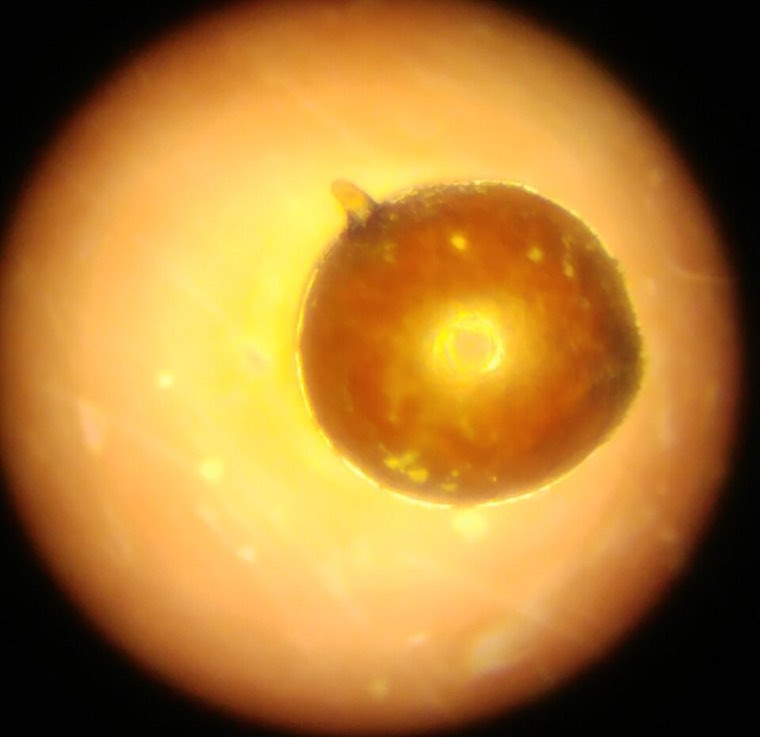
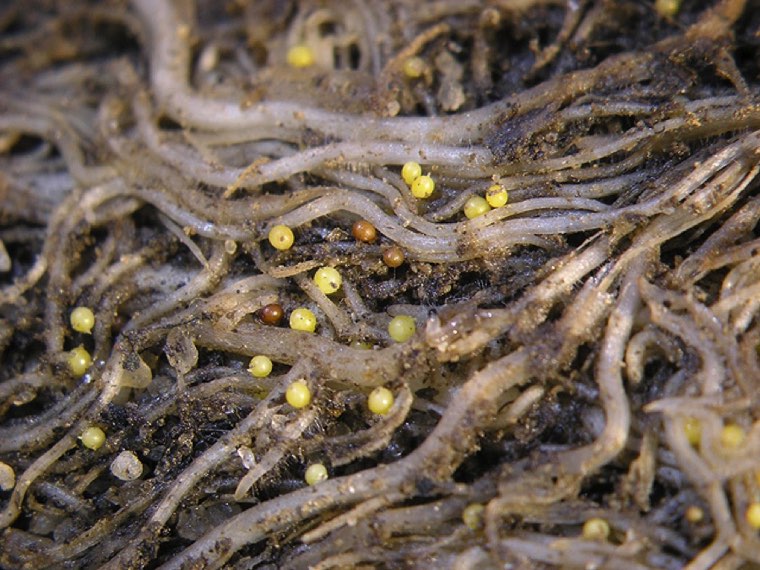
At flowering, tiny round females (about 0.5 mm) are visible on roots - white at first, turning golden-yellow (G. rostochiensis only) before becoming brown cysts; G. pallida females stay white or cream before turning brown. The brown cysts, each holding 200-500 eggs, fall into the soil. Species and pathotypes are identified in a laboratory.
| Crop stage | What you see |
|---|---|
| Emergence to early growth | Patches of slow, uneven emergence that enlarge in the direction of cultivation over the years. |
| Canopy development to flowering | Stunted plants with yellowing lower leaves that wilt in hot weather; dense, much-branched root systems; tiny white or golden females on the roots. |
| Harvest | Many small tubers and low yield in patches; brown cysts in soil attached to roots and tubers. |
Eggs inside cysts stay dormant until chemicals released by potato roots stimulate hatching. Juveniles invade roots, feed on specially induced cells and develop into females (which swell and break out of the root but stay attached) or males (which leave the root to mate). Fertilised females fill with eggs and die, becoming cysts. Only one generation develops per potato crop.
| Stage | Duration | Notes |
|---|---|---|
| Eggs in cysts in soil | Survive many years; declining about 20-30% a year without a host | Hatch stimulated by potato root exudates. |
| Juveniles invade roots | Early in the crop | Second-stage juveniles. |
| Development in roots | About 6-8 weeks | Females swell on the root surface. |
| Cyst formation | By crop maturity | New cysts return to the soil. |
Juveniles hatch and invade at soil temperatures above about 10 °C; G. pallida is adapted to slightly cooler conditions than G. rostochiensis.
One generation per potato crop.
Short rotations with frequent potato crops, movement of soil on seed tubers, machinery and boots, and growing susceptible varieties repeatedly.
There is no single numeric economic threshold that applies everywhere. In most regions the nematodes are regulated: official soil testing is required for land used to produce seed potatoes, and any finding restricts its use. For ware potatoes, advisory services use pre-plant egg counts from soil samples, combined with variety tolerance and rotation, to estimate expected loss.
Thresholds are local. They depend on crop price, control cost, variety and natural-enemy activity, so use the figure your local extension service publishes where one exists.
Heavy infestations can halve yields or cause even larger losses, and repeated susceptible cropping can make land uneconomic for potatoes. Restrictions on seed potato production and trade add further costs.
Control works best as a sequence: prevent, monitor, then act only when a threshold or a risk forecast says so, using the least disruptive option that works.
Nematicides and soil fumigants have been used in some regions but are increasingly restricted; they reduce, not eliminate, populations and must be part of an integrated plan. What is registered differs by country and changes over time; follow the label and your local plant-protection authority.
| Scheme | Group | Mode of action | Notes |
|---|---|---|---|
| IRAC | N-1 | Acetylcholinesterase inhibitors (nematicide group) | Granular uses; many withdrawn. |
| IRAC | N-3 | Mitochondrial complex II electron transport inhibitors (nematicide group) | Newer group where registered. |
| IRAC | N-UNX | Presumed multi-site inhibitors (fumigants) | Licensed operators only. |
Potato is the main host; tomato, eggplant and some wild Solanum species are also hosts. Hosts outside the nightshade family are not known.
How to grow the crop well is the first line of defence. Laisha's free grow guides cover each crop from sowing to harvest:
Written by Laisha from the sources above, in its own words. This page is general reference, not a prescription: confirm identification locally and follow the label and your plant-protection authority.