 Laisha
AI Operating System for Agriculture
Ask Laisha
Laisha
AI Operating System for Agriculture
Ask Laisha
Phytophthora infestans (Mont.) de Bary, 1876 · formerly or also: Botrytis infestans
Late blight is the disease that caused the Irish potato famine in the 1840s, and it is still the most destructive disease of potato and a major disease of tomato worldwide. In cool, wet weather it can kill the foliage of a whole field within a week or two and rot the tubers. It spreads on the wind as microscopic sporangia, so management combines clean seed, forecasting and well-timed protection.
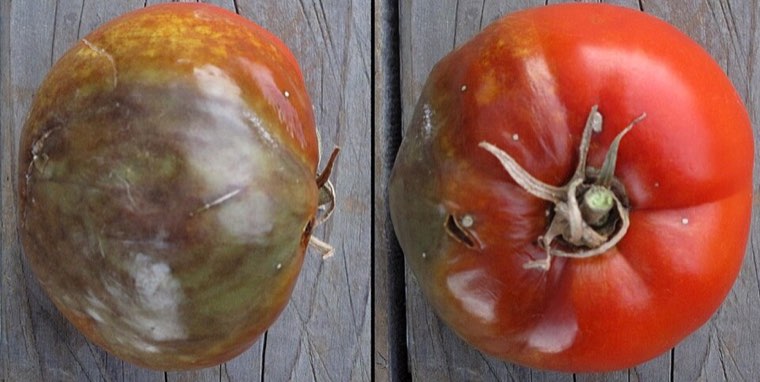
Late blight of potato and tomato is caused by Phytophthora infestans (Mont.) de Bary, 1876, an oomycete (water mould), not a true fungus (order Peronosporales, family Peronosporaceae).
Older or alternative scientific names: Botrytis infestans.
Originating in the Andes and central Mexico, the pathogen spread to North America and Europe in the 1840s and is now present wherever potatoes and tomatoes are grown. Since the 1980s, migrations of new genetic lineages, including the A2 mating type outside Mexico, have produced more aggressive and fungicide-resistant populations in many regions.
| Region | Status |
|---|---|
| Europe | Widespread; sexual reproduction occurs in some northern areas |
| Americas | Native to the Andes/Mexico; widespread |
| South and East Asia | Widespread in hill and plain potato and tomato crops |
| Sub-Saharan Africa | Widespread in highland potato and tomato zones |
| Oceania and the Middle East | Present |
Under humid conditions, a delicate white downy growth forms on the underside of leaves at the edge of lesions; under a microscope these are branched sporangiophores carrying lemon-shaped sporangia. The pathogen survives between seasons mainly in infected tubers (seed, culls and volunteers) and, where both mating types (A1 and A2) occur, as thick-walled oospores in the soil.
| Crop stage | What you see |
|---|---|
| Foliage (any stage, usually from canopy closure) | Pale green to dark brown, water-soaked spots, often at leaf tips and edges, that expand rapidly; white downy growth on the underside of lesion margins in humid mornings; a pale halo around lesions. |
| Stems and petioles | Dark brown to black lesions that girdle stems, causing them to collapse; whole plants can die within days. |
| Tubers (potato) | Irregular, slightly sunken reddish-brown to purplish patches on the skin; beneath, a granular reddish-brown rot extending into the flesh, often followed by soft rots in storage. |
| Fruit (tomato) | Firm, greasy, brown, mottled areas on green or ripening fruit, which later rot. |
Infection starts from infected seed tubers, cull piles, volunteers or airborne sporangia from other fields, or oospores in soil. In wet weather sporangia land on leaves and either release swimming zoospores (in cool conditions) or germinate directly (in warmer conditions). New lesions produce millions of sporangia within a few days, carried by wind to neighbouring plants and fields. Rain washes sporangia into the soil, where they infect tubers.
| Stage | Duration | Notes |
|---|---|---|
| Sporangia land on wet leaves | Needs leaf wetness of several hours | Wind-dispersed, survive a few hours in dry, sunny air. |
| Infection | A few hours at 10-25 °C with free water | Zoospores below about 15 °C; direct germination when warmer. |
| Lesion development (latent period) | About 3-5 days | Faster at about 18-22 °C. |
| Sporulation | Overnight when humidity exceeds about 90% | White down on lesion margins. |
| Tuber infection and survival | Through storage and the off-season | Infected tubers start next season's epidemic; oospores survive years in soil. |
Infection and sporulation occur from about 3 to 26 °C, with the most rapid epidemics at about 15-22 °C combined with long periods of high humidity or leaf wetness. Hot, dry weather (above about 30 °C) halts spread.
A new cycle every 3-5 days in favourable weather, giving dozens of cycles in a season.
Cool to mild temperatures with long periods of high humidity (above 90%), fog, dew or rain; dense canopies; infected seed tubers and cull piles nearby; and susceptible varieties. Forecast systems use such 'blight weather' to time protection.
There is no numeric economic threshold based on disease levels, because the disease can go from first lesion to field loss within days. Action is triggered by risk forecasts and first detection nearby. Common forecast rules include the Hutton Criteria in the UK (two consecutive days with minimum temperature of at least 10 °C and at least six hours each day with relative humidity of 90% or more) and models such as BlightCast, SimCast and others that combine weather and variety resistance.
Thresholds are local. They depend on crop price, control cost, variety and natural-enemy activity, so use the figure your local extension service publishes where one exists.
Uncontrolled epidemics destroy the foliage and can cause total loss of yield, plus tuber rot in store. Globally, losses and control costs together are estimated at several billion US dollars a year, and the disease is a major reason for heavy fungicide use in potato.
Control works best as a sequence: prevent, monitor, then act only when a threshold or a risk forecast says so, using the least disruptive option that works.
Protective fungicides must be on the foliage before infection, and the interval is shortened in high-risk weather; systemic groups are mixed or alternated with multi-site protectants. What is registered differs by country and changes over time; follow the label and your local plant-protection authority.
| Scheme | Group | Mode of action | Notes |
|---|---|---|---|
| FRAC | M03 | Dithiocarbamates and relatives (multi-site contact) | Protectant; low resistance risk. |
| FRAC | M05 | Chloronitriles (multi-site contact) | Protectant. |
| FRAC | 4 | Phenylamides (RNA polymerase I) | Systemic; resistance widespread, use only in mixtures and early. |
| FRAC | 40 | Carboxylic acid amides (CAA; cellulose synthase) | Translaminar; medium resistance risk. |
| FRAC | 49 | Oxysterol binding protein inhibitors (OSBPI) | Systemic; high resistance risk. |
| FRAC | 21 | Quinone inside inhibitors (QiI) | Protectant. |
| FRAC | 27 | Cyanoacetamide-oximes | Short curative action; always in mixtures. |
| FRAC | 43 | Pyridinylmethyl-benzamides | Used in mixtures. |
| FRAC | 29 | Uncouplers of oxidative phosphorylation | Protectant; also tuber blight. |
Potato and tomato are the main hosts. Some other members of the nightshade family, such as pepino and wild Solanum species (for example hairy nightshade), can be infected; populations differ in how well they attack potato versus tomato.
How to grow the crop well is the first line of defence. Laisha's free grow guides cover each crop from sowing to harvest:
Written by Laisha from the sources above, in its own words. This page is general reference, not a prescription: confirm identification locally and follow the label and your plant-protection authority.