 Laisha
AI Operating System for Agriculture
Ask Laisha
Laisha
AI Operating System for Agriculture
Ask Laisha
Streptomyces scabiei Streptomyces scabiei (ex Thaxter 1891) Lambert & Loria 1989; also S. acidiscabies, S. turgidiscabies, S. europaeiscabiei and others · formerly or also: Streptomyces scabies
Common scab covers potato skins with rough, corky lesions that may be flat, raised or deeply pitted. It is caused by soil bacteria of the genus Streptomyces, which produce a plant toxin (thaxtomin) and infect young tubers through their breathing pores. It rarely reduces yield much, but scabby tubers lose value as table potatoes and for processing, and scab is a common reason for seed lots being downgraded.
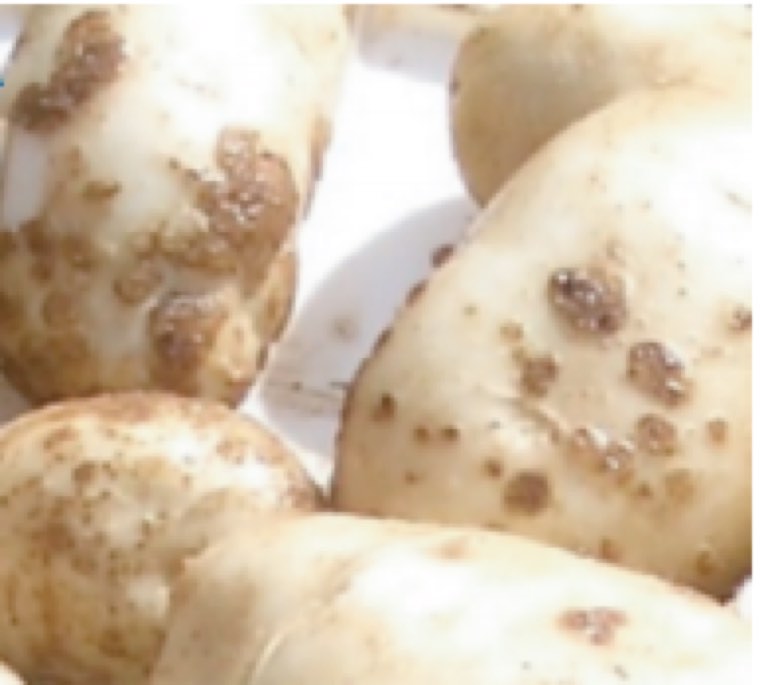
Common scab of potato is caused by Streptomyces scabiei Streptomyces scabiei (ex Thaxter 1891) Lambert & Loria 1989; also S. acidiscabies, S. turgidiscabies, S. europaeiscabiei and others, a bacterium (filamentous soil actinobacterium) (order Kitasatosporales (formerly Streptomycetales), family Streptomycetaceae).
Older or alternative scientific names: Streptomyces scabies.
Found in potato-growing soils worldwide; worst in light, well-aerated, neutral to alkaline soils and in dry seasons.
| Region | Status |
|---|---|
| Europe and North America | Widespread |
| Asia | Widespread |
| Africa and Latin America | Widespread |
| Oceania | Widespread |
Thread-like bacteria that grow in soil and form chains of spores, giving the earthy smell of soil. Pathogenic strains carry genes for thaxtomin, which damages growing plant cells. Different species tolerate different soil acidity: S. scabiei is held back in acid soils, while S. acidiscabies can cause 'acid scab' even at low pH.
| Crop stage | What you see |
|---|---|
| Young tubers | Small brown, slightly raised spots around lenticels a few weeks after tubers start to form. |
| Maturing tubers | Lesions expand into rough, corky patches - flat (russet), raised, or pitted up to several millimetres deep; they may merge to cover much of the tuber. |
| Roots and other crops | Foliage looks normal; on beet, radish and carrot, similar corky lesions appear on the roots. |
The bacteria live for many years in soil and on plant debris, and are also carried on seed tubers. They infect young tubers through lenticels during the first weeks after tubers begin to form; mature skins are no longer infected. Lesions continue to expand as the tuber grows, and scabby tubers return the bacteria to the soil.
| Stage | Duration | Notes |
|---|---|---|
| Survival in soil and on seed | Many years | Builds up with frequent potato crops. |
| Infection of young tubers | About 2-6 weeks after tuber initiation | Through lenticels; the critical period. |
| Lesion expansion | Until harvest | Lesion type varies with strain and variety. |
| Return to soil | At harvest | From scabby tubers and debris. |
Scab is favoured by warm soil (about 20-30 °C) and especially by dry soil during tuber initiation, when the bacteria face less competition at the tuber surface.
One infection period per crop, during early tuber growth.
Dry soil during tuber initiation; soil pH above about 5.2; light sandy or gravelly soils; recent liming or fresh manure; and short rotations with potato or other hosts.
There is no field threshold; markets and seed certification schemes set tolerances for the share of tuber surface covered by scab, which differ between countries and buyers.
Thresholds are local. They depend on crop price, control cost, variety and natural-enemy activity, so use the figure your local extension service publishes where one exists.
Mostly a quality loss: scabby tubers are downgraded or rejected for table and seed markets and need deeper peeling for processing; deep pitted scab causes the greatest losses.
Control works best as a sequence: prevent, monitor, then act only when a threshold or a risk forecast says so, using the least disruptive option that works.
No chemical reliably controls common scab in the field; seed and soil treatments are registered in some countries but give inconsistent results. What is registered differs by country and changes over time; follow the label and your local plant-protection authority.
Potato is the main host; scab also affects beet, carrot, radish, turnip, parsnip and groundnut pods.
How to grow the crop well is the first line of defence. Laisha's free grow guides cover each crop from sowing to harvest:
Written by Laisha from the sources above, in its own words. This page is general reference, not a prescription: confirm identification locally and follow the label and your plant-protection authority.