 Laisha
AI Operating System for Agriculture
Ask Laisha
Laisha
AI Operating System for Agriculture
Ask Laisha
Leptinotarsa decemlineata (Say, 1824) · formerly or also: Doryphora decemlineata
A striped yellow-and-black beetle whose humpbacked red larvae can strip potato fields of leaves in a few weeks. Originally a beetle of wild nightshades in Mexico and the western United States, it shifted to potato in the nineteenth century and spread across North America, Europe and Central Asia. It is famous for evolving resistance to almost every insecticide used against it, so rotation, cultural control and biological options matter.
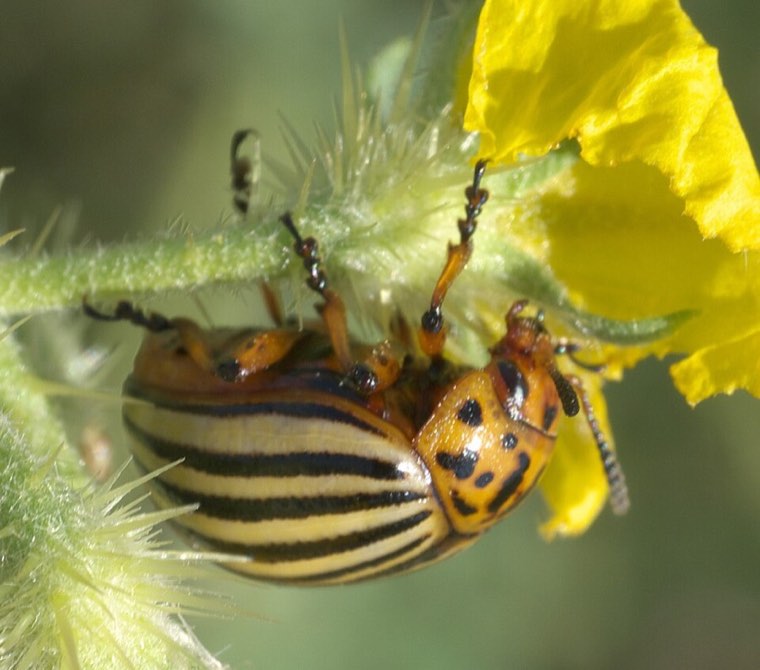
The scientific name of Colorado potato beetle is Leptinotarsa decemlineata (Say, 1824), in the order Coleoptera, family Chrysomelidae.
Older or alternative scientific names: Doryphora decemlineata.
Native to northern Mexico and the south-western United States. It reached potato fields in the US Midwest in the 1850s, Europe in the 1920s (via France), and has since spread across most of Europe, Russia, Central Asia, the Middle East and north-western China. It is absent from South America, Africa south of the Sahara, Australia, New Zealand and most of South and East Asia, and is a quarantine pest in several of those regions.
| Region | Status |
|---|---|
| North America | Native or long established; key potato pest |
| Europe | Invasive since the 1920s; widespread except in some islands and the far north |
| Eastern Europe and Central Asia | Widespread |
| Middle East and western China | Invasive; spreading east |
| Southern Hemisphere and most of South and East Asia | Absent; regulated |
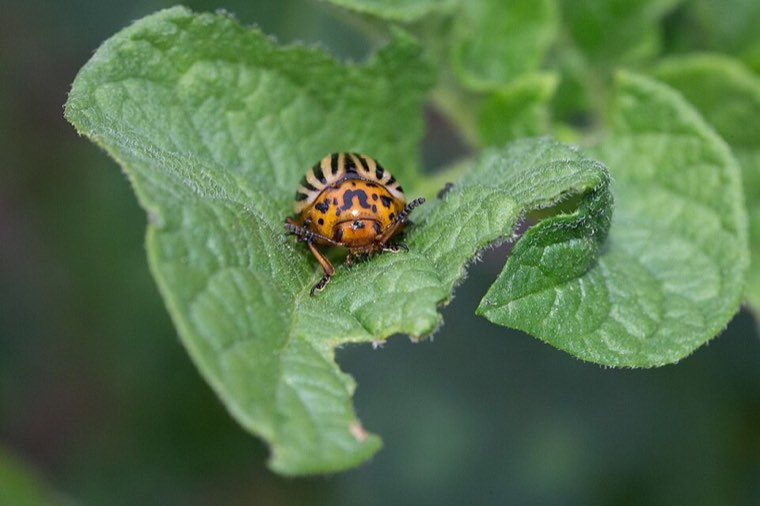
Adults are about 10 mm long, oval and strongly domed; the yellowish wing covers carry ten black stripes (five on each), and the orange thorax has black spots. Eggs are bright yellow-orange, laid upright in clusters of about 20-60 on leaf undersides. Larvae are soft, humpbacked, brick-red to orange, with a black head and two rows of black spots along each side; they grow to about 15 mm.
| Crop stage | What you see |
|---|---|
| Emergence and early growth | Overwintered adults feeding on young shoots; orange egg clusters under leaves; ragged holes in leaves near field edges first. |
| Canopy development to flowering | Larvae eating leaves from the edges inward, leaving only stems and veins; black excrement on leaves. |
| Tuber bulking | Heavy defoliation reduces tuber size; summer generation adults feed on remaining foliage. |
Adults spend the winter in diapause in the soil, mostly in and around fields where potatoes grew. They emerge in spring, walk or fly to new crops, and lay several hundred eggs each. Larvae pass through four instars and then pupate in the soil. Summer adults may lay a second generation or, in short days, feed and dig in for winter.
| Stage | Duration | Notes |
|---|---|---|
| Egg cluster | About 4-9 days | Under leaves; bright yellow-orange. |
| Larva (4 instars) | About 2-3 weeks | The last two instars eat most of the foliage. |
| Pupa in soil | About 1-2 weeks | A few centimetres deep. |
| Adult (overwinters in soil) | Can live a year or more | Strong walker; flies on warm days; diapause triggered by short days. |
Development runs from a lower threshold of about 10-12 °C; egg to adult takes about 3-4 weeks in warm weather. Diapausing adults survive soil temperatures down to about -7 °C, which limits their spread into very cold regions.
1-3 generations a year depending on the length of the warm season; one in cool northern regions.
Potatoes planted in or next to last year's potato or eggplant field; warm, dry summers; long growing seasons; and repeated use of the same insecticide group.
There is no single agreed numeric threshold. Potato tolerates moderate leaf loss early and late in the season but is sensitive around flowering and early tuber bulking. Extension services publish local thresholds based on defoliation or on numbers of adults and large larvae per plant, which differ between regions; use the local figure.
Thresholds are local. They depend on crop price, control cost, variety and natural-enemy activity, so use the figure your local extension service publishes where one exists.
Uncontrolled populations can completely defoliate potato and eggplant; complete defoliation during tuber bulking can reduce yield by more than half. Losses depend mainly on how much leaf area is lost at the crop's most sensitive stage.
Control works best as a sequence: prevent, monitor, then act only when a threshold or a risk forecast says so, using the least disruptive option that works.
Target small larvae and avoid treating the whole field when only edges are infested. What is registered differs by country and changes over time; follow the label and your local plant-protection authority.
| Scheme | Group | Mode of action | Notes |
|---|---|---|---|
| IRAC | 5 | Nicotinic acetylcholine receptor allosteric modulators, site I (spinosyns) | Larvicide; resistance reported in some areas. |
| IRAC | 28 | Ryanodine receptor modulators (diamides) | Larvicide. |
| IRAC | 4A | Nicotinic acetylcholine receptor competitive modulators (neonicotinoids) | Resistance widespread in parts of North America. |
| IRAC | 15 | Inhibitors of chitin biosynthesis, CHS1 (benzoylureas) | Acts on eggs and larvae. |
| IRAC | 11A | Bacillus thuringiensis (beetle-active strains) | Biological; small larvae. |
Restricted to plants of the nightshade family. Potato is the main host; eggplant and tomato are also damaged, and wild Solanum species (buffalo bur, horse nettle, black nightshade) and tobacco support populations.
How to grow the crop well is the first line of defence. Laisha's free grow guides cover each crop from sowing to harvest:
Written by Laisha from the sources above, in its own words. This page is general reference, not a prescription: confirm identification locally and follow the label and your plant-protection authority.