 Laisha
AI Operating System for Agriculture
Ask Laisha
Laisha
AI Operating System for Agriculture
Ask Laisha
Phthorimaea operculella (Zeller, 1873) · formerly or also: Gnorimoschema operculella
The potato tuber moth is a small grey moth whose caterpillars mine potato leaves in the field and, more seriously, bore into tubers in the soil and in storage. Infested tubers fill with tunnels and frass and rot, and in warm countries farm stores can be almost completely destroyed within a few months. It occurs in nearly every warm potato-growing region; it is a close relative of the tomato leaf miner.
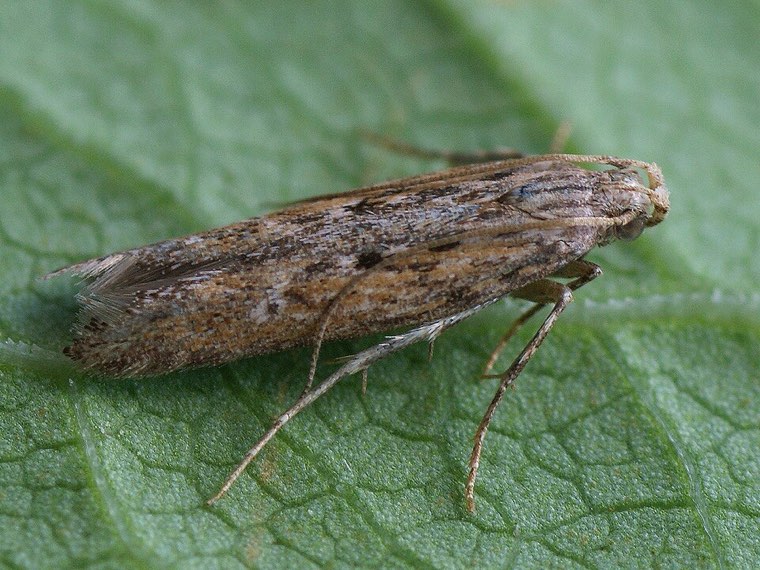
The scientific name of potato tuber moth is Phthorimaea operculella (Zeller, 1873), in the order Lepidoptera, family Gelechiidae.
Older or alternative scientific names: Gnorimoschema operculella.
Native to South America, it spread with potatoes to warm temperate, subtropical and tropical regions worldwide: the Mediterranean, the Middle East, Africa, South and East Asia, Australia and the Americas. Related species (Tecia solanivora, Symmetrischema tangolias) are important in the Andes.
| Region | Status |
|---|---|
| Americas | Native to South America; widespread |
| Mediterranean, Middle East and North Africa | Widespread; major storage pest |
| Sub-Saharan Africa | Widespread in potato areas |
| South and East Asia | Widespread |
| Oceania | Present |
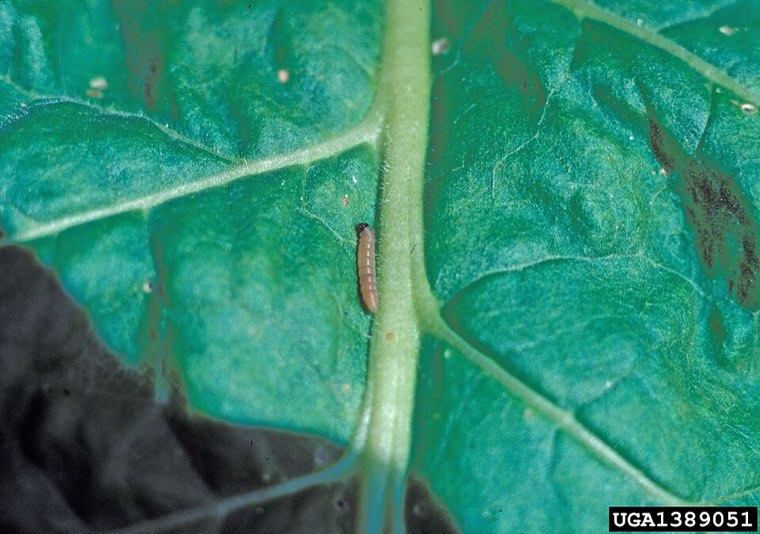
Moths are about 1 cm long, narrow, grey-brown with small dark spots and fringed wings. Eggs are tiny and laid singly on leaves, on exposed tubers and in tuber eyes. Larvae are pale to pinkish or greenish with a dark head, up to about 1-1.5 cm.
| Crop stage | What you see |
|---|---|
| Vegetative growth | Blotch mines in leaves and tunnels in petioles and stems; leaves folded or webbed. |
| Tuber formation and harvest | Larvae enter tubers exposed through soil cracks or shallow planting; small holes near the eyes with frass. |
| Storage | Tubers riddled with tunnels filled with frass, often with secondary rots; infestation spreads from tuber to tuber. |
Females lay eggs on foliage and on tubers exposed at the soil surface or in store. Larvae mine leaves or bore into tubers, then pupate in silk cocoons on tubers, in soil or in store debris. The cycle continues in storage, so moths emerge from stores to infest new crops.
| Stage | Duration | Notes |
|---|---|---|
| Egg | About 3-7 days | Laid singly. |
| Larva (4 instars) | About 2-3 weeks | Leaf mines or tuber tunnels. |
| Pupa | About 1-2 weeks | In a silk cocoon. |
| Adult moth | About 1-2 weeks | Nocturnal; attracted to sex pheromone and light. |
A generation takes about 3-4 weeks at 25-30 °C and much longer in cool conditions; development stops below about 10 °C, so cool storage greatly reduces damage.
Several to many generations a year in warm climates, continuing in storage.
Warm, dry weather; cracked soils and shallow tubers; delayed harvest; tubers left exposed in the field overnight; and warm, unprotected farm stores.
There is no internationally agreed numeric threshold; pheromone-trap catches are used to judge risk before harvest, and in storage any infestation spreads, so tubers are protected from the start.
Thresholds are local. They depend on crop price, control cost, variety and natural-enemy activity, so use the figure your local extension service publishes where one exists.
Losses in farm stores in warm regions can reach 50-100% of stored tubers over several months; field losses come from tuber infestation at harvest and from leaf mining in hot, dry seasons.
Control works best as a sequence: prevent, monitor, then act only when a threshold or a risk forecast says so, using the least disruptive option that works.
Field sprays target adults and young larvae before harvest when traps show high activity; storage treatments must be registered for food use. What is registered differs by country and changes over time; follow the label and your local plant-protection or food-safety authority.
| Scheme | Group | Mode of action | Notes |
|---|---|---|---|
| IRAC | 31 | Baculoviruses (granulovirus) | Storage dust where registered. |
| IRAC | 11A | Bacillus thuringiensis | Biological; young larvae. |
| IRAC | 3A | Sodium channel modulators (pyrethroids) | Field sprays where registered. |
Potato is the main host; tomato, eggplant, pepper, tobacco and solanaceous weeds are also attacked, mostly on leaves.
How to grow the crop well is the first line of defence. Laisha's free grow guides cover each crop from sowing to harvest:
Written by Laisha from the sources above, in its own words. This page is general reference, not a prescription: confirm identification locally and follow the label and your plant-protection authority.