 Laisha
AI Operating System for Agriculture
Ask Laisha
Laisha
AI Operating System for Agriculture
Ask Laisha
Potato leafroll virus ICTV species: Polerovirus PLRV (genus Polerovirus) · formerly or also: PLRV
Potato leafroll virus makes the lower leaves of potato plants roll upward, become stiff and leathery, and turn pale; infected plants are stunted and give small tubers, and some varieties develop brown net necrosis inside the tubers. It lives only in the plant's phloem and is carried mainly by the green peach aphid, which keeps it for life. It was the main reason for seed-potato degeneration for most of the twentieth century.
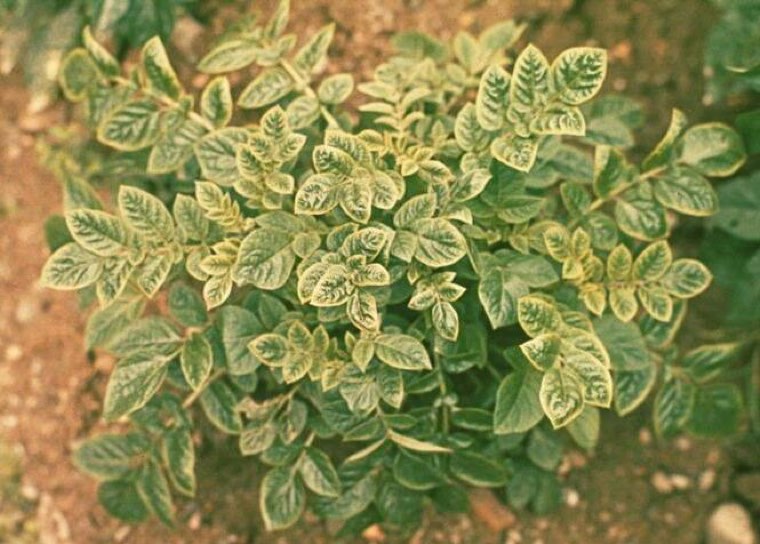
Potato leafroll virus is caused by Potato leafroll virus, a virus (polerovirus with an RNA genome), spread by aphids and seed tubers (order Sobelivirales, family Solemoviridae).
Older or alternative scientific names: PLRV.
Present in potato-growing regions worldwide; its importance has fallen in regions with strong seed certification and aphid control, and remains high where farmers replant their own seed.
| Region | Status |
|---|---|
| Europe and North America | Present; controlled by seed certification |
| South and East Asia | Widespread |
| Africa and Latin America | Widespread; important in farmer-saved seed |
| Oceania | Present |
A small icosahedral RNA virus confined to the phloem, detected by ELISA or RT-PCR. It is transmitted by aphids in a persistent, circulative way: aphids (mainly Myzus persicae) need to feed for minutes to hours to acquire it, and after a latent period remain infective for life. It is not spread mechanically. Because the virus stays in the phloem, it is not spread by hands, tools or contact between plants, unlike some other potato viruses.
| Crop stage | What you see |
|---|---|
| Plants grown from infected tubers (secondary infection) | Lower leaves roll upward, become stiff, leathery and rattle when shaken; plants upright, pale and stunted; small tubers. |
| Current-season infection (primary infection) | Upper young leaves roll and turn pale or reddish at the margins. |
| Tubers | Brown net-like necrosis in the vascular tissue of tubers in susceptible varieties, which lowers quality. |
Infected seed tubers and volunteers provide the virus. Colonising aphids acquire it by feeding, and after a latent period of about a day carry it to new plants for the rest of their lives. The virus moves to tubers, which carry it to the next crop.
| Stage | Duration | Notes |
|---|---|---|
| Infected seed tuber or volunteer | Between seasons | Main source. |
| Aphid acquisition | Minutes to hours of feeding | Persistent, circulative. |
| Latent period in the aphid | About 12-24 hours | Then infective for life. |
| Translocation to tubers | Weeks | Carried into the next season. |
Spread follows aphid colonisation, which is greatest in warm weather; cool climates with few aphids (highlands, northern regions) are used for seed production.
Spread during aphid activity; carry-over through tubers.
Farmer-saved seed used repeatedly, high populations of colonising aphids, volunteer potatoes, and susceptible varieties.
There is no aphid-count threshold in general use; seed certification schemes set maximum tolerated levels of leafroll in seed lots, set nationally. Because transmission needs aphids to feed for some time, controlling colonising aphids in seed crops reduces spread, timed by monitoring.
Thresholds are local. They depend on crop price, control cost, variety and natural-enemy activity, so use the figure your local extension service publishes where one exists.
Plants grown from infected tubers may yield 50% less or more; net necrosis reduces tuber quality; infected seed lots are downgraded.
Control works best as a sequence: prevent, monitor, then act only when a threshold or a risk forecast says so, using the least disruptive option that works.
Because the virus is transmitted persistently by colonising aphids, insecticides against aphids can reduce spread in seed crops. What is registered differs by country and changes over time; follow the label and your local plant-protection authority.
| Scheme | Group | Mode of action | Notes |
|---|---|---|---|
| IRAC | 9B | Chordotonal organ TRPV channel modulators, against aphid vectors | Feeding inhibitor. |
| IRAC | 4D | Nicotinic acetylcholine receptor competitive modulators (butenolides), against aphid vectors | Check local resistance. |
| IRAC | 23 | Inhibitors of acetyl CoA carboxylase, against aphid vectors | Systemic. |
Potato is the main host; tomato and several solanaceous and other weeds (for example Physalis and Datura species) can be infected.
How to grow the crop well is the first line of defence. Laisha's free grow guides cover each crop from sowing to harvest:
Written by Laisha from the sources above, in its own words. This page is general reference, not a prescription: confirm identification locally and follow the label and your plant-protection authority.