 Laisha
AI Operating System for Agriculture
Ask Laisha
Laisha
AI Operating System for Agriculture
Ask Laisha
Cercospora sojina Cercospora sojina Hara, 1915 · formerly or also: Passalora sojina
Frogeye leaf spot is a fungal disease of soybean that causes small round spots with grey or tan centres and dark reddish-purple borders, like a frog's eye, mainly on the upper leaves. Heavy infection makes leaves drop early and reduces yield, and the fungus can infect stems, pods and seeds. Resistance to strobilurin (QoI) fungicides is now widespread in the United States, which has made variety choice even more important.
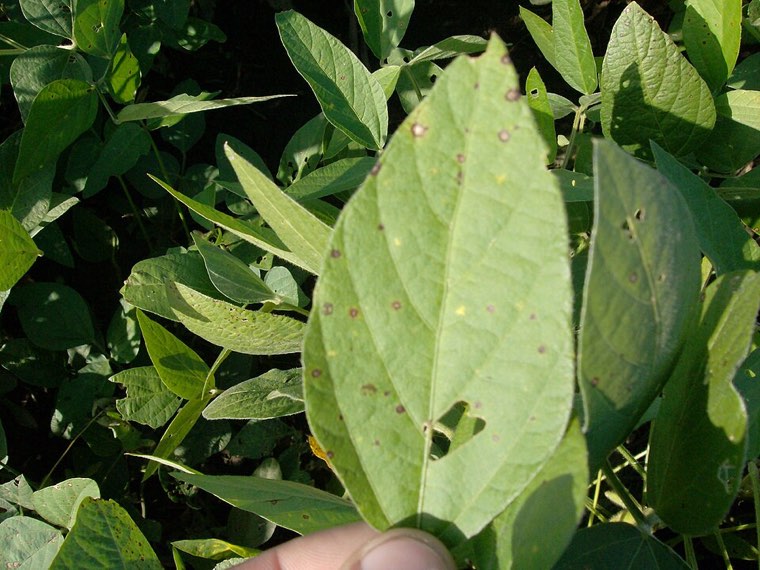
Frogeye leaf spot of soybean is caused by Cercospora sojina Cercospora sojina Hara, 1915, a fungus (ascomycete) (order Mycosphaerellales, family Mycosphaerellaceae).
Older or alternative scientific names: Passalora sojina.
Found in soybean-growing regions with warm, humid weather: the Americas (United States, Brazil, Argentina), East and South Asia and Africa.
| Region | Status |
|---|---|
| North America | Widespread; spreading north with warmer seasons |
| South America | Present |
| Asia | Present; important in China and India |
| Africa | Present |
A fungus that produces greyish spore-bearing structures in the centres of lesions, mostly on the undersides of leaves in humid weather. Many races exist, and populations reproduce sexually in some regions, which increases variability. Young, expanding leaves are the most susceptible, which is why symptoms are usually most obvious in the upper canopy.
| Crop stage | What you see |
|---|---|
| Leaves | Small water-soaked spots that become round to angular lesions 1-5 mm across, with light grey to tan centres and narrow dark reddish-purple to brown margins; lesions may merge and leaves drop. |
| Stems and pods | Elongated reddish lesions on stems and round to elongated sunken lesions on pods late in the season. |
| Seeds | Grey to brown discoloration and cracking of seed coats; infected seed can carry the fungus. |
The fungus survives on infested soybean residue and in seed. In warm, humid weather, spores are spread by wind and rain to new leaves. New lesions produce spores within about two weeks, so the disease builds up through the season, especially after flowering. Infected seed can carry the fungus to new areas. In no-till fields, residue left on the surface provides an early source of spores the following season.
| Stage | Duration | Notes |
|---|---|---|
| Survival on residue and seed | Between seasons | Main sources. |
| Leaf infection | During warm, wet periods | Young leaves most susceptible. |
| Lesion development and sporulation | About 2 weeks | Repeated cycles. |
| Pod and seed infection | Late season | Carries the fungus forward. |
Most severe in warm (about 25-30 °C), humid weather with frequent rain or dew.
Several cycles per season.
Continuous soybean with no-till residue, warm and humid weather during flowering and pod fill, susceptible varieties, and repeated use of QoI fungicides that select resistant strains. Late-planted soybean may face higher disease pressure where spores have already built up in earlier fields.
There is no numeric economic threshold; fungicide decisions consider variety susceptibility, field history, disease on upper leaves around early pod set, and weather.
Thresholds are local. They depend on crop price, control cost, variety and natural-enemy activity, so use the figure your local extension service publishes where one exists.
Yield losses of up to about 30% have been measured in susceptible varieties in favourable seasons, through early leaf drop and smaller seeds; infected seed lowers quality. Losses are greatest when the upper leaves are heavily spotted before the beginning of seed fill.
Control works best as a sequence: prevent, monitor, then act only when a threshold or a risk forecast says so, using the least disruptive option that works.
Foliar fungicides at early pod set protect susceptible varieties under favourable weather. QoI-resistant strains are widespread in the United States. What is registered differs by country and changes over time; follow the label and your local plant-protection authority.
| Scheme | Group | Mode of action | Notes |
|---|---|---|---|
| FRAC | 3 | Demethylation inhibitors (DMI) | Effective where QoI resistance occurs. |
| FRAC | 7 | Succinate dehydrogenase inhibitors (SDHI) | Usually in mixtures. |
| FRAC | 11 | Quinone outside inhibitors (QoI) | Resistance widespread; use only in mixtures where still effective. |
Soybean is the main host; a few other legumes have been reported as hosts.
How to grow the crop well is the first line of defence. Laisha's free grow guides cover each crop from sowing to harvest:
Written by Laisha from the sources above, in its own words. This page is general reference, not a prescription: confirm identification locally and follow the label and your plant-protection authority.