 Laisha
AI Operating System for Agriculture
Ask Laisha
Laisha
AI Operating System for Agriculture
Ask Laisha
Spodoptera litura (Fabricius, 1775) · formerly or also: Prodenia litura
A moth whose caterpillars hatch in clusters, skeletonise leaves together and then spread out to devour foliage, pods and fruit of a very wide range of crops across Asia and the Pacific. It feeds at night and hides in soil or the canopy by day, so heavy defoliation can appear almost overnight. It is notorious for resistance to many insecticide groups.
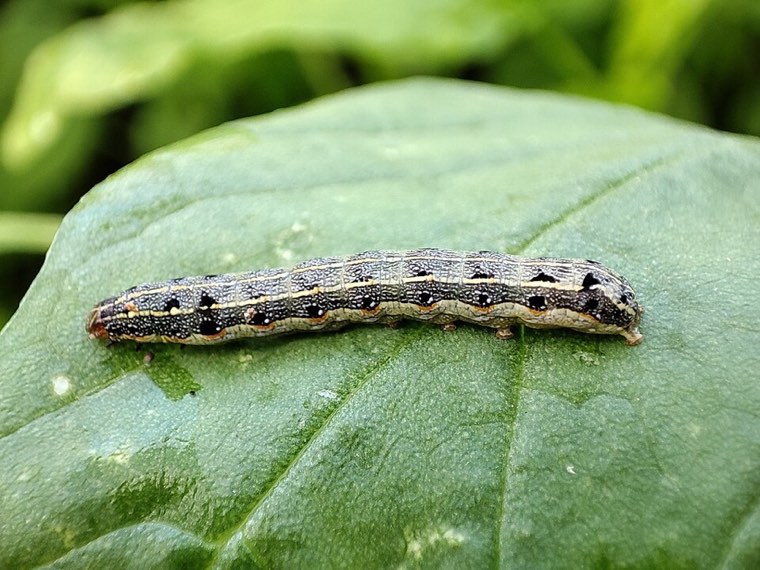
The scientific name of tobacco cutworm is Spodoptera litura (Fabricius, 1775), in the order Lepidoptera, family Noctuidae.
Older or alternative scientific names: Prodenia litura.
Widespread in tropical and subtropical Asia and Oceania, from Pakistan to Japan, Australia and the Pacific islands. In Africa, the Mediterranean and the Middle East the closely related Egyptian cotton leafworm, Spodoptera littoralis, occupies the same niche. It is regulated as a quarantine pest in Europe.
| Region | Status |
|---|---|
| South Asia | Native; major pest of soybean, groundnut, cotton, tobacco and vegetables |
| Southeast and East Asia | Native; major pest of vegetables, soybean and taro; migrates seasonally north |
| Oceania and the Pacific | Native or long established |
| Europe | Absent; regulated, intercepted on imported plants |
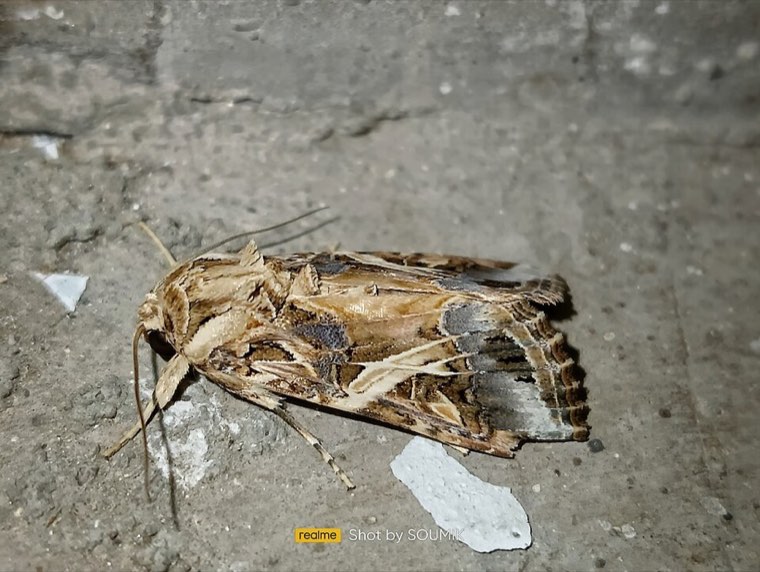
Eggs are laid in masses of a few hundred on leaf undersides, covered with golden-brown hair scales. Young larvae are pale green and feed in groups. Older larvae are greyish green to dark brown, up to about 4-5 cm, with a yellow line along the back and sides and a row of dark, triangular to half-moon marks along each side of the back; a dark band on the first abdominal segment is typical. The moth has a wingspan of about 3.5-4 cm; brown forewings carry a complex pattern of pale, oblique streaks, and the hindwings are whitish.
| Crop stage | What you see |
|---|---|
| Vegetative (egg hatch) | Groups of leaves with the green surface eaten away, leaving a papery, lace-like skeleton with veins intact. |
| Vegetative (older larvae) | Large irregular holes and complete defoliation, often in patches that spread across the field; larvae under soil clods or debris by day. |
| Flowering and pod/fruit set | Larvae feed on buds, flowers, pods and fruit; in groundnut they may attack pegs and pods near the surface. |
Each female lays roughly 1,000-2,000 eggs in several masses. Larvae pass through six instars and the final two cause most of the feeding. Pupation is in an earthen cell in the soil. There is no true diapause, so the pest breeds wherever winters allow and migrates into cooler areas in summer.
| Stage | Duration | Notes |
|---|---|---|
| Egg mass | About 3-4 days at 25-28 °C | Covered with hair scales. |
| Larva (6 instars) | About 15-20 days at 25-28 °C | Young larvae gregarious; older larvae solitary and nocturnal. |
| Pupa in soil | About 7-10 days | Reddish-brown pupa 1-3 cm deep. |
| Adult moth | About 1-2 weeks | Nocturnal; attracted to light and sex pheromone. |
Development is fastest at about 25-30 °C; a generation takes roughly a month in warm conditions and two or more months in cool weather. Prolonged cold below about 10 °C stops development.
Continuous, overlapping generations in the tropics (8 or more a year); fewer in temperate East Asia where populations are re-established by migration.
Warm, humid weather after rain, intensive vegetable and oilseed cropping with a succession of hosts, irrigation that keeps crops lush, and repeated broad-spectrum spraying that removes natural enemies and selects resistance.
There is no single internationally agreed numeric threshold. Programmes in South and East Asia use local action levels based on egg masses or larvae per plant or per metre of row, or a percentage of defoliation, which differ by crop and crop stage. The most effective trigger is finding egg masses and newly hatched groups and removing or treating them before larvae disperse.
Thresholds are local. They depend on crop price, control cost, variety and natural-enemy activity, so use the figure your local extension service publishes where one exists.
Defoliation reduces photosynthesis and yield, and feeding on pods, heads and fruit destroys produce directly. In soybean and groundnut outbreaks, losses of 25-50% have been reported in South and Southeast Asia; vegetable crops such as cabbage and cauliflower can be made unmarketable.
Control works best as a sequence: prevent, monitor, then act only when a threshold or a risk forecast says so, using the least disruptive option that works.
Target young larvae before they disperse; older larvae are far harder to kill. What is registered differs by country and changes over time; follow the label and your local plant-protection authority.
| Scheme | Group | Mode of action | Notes |
|---|---|---|---|
| IRAC | 28 | Ryanodine receptor modulators (diamides) | Reduced susceptibility reported in some Asian populations. |
| IRAC | 5 | Nicotinic acetylcholine receptor allosteric modulators, site I (spinosyns) | Larvicide. |
| IRAC | 6 | Glutamate-gated chloride channel allosteric modulators (avermectins) | Larvicide. |
| IRAC | 15 | Inhibitors of chitin biosynthesis, CHS1 (benzoylureas) | Act on moulting larvae. |
| IRAC | 31 | Baculoviruses | Nucleopolyhedrovirus products where registered. |
Recorded on well over 100 plant species in more than 40 families: cotton, soybean, groundnut, tobacco, castor, taro, sweet potato, brassicas, tomato, chilli, okra, lucerne, many ornamentals and weeds.
How to grow the crop well is the first line of defence. Laisha's free grow guides cover each crop from sowing to harvest:
Written by Laisha from the sources above, in its own words. This page is general reference, not a prescription: confirm identification locally and follow the label and your plant-protection authority.