 Laisha
AI Operating System for Agriculture
Ask Laisha
Laisha
AI Operating System for Agriculture
Ask Laisha
Nezara viridula, Euschistus heros and Piezodorus guildinii Nezara viridula (Linnaeus, 1758); Euschistus heros (Fabricius, 1798); Piezodorus guildinii (Westwood, 1837) · formerly or also: southern green stink bug (N. viridula), neotropical brown stink bug (E. heros), red-banded stink bug (P. guildinii)
Stink bugs pierce soybean pods and suck the developing seeds, which become shrivelled, deformed and spotted, with lower germination and oil quality; heavy feeding can also delay maturity and leave plants green at harvest. In Brazil the neotropical brown stink bug is the main soybean pest, while the southern green stink bug is found worldwide and the red-banded stink bug is important in the Americas. Several species usually attack together.
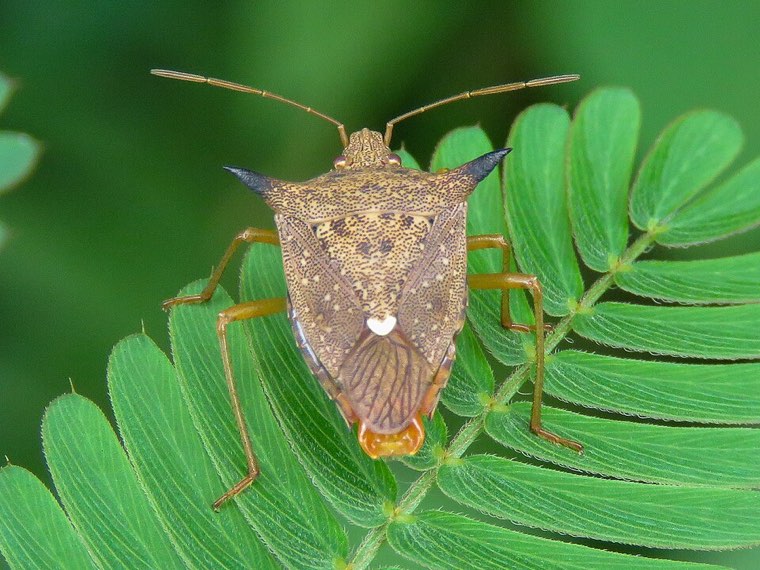
The scientific name of stink bugs of soybean is Nezara viridula, Euschistus heros and Piezodorus guildinii Nezara viridula (Linnaeus, 1758); Euschistus heros (Fabricius, 1798); Piezodorus guildinii (Westwood, 1837), in the order Hemiptera, family Pentatomidae.
Older or alternative scientific names: southern green stink bug (N. viridula), neotropical brown stink bug (E. heros), red-banded stink bug (P. guildinii).
The southern green stink bug is found on all continents in warm regions; the neotropical brown stink bug occurs in South America, especially Brazil and Paraguay; the red-banded stink bug occurs from the southern United States to Argentina.
| Region | Status |
|---|---|
| South America | All three species; major pests of soybean |
| North America | Southern green and red-banded stink bugs in the south |
| Africa, Asia, Europe and Oceania | Southern green stink bug widespread |
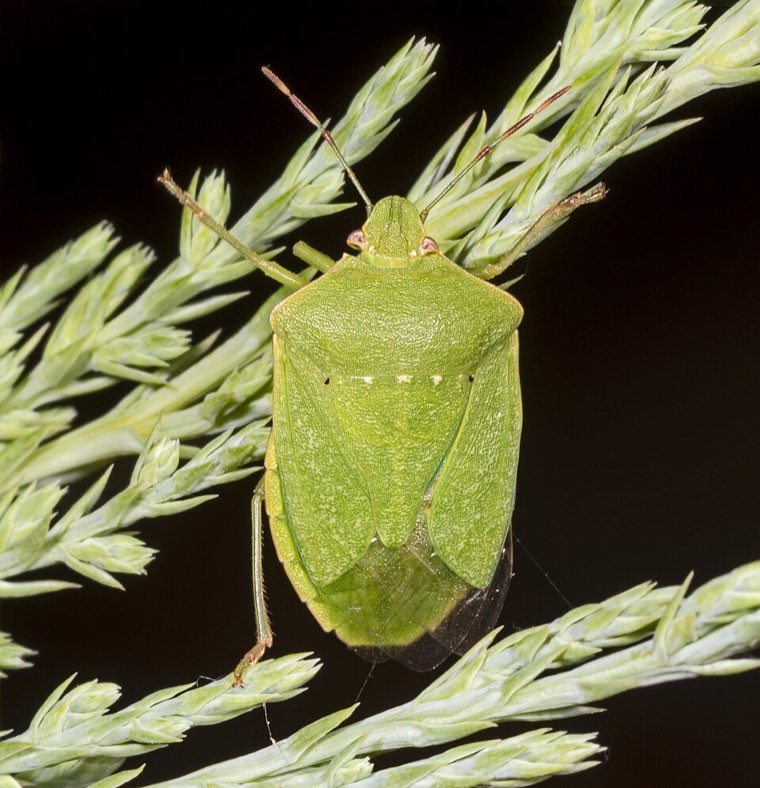
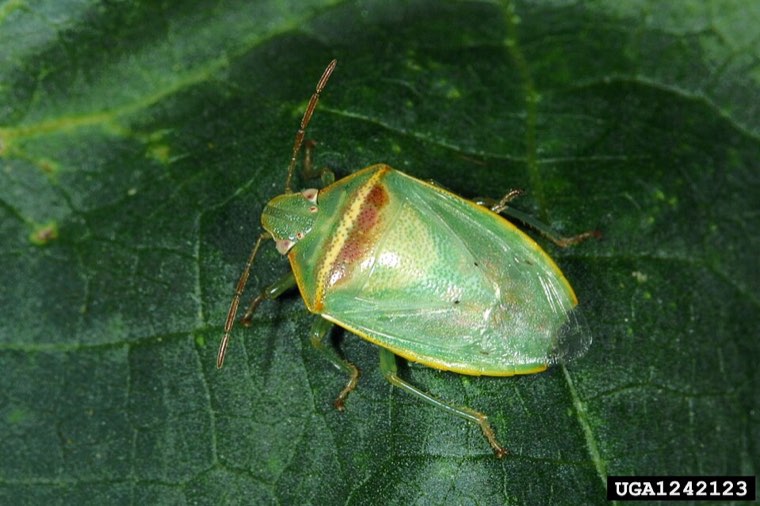
Southern green stink bug adults are about 12-15 mm long, bright green and shield-shaped. Neotropical brown stink bug adults are about 11 mm long, brown, with two spine-like points on the shoulders and a pale half-moon spot at the tip of the scutellum. Red-banded stink bugs are smaller (about 10 mm), green, with a red or pink band across the back. Eggs are barrel-shaped and laid in clusters; nymphs are rounded, often colourful, and pass through five instars.
| Crop stage | What you see |
|---|---|
| Pod formation and seed filling | Bugs on pods; feeding punctures on pods; pods abort or have few seeds. |
| Seeds | Shrivelled, wrinkled and deformed seeds with dark puncture spots; reduced germination and vigour. |
| Maturity | Plants stay green with retained leaves at harvest (delayed maturity) in heavily attacked fields. |
Adults move into soybean at flowering and pod formation and lay egg clusters on leaves and pods. Nymphs feed in groups at first, then spread out. Adults that develop late in the season move to other hosts or overwinter. In Brazil, neotropical brown stink bugs spend the off-season in diapause under crop residue and leaf litter, and return to the next soybean crop.
| Stage | Duration | Notes |
|---|---|---|
| Egg (clusters) | About 5-7 days | Barrel-shaped. |
| Nymph (5 instars) | About 3-5 weeks | Older nymphs feed on pods. |
| Adult | Several weeks to months | Overwinters or enters diapause. |
Development is fastest in warm weather; one generation takes about five to seven weeks.
Two to five generations per year depending on species and climate.
Warm climates with mild winters, large areas of soybean and successive crops (such as soybean followed by maize) that keep bugs in the landscape, crop residues for overwintering, and late-planted fields that attract bugs from earlier crops.
There is no single international threshold. Brazil and the United States use thresholds based on drop-cloth or sweep-net counts at pod formation and seed filling, with lower values for seed production and for the more damaging red-banded stink bug; check with your local extension service.
Thresholds are local. They depend on crop price, control cost, variety and natural-enemy activity, so use the figure your local extension service publishes where one exists.
Seed feeding reduces yield and seed quality and germination; seed lots for planting are most affected. Without control, losses can be large, and stink bugs are a major reason for insecticide use in South American soybean.
Control works best as a sequence: prevent, monitor, then act only when a threshold or a risk forecast says so, using the least disruptive option that works.
Sprays are applied when thresholds are reached during pod formation and seed filling. Resistance to some groups has been reported in neotropical brown stink bug populations. What is registered differs by country and changes over time; follow the label and your local plant-protection authority.
| Scheme | Group | Mode of action | Notes |
|---|---|---|---|
| IRAC | 3A | Sodium channel modulators (pyrethroids) | Often in mixtures; harmful to egg parasitoids. |
| IRAC | 4A | Nicotinic acetylcholine receptor competitive modulators (neonicotinoids) | Toxic to pollinators. |
| IRAC | 1B | Acetylcholinesterase inhibitors (organophosphates) | Highly toxic; resistance reported. |
Soybean and other legumes; the southern green stink bug feeds on a very wide range of crops, including beans, cotton, rice, sunflower, tomato, macadamia and pecan, and on weeds.
How to grow the crop well is the first line of defence. Laisha's free grow guides cover each crop from sowing to harvest:
Written by Laisha from the sources above, in its own words. This page is general reference, not a prescription: confirm identification locally and follow the label and your plant-protection authority.