 Laisha
AI Operating System for Agriculture
Ask Laisha
Laisha
AI Operating System for Agriculture
Ask Laisha
Amaranthus palmeri S. Watson, 1877
Palmer amaranth is a fast-growing pigweed that has become one of the most damaging and herbicide-resistant weeds in the world. It can grow several centimetres a day, reach over 2 m, and a single female plant can produce hundreds of thousands of seeds. Native to the south-western deserts of North America, it has spread through the cotton and soybean regions of the Americas and is a regulated alert-list weed in other regions.
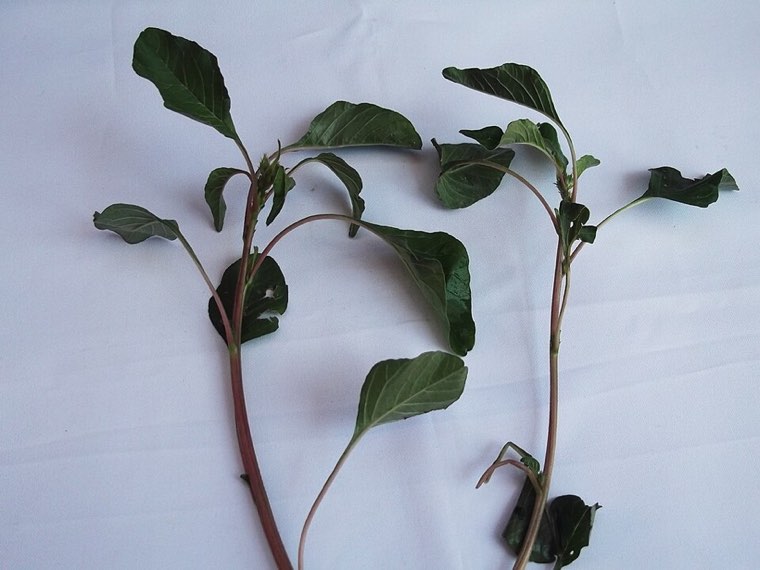
The scientific name of Palmer amaranth is Amaranthus palmeri S. Watson, 1877, in the order Caryophyllales, family Amaranthaceae.
Native to the south-western United States and northern Mexico. It spread across the southern and midwestern United States from the 1990s and has been found in South America (Argentina, Brazil from 2015), and introduced locally in parts of Europe, the Middle East, southern Africa and Asia, often with contaminated grain, seed or machinery. It is on the EPPO alert list and regulated in some countries.
| Region | Status |
|---|---|
| North America | Native in the south-west; invasive across much of the US |
| South America | Invasive in Argentina and Brazil |
| Europe and the Mediterranean | Occasional introductions; established locally in some areas |
| Middle East, Africa and Asia | Recorded locally; regulated in some countries |
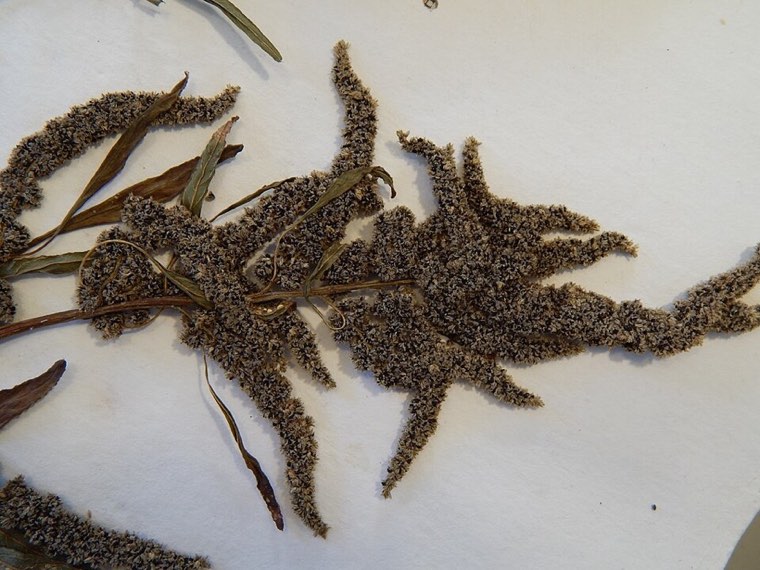
An upright, usually hairless annual, often 1-2 m tall or more, with diamond- to egg-shaped leaves arranged in a symmetrical, poinsettia-like rosette when young. A reliable sign: the leaf stalk (petiole) of older leaves is as long as or longer than the leaf blade. Some plants have a V-shaped white or purple 'watermark' on the leaf. Plants are either male or female; female seed heads are long (up to about 60 cm), dense and spiny to touch because of stiff bracts.
| Crop stage | What you see |
|---|---|
| Crop emergence | Flushes of hairless amaranth seedlings, with emergence continuing over many weeks. |
| Crop vegetative growth | Weeds outgrowing and shading the crop within a few weeks; very fast stem growth. |
| Crop maturity and harvest | Tall weeds with long seed heads above the canopy; thick stems interfering with harvest machinery. |
Seeds germinate in flushes from late spring through summer, mostly from the top centimetre or two of soil. Plants grow very fast in heat, and male and female plants must cross-pollinate (by wind), which spreads resistance genes through pollen as well as seed. Female plants shed huge numbers of small seeds that persist in soil for several years.
| Stage | Duration | Notes |
|---|---|---|
| Seed in soil | Several years; most die within about 3-4 years | Shallow seeds germinate best. |
| Emergence | Over many weeks of the warm season | Continuous flushes. |
| Rapid growth | About 4-8 weeks | Can grow several centimetres a day. |
| Flowering and seed production | From about 6-8 weeks after emergence | Hundreds of thousands of seeds per female plant. |
A C4 plant favoured by high temperatures (about 25-35 °C) and full sun; tolerant of drought.
One main generation a year, with staggered emergence.
Reduced tillage that leaves seeds near the surface, wide crop rows that close late, reliance on a single herbicide group, and spread through contaminated seed, feed, manure, cotton gin trash and machinery.
There is no tolerated threshold in practice: because one female plant can add hundreds of thousands of seeds to the soil, extension services recommend zero tolerance of plants going to seed ('zero seed rain'), and early control of every flush.
Thresholds are local. They depend on crop price, control cost, variety and natural-enemy activity, so use the figure your local extension service publishes where one exists.
Competition studies in North America report yield losses of up to about 65-80% in soybean and cotton and over 90% in maize at high densities; harvest is also slowed or prevented by large weeds.
Control works best as a sequence: prevent, monitor, then act only when a threshold or a risk forecast says so, using the least disruptive option that works.
Programmes rely on overlapping residual pre-emergence herbicides plus timely post-emergence applications on weeds under about 10 cm, using several effective groups. What is registered differs by country and changes over time; follow the label and your local plant-protection authority.
| Scheme | Group | Mode of action | Notes |
|---|---|---|---|
| HRAC | 15 | Inhibition of very-long-chain fatty acid synthesis (VLCFA) | Residual pre-emergence; layered. |
| HRAC | 14 | Inhibition of protoporphyrinogen oxidase (PPO) | Pre- and post-emergence; resistance documented. |
| HRAC | 5 | Inhibition of photosynthesis at photosystem II (serine 264 binders) | Residual in some crops. |
| HRAC | 10 | Inhibition of glutamine synthetase | Post-emergence in tolerant crops; resistance reported. |
| HRAC | 27 | Inhibition of hydroxyphenyl pyruvate dioxygenase (HPPD) | Maize and tolerant crops. |
| HRAC | 4 | Auxin mimics | Tolerant crops; resistance reported. |
As a weed it infests soybean, cotton, maize, groundnut, sorghum, vegetables and field margins, especially in warm summer cropping systems.
How to grow the crop well is the first line of defence. Laisha's free grow guides cover each crop from sowing to harvest:
Written by Laisha from the sources above, in its own words. This page is general reference, not a prescription: confirm identification locally and follow the label and your plant-protection authority.