 Laisha
AI Operating System for Agriculture
Ask Laisha
Laisha
AI Operating System for Agriculture
Ask Laisha
Rhynchophorus ferrugineus (Olivier, 1790) · formerly or also: Rhynchophorus vulneratus (now usually treated as the same species)
A large reddish weevil whose fat white grubs tunnel unseen through the trunk and crown of palms until the crown collapses. Native to tropical Asia, it spread with the trade in young palms to the date-growing regions of the Middle East and North Africa, the Mediterranean and the Caribbean, and is now the most destructive pest of date palm and ornamental palms. By the time symptoms are obvious the palm is often beyond saving, so early detection is everything.
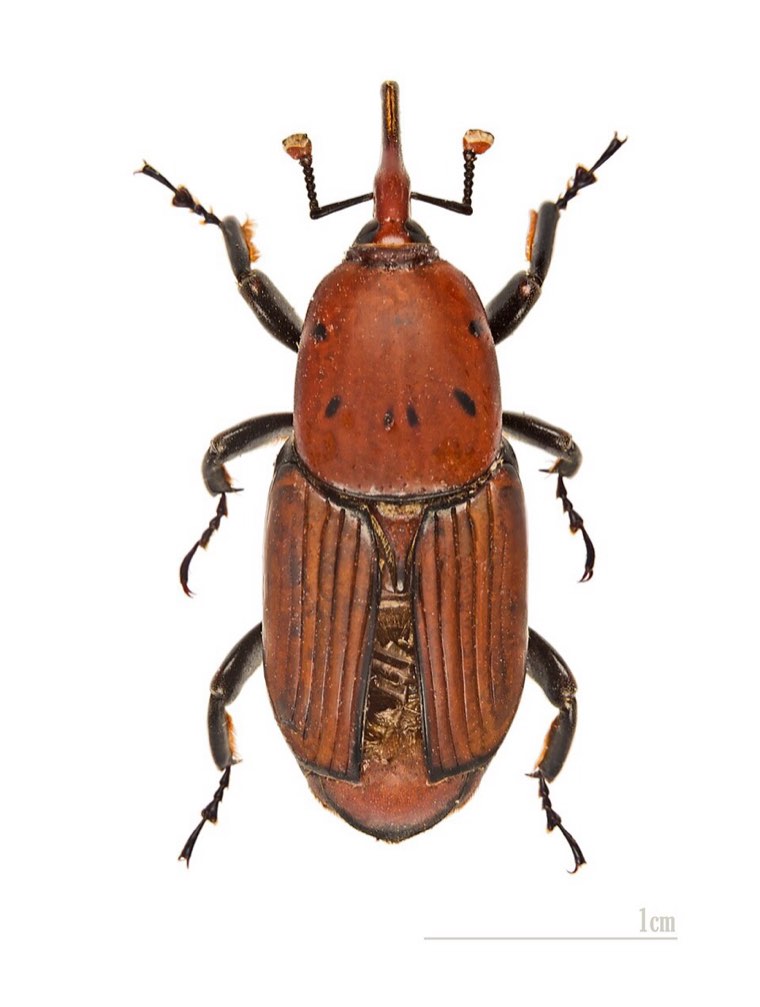
The scientific name of red palm weevil is Rhynchophorus ferrugineus (Olivier, 1790), in the order Coleoptera, family Curculionidae (Dryophthorinae).
Older or alternative scientific names: Rhynchophorus vulneratus (now usually treated as the same species).
Native to South and Southeast Asia and Melanesia. It reached the Arabian Peninsula and the Gulf in the mid-1980s, Egypt by 1992, Spain by 1994, and then most Mediterranean countries; it has also been found in the Caribbean. It is regulated in many regions, and FAO coordinates a framework strategy against it.
| Region | Status |
|---|---|
| South and Southeast Asia | Native; key pest of coconut |
| Middle East and Gulf | Invasive since the 1980s; key pest of date palm |
| North Africa | Invasive in several countries |
| Mediterranean Europe | Invasive since the 1990s; destroyed many ornamental Canary palms |
| Caribbean | Recorded on some islands; regulated in the Americas |
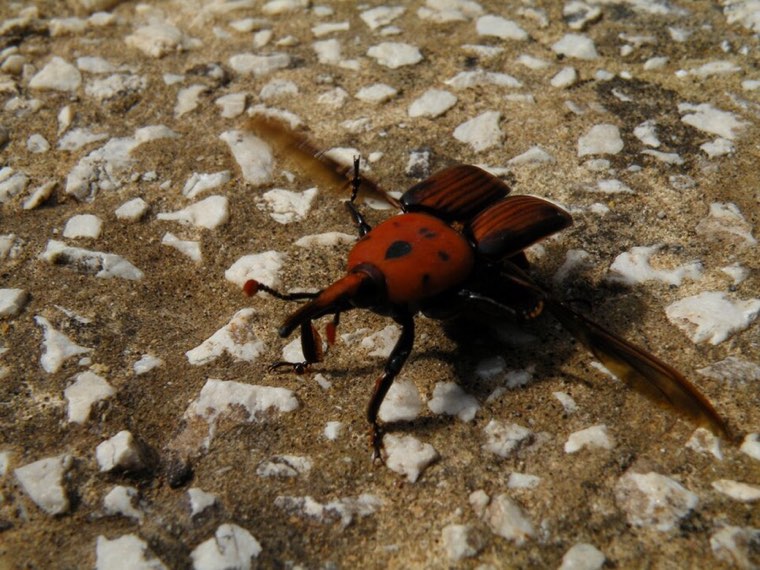
Adults are 2-4 cm long, reddish-brown with variable black markings on the thorax, and a long curved snout; males have a tuft of hairs on the snout. Larvae are legless, creamy-white grubs with a brown head, up to about 5 cm. Pupae develop inside an oval cocoon of chewed palm fibres.
| Crop stage | What you see |
|---|---|
| Early (young palm or offshoot) | Holes in the trunk or at frond bases oozing brown, foul-smelling liquid; chewed fibres pushed out of holes; a crunching sound of feeding larvae audible with an ear against the trunk. |
| Advanced | Yellowing and wilting of inner fronds; fronds break and hang down; the crown becomes asymmetric. |
| Final | The crown collapses or the trunk breaks; cocoons and adults found in the rotten crown. |
Females lay 200-300 eggs in wounds, cuts and soft tissue, especially at frond bases and on offshoots. Larvae tunnel through the soft tissue for one to three months, then make fibre cocoons inside the palm. New adults often stay and breed in the same palm for several generations before flying to new palms; adults are attracted by fermenting palm tissue and an aggregation pheromone released by males.
| Stage | Duration | Notes |
|---|---|---|
| Egg | About 2-5 days | Laid in wounds and soft tissue. |
| Larva | About 1-3 months | Tunnels inside trunk and crown. |
| Pupa in fibre cocoon | About 2-3 weeks | Inside the palm. |
| Adult | About 2-3 months | Flies up to several kilometres; attracted to pheromone and fermenting tissue. |
A generation takes about 3-4 months in warm climates; development slows in cool Mediterranean winters but continues inside palms, which are warmer than the air.
Usually 2-4 overlapping generations a year.
Moving infested offshoots and ornamental palms; wounds from pruning, offshoot removal and frond cutting; dense plantings; and failure to destroy infested palms quickly.
There is no numeric economic threshold: a single infested palm is a breeding site that can infest its neighbours. Action is triggered by detection of an infested palm, and by pheromone-trap catches that show weevils are present in an area.
Infested palms usually die if not treated early. In date-growing regions of the Middle East, a few per cent of palms are infested at any time in affected areas, with losses estimated in the tens of millions of US dollars a year in some countries; many thousands of ornamental palms have been lost in Mediterranean cities.
Control works best as a sequence: prevent, monitor, then act only when a threshold or a risk forecast says so, using the least disruptive option that works.
Chemical treatments are used preventively on wounds and the crown, and curatively by trunk injection under official programmes. What is registered differs by country and changes over time; follow the label and your local plant-protection authority.
| Scheme | Group | Mode of action | Notes |
|---|---|---|---|
| IRAC | 4A | Nicotinic acetylcholine receptor competitive modulators (neonicotinoids) | Trunk injection in some programmes. |
| IRAC | 6 | Glutamate-gated chloride channel allosteric modulators (avermectins) | Trunk injection in some programmes. |
| IRAC | UNF | Fungal agents of unknown or uncertain mode of action | Beauveria-based preventive treatments. |
Recorded on about 40 palm species. Major hosts are date palm, coconut, Canary Island date palm (very susceptible), oil palm, sago palm and Washingtonia palms. Young palms under about 20 years old are most often attacked.
How to grow the crop well is the first line of defence. Laisha's free grow guides cover each crop from sowing to harvest:
Written by Laisha from the sources above, in its own words. This page is general reference, not a prescription: confirm identification locally and follow the label and your plant-protection authority.