 Laisha
AI Operating System for Agriculture
Ask Laisha
Laisha
AI Operating System for Agriculture
Ask Laisha
Liriomyza trifolii (Burgess, 1880) (with L. sativae Blanchard, 1938 and L. huidobrensis (Blanchard, 1926)) · formerly or also: Agromyza trifolii
Leafminers are tiny black-and-yellow flies whose maggots tunnel inside leaves, leaving pale, winding trails. Three Liriomyza species from the Americas have spread worldwide on vegetables and flowers and are among the most serious pests of greenhouse and field crops such as tomato, beans, cucurbits, potato, celery and chrysanthemum. They resist many insecticides, but parasitic wasps control them well when sprays are kept to a minimum.
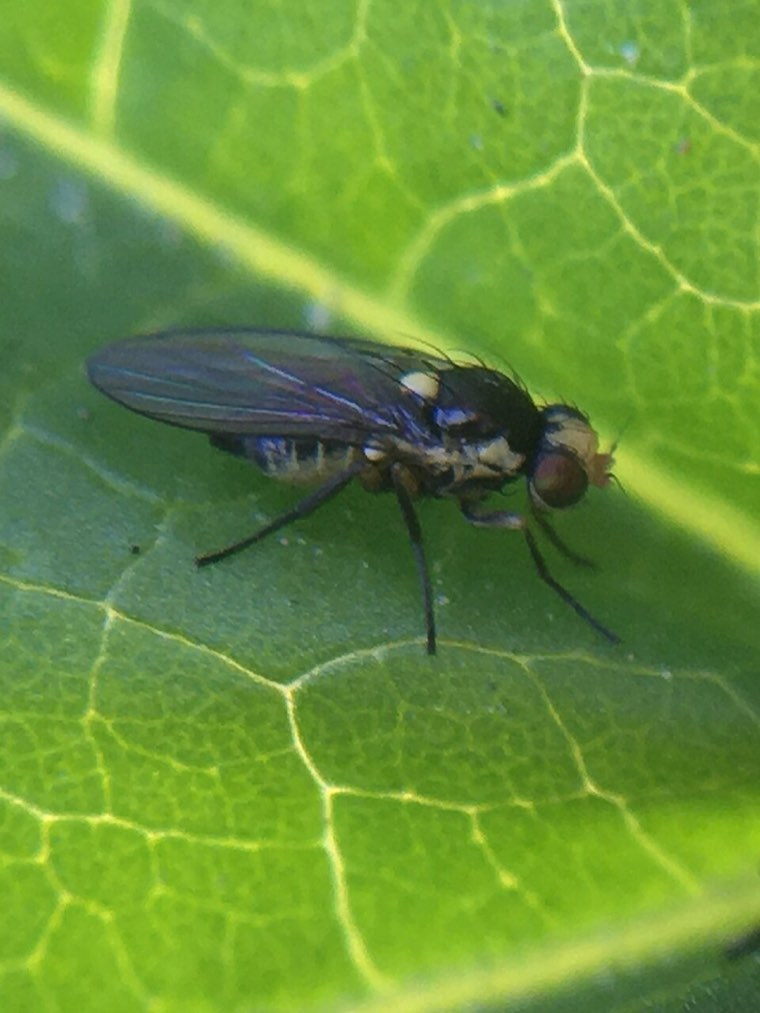
The scientific name of serpentine leafminer is Liriomyza trifolii (Burgess, 1880) (with L. sativae Blanchard, 1938 and L. huidobrensis (Blanchard, 1926)), in the order Diptera, family Agromyzidae.
Older or alternative scientific names: Agromyza trifolii.
Native to the Americas. From the 1970s-1990s they spread with ornamental cuttings and vegetables to Europe, Africa, the Middle East and Asia, and are now present on every continent; they are regulated quarantine pests in parts of Europe and elsewhere.
| Region | Status |
|---|---|
| Americas | Native; widespread |
| Europe and the Mediterranean | Invasive; key greenhouse pests |
| Africa and the Middle East | Invasive; important in vegetables and export flowers |
| South, Southeast and East Asia | Invasive since the 1990s; widespread in vegetables |
| Oceania | Present; L. sativae and L. huidobrensis recorded in Australia more recently |
Adults are about 2 mm long, black and yellow, with a bright yellow scutellum (the shield at the back of the thorax). Females puncture leaves with their ovipositor to feed and lay eggs. Larvae are legless yellowish maggots up to about 3 mm that tunnel between the leaf surfaces. Species are separated by experts using the colour of the head and thorax, male genitalia or DNA.
| Crop stage | What you see |
|---|---|
| Seedling and transplant | Small white speckles (feeding punctures made by females) on leaves; first narrow mines. |
| Vegetative growth | Pale, winding, serpentine mines that widen as the larva grows, with a thin line of dark frass; leaves dry and fall when mines are dense. |
| Flowering and harvest | Reduced yield from loss of leaf area; ornamentals and leafy vegetables unsaleable because of visible mines. |
Females insert eggs just under the leaf surface. Larvae pass through three instars inside the mine, then cut a slit and drop to the soil or growing medium to pupate (L. trifolii and L. sativae), or pupate on the leaf. Generations are short, so populations build quickly in warm greenhouses.
| Stage | Duration | Notes |
|---|---|---|
| Egg (in leaf) | About 2-5 days at 25 °C | Inserted through feeding punctures. |
| Larva (3 instars, inside the leaf) | About 4-7 days at 25 °C | Serpentine mine. |
| Puparium (soil or leaf) | About 7-14 days | Brown, barrel-shaped. |
| Adult | About 1-3 weeks | Females lay 100-300 eggs. |
A generation takes about three weeks at 25 °C and longer in cool weather; L. huidobrensis tolerates cooler conditions than L. trifolii and L. sativae.
Continuous overlapping generations in greenhouses and the tropics (10 or more a year).
Warm greenhouses, continuous cropping of hosts, movement of infested plants and cut flowers, and above all broad-spectrum insecticide sprays that kill parasitoids and leave resistant leafminers behind.
There is no single numeric threshold; tolerable damage depends strongly on the crop. Fruiting vegetables tolerate many mines before yield is affected, while ornamentals and leafy greens tolerate almost none. Extension programmes use counts of active mines, live larvae or parasitised larvae per leaf, and yellow-trap counts, to time action locally.
Thresholds are local. They depend on crop price, control cost, variety and natural-enemy activity, so use the figure your local extension service publishes where one exists.
Heavy mining reduces photosynthesis and yield and can kill seedlings; in leafy vegetables and flowers any mine lowers market value, and quarantine restrictions affect exports. Yield losses reported in heavily infested vegetables range from about 10% to over 50%.
Control works best as a sequence: prevent, monitor, then act only when a threshold or a risk forecast says so, using the least disruptive option that works.
Choose groups that act on larvae inside leaves (translaminar or systemic) and spare parasitoids; broad-spectrum sprays often make leafminer problems worse. What is registered differs by country and changes over time; follow the label and your local plant-protection authority.
| Scheme | Group | Mode of action | Notes |
|---|---|---|---|
| IRAC | 17 | Moulting disruptors, Dipteran | Selective; resistance documented. |
| IRAC | 6 | Glutamate-gated chloride channel allosteric modulators (avermectins) | Translaminar. |
| IRAC | 5 | Nicotinic acetylcholine receptor allosteric modulators, site I (spinosyns) | Translaminar. |
| IRAC | 28 | Ryanodine receptor modulators (diamides) | Systemic uses. |
Highly polyphagous: L. trifolii and L. sativae attack more than 100 plants in many families, including tomato, pepper, beans, peas, cucurbits, celery, lettuce, onion, cotton, chrysanthemum and gerbera; L. huidobrensis is especially damaging on potato, beans, peas and flowers in cooler highlands.
How to grow the crop well is the first line of defence. Laisha's free grow guides cover each crop from sowing to harvest:
Written by Laisha from the sources above, in its own words. This page is general reference, not a prescription: confirm identification locally and follow the label and your plant-protection authority.