 Laisha
AI Operating System for Agriculture
Ask Laisha
Laisha
AI Operating System for Agriculture
Ask Laisha
Zymoseptoria tritici (Desm.) Quaedvl. & Crous, 2011 · formerly or also: Mycosphaerella graminicola, Septoria tritici
Septoria tritici blotch is the most important leaf disease of wheat in Europe and a major one in other wet temperate regions. Rain splashes its spores up the plant, and long brown blotches peppered with tiny black dots destroy the upper leaves during grain filling. The fungus has evolved resistance to several fungicide groups in turn, which makes resistant varieties and careful programmes essential.
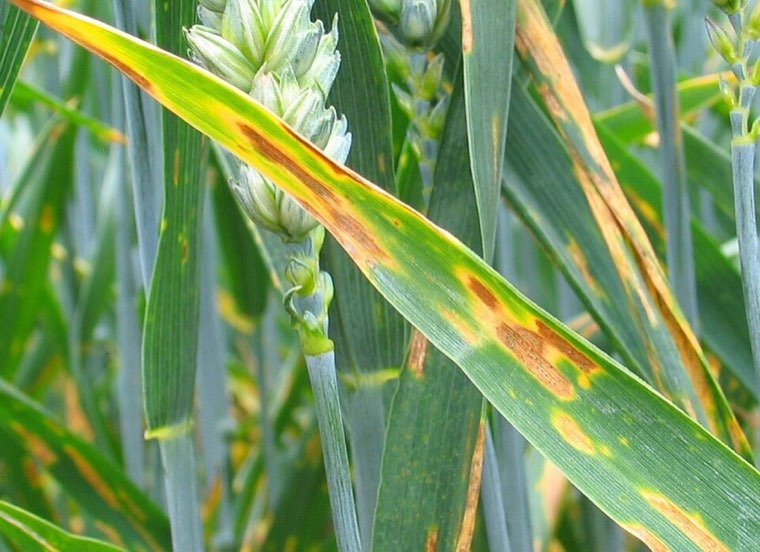
Septoria tritici blotch of wheat is caused by Zymoseptoria tritici (Desm.) Quaedvl. & Crous, 2011, a fungus (ascomycete) (order Mycosphaerellales (formerly Capnodiales), family Mycosphaerellaceae).
Older or alternative scientific names: Mycosphaerella graminicola, Septoria tritici.
Present in almost all wheat-growing regions, and most damaging where springs and early summers are mild and wet: north-western Europe, the Mediterranean, the Southern Cone of South America, East African highlands, the Middle East and North Africa, North America and southern Australia.
| Region | Status |
|---|---|
| North-western Europe | Widespread; the main foliar disease of wheat |
| Mediterranean, Middle East and North Africa | Widespread in rain-fed wheat |
| South America | Widespread in the Southern Cone |
| East Africa | Important in highland wheat |
| North America and Oceania | Present; important in wet seasons |
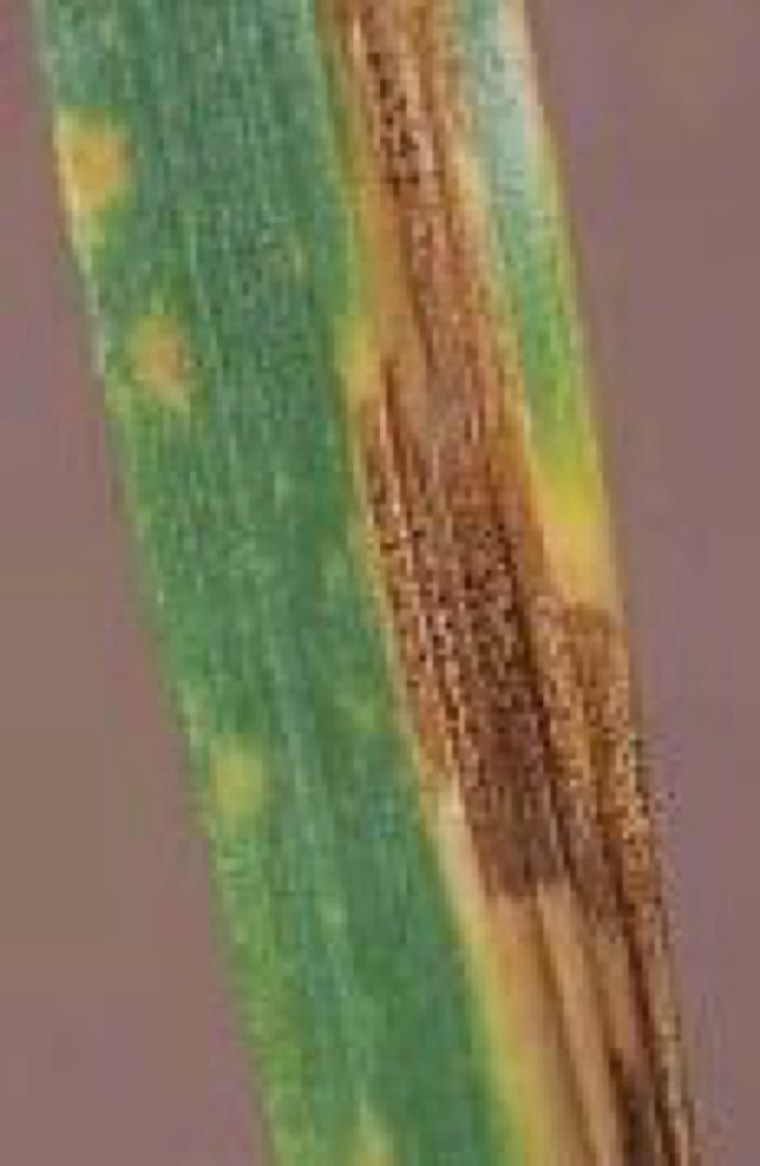
Lesions contain small, dark brown to black, flask-shaped fruiting bodies (pycnidia) embedded in the leaf, visible as black dots with a hand lens; in wet conditions they exude creamy tendrils of spores. The sexual stage forms on older lesions and stubble and releases airborne ascospores.
| Crop stage | What you see |
|---|---|
| Autumn and winter (seedling to tillering) | Small yellow flecks and brown blotches on the oldest leaves. |
| Stem elongation | Irregular, elongated tan-to-brown blotches, often limited by veins, with black pycnidia; lower leaves die. |
| Flag leaf to grain filling | Lesions move up to the top three leaves after rain; leaves die early; smaller, shrivelled grains. |
Airborne ascospores from wheat stubble start infection in newly sown crops in autumn. Thereafter, asexual spores from pycnidia are splashed upward by rain from leaf to leaf. The fungus has a long symptomless phase inside the leaf, so infections that happened during rain at stem elongation only become visible two to four weeks later - which is why protection is preventive.
| Stage | Duration | Notes |
|---|---|---|
| Ascospores from stubble infect young crops | Autumn to spring | Airborne over long distances. |
| Symptomless (latent) phase | About 14-28 days | Shorter in warm weather. |
| Lesions with pycnidia | Through the season | Pycnidiospores spread by rain splash. |
| Sexual stage on old lesions and stubble | Late season and between crops | Generates new genetic diversity including fungicide resistance. |
Infection needs long leaf wetness (about 1-2 days) and temperatures of about 15-25 °C; the long latent period shortens as temperature rises. Frequent rain at stem elongation and flag-leaf emergence is the strongest predictor of severe disease.
Several splash-dispersed cycles in each wheat season.
Mild, wet weather in spring and early summer, early sowing (more autumn infection), susceptible varieties, wheat after wheat with stubble retained, and dense canopies.
There is no simple numeric economic threshold; decisions are based on variety resistance rating, rainfall in the weeks before key growth stages, and disease on the lower leaves. In temperate Europe, programmes protect the final leaves at stem elongation (around growth stage 32) and flag-leaf emergence (around growth stage 39), and rainfall-based risk models help decide whether each treatment is needed.
Thresholds are local. They depend on crop price, control cost, variety and natural-enemy activity, so use the figure your local extension service publishes where one exists.
Yield losses of 5-10% are common in average seasons and 30-50% in susceptible varieties in wet seasons. In Europe the disease is the main reason for fungicide use on wheat.
Control works best as a sequence: prevent, monitor, then act only when a threshold or a risk forecast says so, using the least disruptive option that works.
Programmes are preventive and timed to protect the top leaves; mixtures with multi-site protectants reduce resistance risk. What is registered differs by country and changes over time; follow the label and your local plant-protection authority.
| Scheme | Group | Mode of action | Notes |
|---|---|---|---|
| FRAC | 3 | Demethylation inhibitors (DMI) | Reduced sensitivity widespread in Europe; still used in mixtures. |
| FRAC | 7 | Succinate dehydrogenase inhibitors (SDHI) | Key partner; resistance emerging. |
| FRAC | M04 | Phthalimides (multi-site contact) | Protectant partner where registered. |
| FRAC | M05 | Chloronitriles (multi-site contact) | Protectant; withdrawn in some regions. |
| FRAC | 21 | Quinone inside inhibitors (QiI) | Newer group for this disease. |
Bread and durum wheat, triticale and some wild grasses. It does not cause significant disease on barley or oats.
How to grow the crop well is the first line of defence. Laisha's free grow guides cover each crop from sowing to harvest:
Written by Laisha from the sources above, in its own words. This page is general reference, not a prescription: confirm identification locally and follow the label and your plant-protection authority.