 Laisha
AI Operating System for Agriculture
Ask Laisha
Laisha
AI Operating System for Agriculture
Ask Laisha
Pyricularia oryzae Triticum lineage Pyricularia oryzae Cavara, 1892 (wheat-adapted lineage; also called Magnaporthe oryzae pathotype Triticum) · formerly or also: Magnaporthe oryzae Triticum pathotype (MoT)
Wheat blast is a fast, destructive disease of wheat caused by a wheat-adapted lineage of the rice blast fungus. It bleaches wheat ears above an infection point on the rachis within days, so grains shrivel or never form. It emerged in Brazil in 1985, spread in South America, and jumped to Bangladesh in 2016 and Zambia in 2018, putting the warm wheat regions of South Asia and Africa at risk. The disease spreads through infected seed and on wind, and the main defences are clean seed, sowing dates that avoid hot, wet heading, and resistant varieties.
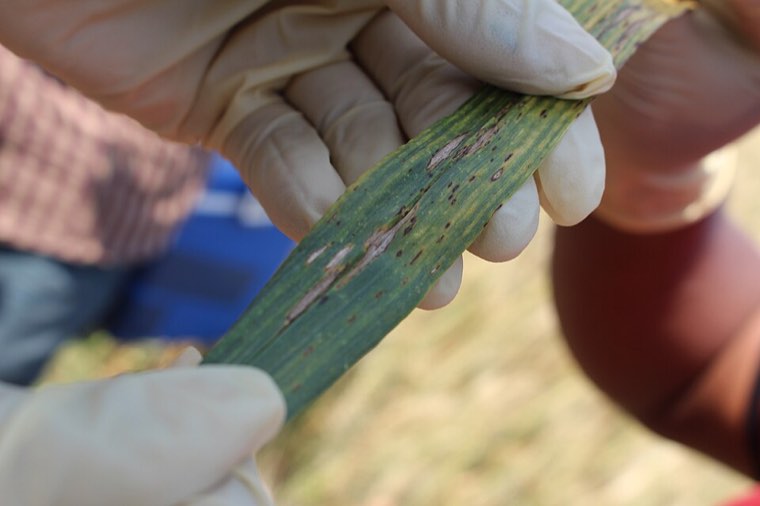
Wheat blast is caused by Pyricularia oryzae Triticum lineage Pyricularia oryzae Cavara, 1892 (wheat-adapted lineage; also called Magnaporthe oryzae pathotype Triticum), a fungus (ascomycete) (order Magnaporthales, family Pyriculariaceae).
Older or alternative scientific names: Magnaporthe oryzae Triticum pathotype (MoT).
South America (Brazil, Bolivia, Paraguay, Argentina), Bangladesh since 2016 and Zambia since 2018. It is a regulated quarantine pest in many countries.
| Region | Status |
|---|---|
| South America | Present since 1985; recurrent epidemics |
| South Asia | Present in Bangladesh since 2016; quarantine concern for neighbouring countries |
| Southern Africa | Present in Zambia since 2018 |
| Other regions | Absent; regulated |
Morphologically identical to rice blast; the wheat lineage is identified by molecular markers. It produces pear-shaped, two-septate conidia in grey lesions and spreads by airborne spores and infected seed.
| Crop stage | What you see |
|---|---|
| Vegetative | Eye-shaped lesions with grey centres on leaves, often inconspicuous. |
| Heading to grain fill | Bleaching of all or part of the ear above a dark, shiny lesion on the rachis; the ear above the lesion dies within days while the rest of the plant stays green. |
| Maturity | Shrivelled, light or absent grain in bleached ears; low test weight. |
The fungus survives on infected seed, crop residues and grass hosts. Airborne conidia infect ears during warm, wet weather around heading; the rachis is invaded, cutting off water and sugars to the grain above. Infected seed spreads the disease to new areas. Leaf infections early in the season produce spores that later infect the ears; ears can be infected from heading to early grain fill, and the window when weather is warm and wet decides how severe an epidemic becomes.
| Stage | Duration | Notes |
|---|---|---|
| Survival | Between crops | Seed, residues, grasses. |
| Spore release | Warm, humid nights | Airborne. |
| Ear infection | Heading; needs about 10 hours or more of wetness at 25-30 °C | Rachis infection. |
| Bleaching | Within about a week | Grain fill stops above the lesion. |
Epidemics follow warm (about 25-30 °C) and wet weather with long leaf-wetness periods at heading.
One main ear-infection period per crop, with secondary spread.
Warm, rainy weather at heading, early sowing that puts heading into warm weather, infected seed, and susceptible varieties. Irrigated wheat sown into warm conditions, and wheat grown near infected grasses, face higher risk.
There is no numeric threshold: when weather at heading favours blast, protection must be in place beforehand, and in newly affected countries any detection triggers official measures.
Thresholds are local. They depend on crop price, control cost, variety and natural-enemy activity, so use the figure your local extension service publishes where one exists.
Losses range up to total crop failure in affected fields; in Bangladesh in 2016 about 15,000 hectares were affected in the first season, and Brazilian epidemics have caused losses of 40-100% in individual fields. Grain from blasted ears is small and shrivelled, lowers test weight and seed quality, and can carry the fungus to new areas if used as seed.
Control works best as a sequence: prevent, monitor, then act only when a threshold or a risk forecast says so, using the least disruptive option that works.
Fungicides at heading give partial control and are least effective under heavy pressure; seed treatment reduces seed-borne spread. What is registered differs by country and changes over time; follow the label and your local plant-protection authority.
| Scheme | Group | Mode of action | Notes |
|---|---|---|---|
| FRAC | 11 | Quinone outside inhibitors (QoI) | Resistance documented in South America. |
| FRAC | 3 | Demethylation inhibitors (DMI) | In mixtures. |
| FRAC | M03 | Dithiocarbamates and relatives (multi-site) | Protectant partner. |
Wheat is the main host; triticale, barley and several grasses (for example signal grass, Urochloa species) can be infected and may carry the fungus.
How to grow the crop well is the first line of defence. Laisha's free grow guides cover each crop from sowing to harvest:
Written by Laisha from the sources above, in its own words. This page is general reference, not a prescription: confirm identification locally and follow the label and your plant-protection authority.