 Laisha
AI Operating System for Agriculture
Ask Laisha
Laisha
AI Operating System for Agriculture
Ask Laisha
Puccinia striiformis f. sp. tritici Erikss., 1894 (species Puccinia striiformis Westend., 1854) · formerly or also: Puccinia glumarum
Yellow rust, or stripe rust, is a cool-weather rust that covers wheat leaves with stripes of bright yellow-orange powdery spores. It can start early in the season and destroy much of the leaf area before grain filling. Since about 2000, new aggressive strains adapted to warmer temperatures, and since 2011 further new races, have made it the most widespread wheat rust in many regions.
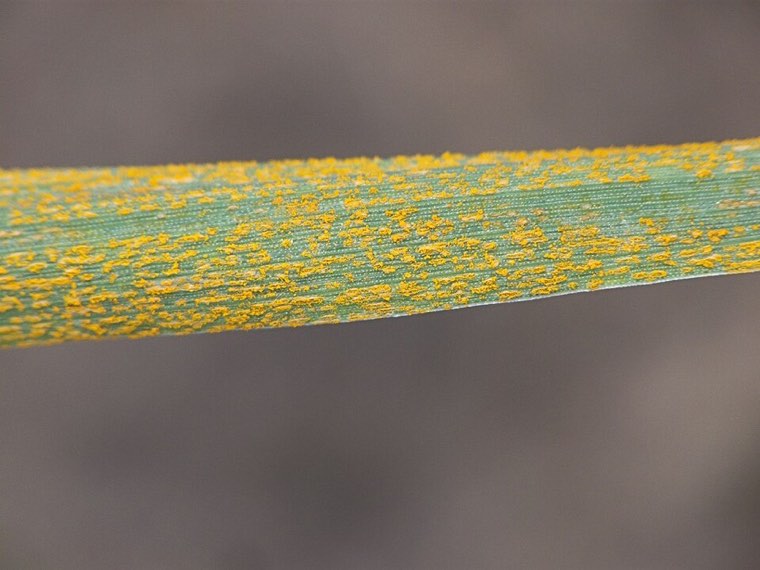
Yellow rust of wheat is caused by Puccinia striiformis f. sp. tritici Erikss., 1894 (species Puccinia striiformis Westend., 1854), a fungus (rust fungus, a basidiomycete) (order Pucciniales, family Pucciniaceae).
Older or alternative scientific names: Puccinia glumarum.
Most important in cool and temperate wheat regions and highlands: north-western Europe, the Mediterranean, Central and West Asia, the Himalayan region and north-western plains of South Asia, western China, the East African highlands, the Andes, North America and Australia. Warm-adapted strains have spread it into warmer areas since 2000.
| Region | Status |
|---|---|
| Europe | Widespread; new races since 2011 replaced older populations |
| West, Central and South Asia | Widespread; recurrent epidemics in cool seasons and hills |
| East Asia | Major disease in western and northern China |
| East Africa and North Africa | Widespread in highland and Mediterranean wheat |
| Americas and Oceania | Widespread; warm-adapted strains since 2000 |
The fungus produces yellow to orange urediniospores in small pustules that line up in narrow stripes between leaf veins on adult plants. Late in the season, black telia form in stripes under the epidermis. Spores rub off as a yellow powder.
| Crop stage | What you see |
|---|---|
| Seedling and tillering (autumn and winter) | Pustules in patches rather than stripes on young leaves; small 'hot spots' of infected plants in a field. |
| Stem elongation to flag leaf | Yellow-orange pustules in long stripes along the veins, often on both leaf surfaces; leaves turn yellow and dry from the tips. |
| Heading to grain filling | Pustules on ears and glumes; black stripes of telia appear; crops look yellow from a distance; shrivelled grain. |
The fungus survives between crops on volunteer wheat and grasses and, in some regions, in green wheat through mild winters. Urediniospores are carried by wind over long distances and infect leaves in cool, moist conditions. The fungus grows inside the leaf for one to three weeks before producing new pustules, so infections that started weeks earlier appear suddenly in warm spring weather.
| Stage | Duration | Notes |
|---|---|---|
| Urediniospore lands on a wet leaf | Needs about 3-6 hours of leaf wetness | Cool, dewy nights favour infection. |
| Latent period inside the leaf | About 10-14 days at 12-15 °C; longer in winter | Symptoms appear long after infection. |
| Sporulation in stripes | Repeated cycles through the season | Wind spreads spores to other fields. |
| Telia and survival | Late season | Survival mainly on green volunteers; barberry in some regions. |
The coolest of the wheat rusts: infection is favoured by about 7-15 °C with dew, and spore production slows above about 20-25 °C. Warm-adapted strains (since about 2000) infect and spread at higher temperatures than older populations.
Several asexual cycles a season; continuous survival on green hosts in mild climates.
Mild winters that allow survival on green leaves, cool and wet springs, dew, early sowing in autumn, susceptible varieties grown widely, and nearby volunteer wheat.
There is no general numeric economic threshold. Advisory services recommend action at the first sign of yellow rust (for example the first active foci) in susceptible varieties during stem elongation, and protection of the flag leaf and ear; resistant varieties may need no treatment. Varietal resistance ratings and regional race information should guide the decision.
Thresholds are local. They depend on crop price, control cost, variety and natural-enemy activity, so use the figure your local extension service publishes where one exists.
Losses of 10-70% are reported in susceptible varieties in epidemic years, and total loss is possible when infection starts early. Even moderate infection of the flag leaf during grain filling reduces grain size and quality.
Control works best as a sequence: prevent, monitor, then act only when a threshold or a risk forecast says so, using the least disruptive option that works.
Where susceptible varieties are grown, fungicides at stem elongation and flag-leaf emergence are common in temperate regions; earlier applications may be needed after mild winters. What is registered differs by country and changes over time; follow the label and your local plant-protection authority.
| Scheme | Group | Mode of action | Notes |
|---|---|---|---|
| FRAC | 3 | Demethylation inhibitors (DMI) | Systemic; curative activity in the latent period. |
| FRAC | 11 | Quinone outside inhibitors (QoI, strobilurins) | Preventive; in mixtures. |
| FRAC | 7 | Succinate dehydrogenase inhibitors (SDHI) | Used in mixtures. |
Wheat (bread and durum) and triticale are the main hosts of this form; some races infect barley and rye, and several wild grasses carry the fungus. Barberry (Berberis species) was confirmed as an alternate host in 2010, where the sexual stage occurs in some regions such as the Himalayan foothills and parts of China.
How to grow the crop well is the first line of defence. Laisha's free grow guides cover each crop from sowing to harvest:
Written by Laisha from the sources above, in its own words. This page is general reference, not a prescription: confirm identification locally and follow the label and your plant-protection authority.