 Laisha
AI Operating System for Agriculture
Ask Laisha
Laisha
AI Operating System for Agriculture
Ask Laisha
Blumeria graminis (DC.) Speer, 1975 (f. sp. tritici on wheat, f. sp. hordei on barley) · formerly or also: Erysiphe graminis
Powdery mildew covers the leaves, stems and ears of wheat and barley with fluffy white to grey pustules that later turn brownish with tiny black dots. It thrives in dense, well-fertilised crops in mild weather and reduces yield by draining the plant and killing leaves early. Separate forms of the fungus attack wheat, barley, oats and rye, and the fungus adapts quickly to resistant varieties and fungicides.
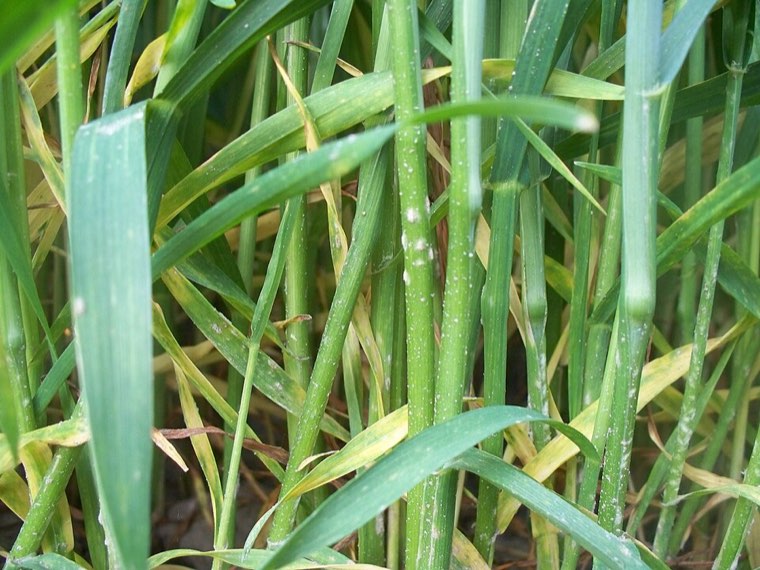
Powdery mildew of wheat and barley is caused by Blumeria graminis (DC.) Speer, 1975 (f. sp. tritici on wheat, f. sp. hordei on barley), a fungus (powdery mildew, an obligate parasite) (order Erysiphales, family Erysiphaceae).
Older or alternative scientific names: Erysiphe graminis.
Found wherever wheat and barley are grown, and most damaging in humid temperate and maritime climates (north-western Europe, East Asia, parts of North America), in irrigated crops and in high-input systems.
| Region | Status |
|---|---|
| Europe | Widespread |
| East Asia | Major wheat disease in China |
| Americas | Widespread |
| South Asia, Middle East and Africa | Present; important in cool, humid areas and highlands |
| Oceania | Present |
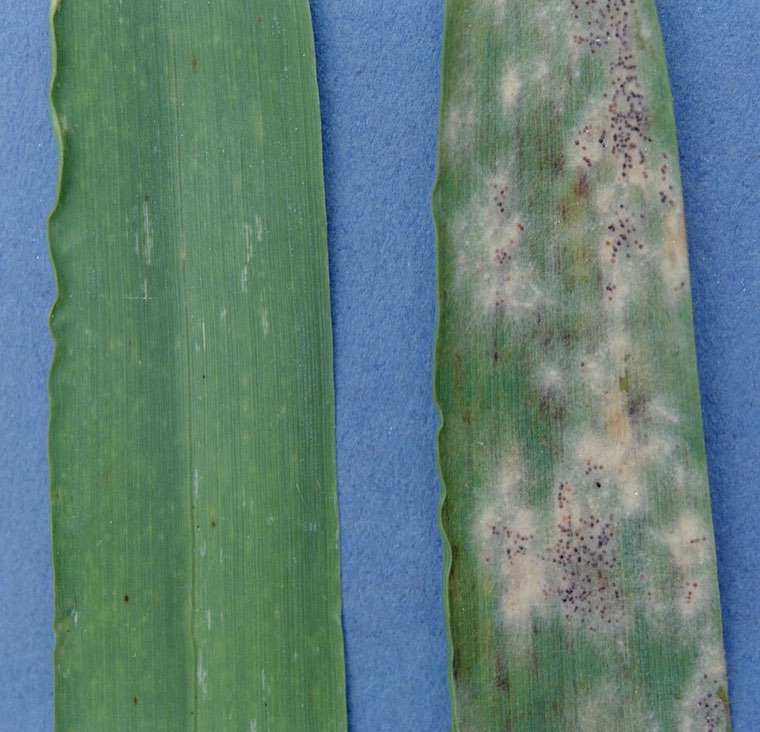
The fungus grows on the leaf surface with haustoria inside epidermal cells, producing chains of oval conidia that give the white, powdery appearance. Later, dark round chasmothecia (sexual fruiting bodies) form in the pustules and survive on stubble.
| Crop stage | What you see |
|---|---|
| Tillering | White, fluffy pustules on lower leaves and leaf sheaths; yellow patches on the opposite side of the leaf. Infections are easiest to find on the lowest leaves and inside the canopy. |
| Stem elongation to flag leaf | Pustules spread up the plant, merge and turn grey-brown with black dots; leaves yellow and die early. |
| Heading | Pustules on ears and awns in severe cases; shrivelled grain. |
The fungus survives on volunteer cereals and early-sown crops as mycelium and on stubble as chasmothecia, whose ascospores start new infections. Conidia are spread by wind and infect without free water. New conidia form in about a week, so many cycles occur during the season. Sexual recombination in chasmothecia creates new combinations of virulence and fungicide resistance, which is why resistance genes and fungicides lose effect over time.
| Stage | Duration | Notes |
|---|---|---|
| Survival | Between seasons | Volunteers, early crops, chasmothecia on stubble. |
| Infection | Hours at high humidity; free water not needed | Optimum about 15-22 °C. |
| Sporulation | About 7-10 days | Wind-borne conidia. |
| Chasmothecia | Late season | Sexual recombination creates new virulence. |
Favoured by mild temperatures (about 15-22 °C) and high humidity without rain; hot weather above about 25 °C slows it, and heavy rain washes spores off.
Many cycles in each season.
Dense crops, high nitrogen, mild humid weather, early sowing, volunteer cereals, and susceptible varieties. Irrigated crops and sheltered fields, where humidity stays high around the canopy, are especially affected.
There is no universal numeric threshold; advisory services relate treatment to variety resistance rating, crop stage and the amount of mildew on the upper leaves. Resistant varieties often need no treatment.
Thresholds are local. They depend on crop price, control cost, variety and natural-enemy activity, so use the figure your local extension service publishes where one exists.
Yield losses are usually 5-20% in susceptible varieties and can be higher when mildew reaches the flag leaf and ear early. Losses are greatest when the upper three leaves are covered before flowering; mildew on lower leaves early in the season usually matters less unless it moves up.
Control works best as a sequence: prevent, monitor, then act only when a threshold or a risk forecast says so, using the least disruptive option that works.
Fungicides are applied when mildew develops on upper leaves of susceptible varieties. What is registered differs by country and changes over time; follow the label and your local plant-protection authority.
| Scheme | Group | Mode of action | Notes |
|---|---|---|---|
| FRAC | 3 | Demethylation inhibitors (DMI) | Reduced sensitivity widespread. |
| FRAC | 5 | Amines (sterol biosynthesis inhibitors, class II) | Used in some regions. |
| FRAC | 13 | Aryloxyquinolines and quinazolinones | Specific to powdery mildews. |
| FRAC | 50 | Aryl-phenyl-ketones | Specific to powdery mildews. |
| FRAC | U06 | Phenyl-acetamides | Specific to powdery mildews. |
Each special form is largely restricted to one cereal: f. sp. tritici to wheat, f. sp. hordei to barley, and others to oats, rye and grasses; a hybrid form attacks triticale.
How to grow the crop well is the first line of defence. Laisha's free grow guides cover each crop from sowing to harvest:
Written by Laisha from the sources above, in its own words. This page is general reference, not a prescription: confirm identification locally and follow the label and your plant-protection authority.