 Laisha
AI Operating System for Agriculture
Ask Laisha
Laisha
AI Operating System for Agriculture
Ask Laisha
Puccinia graminis f. sp. tritici Erikss. & E. Henn., 1894 (species Puccinia graminis Pers., 1794)
Stem rust, or black rust, is historically the most feared disease of wheat: in a warm, humid season it can turn a healthy-looking crop into a tangle of broken, shrivelled stems within weeks. It was largely controlled for decades by resistant varieties, until the Ug99 race group, found in Uganda in 1998, overcame widely used resistance genes and spread through Africa and the Middle East. New races have since caused outbreaks in Europe and elsewhere.
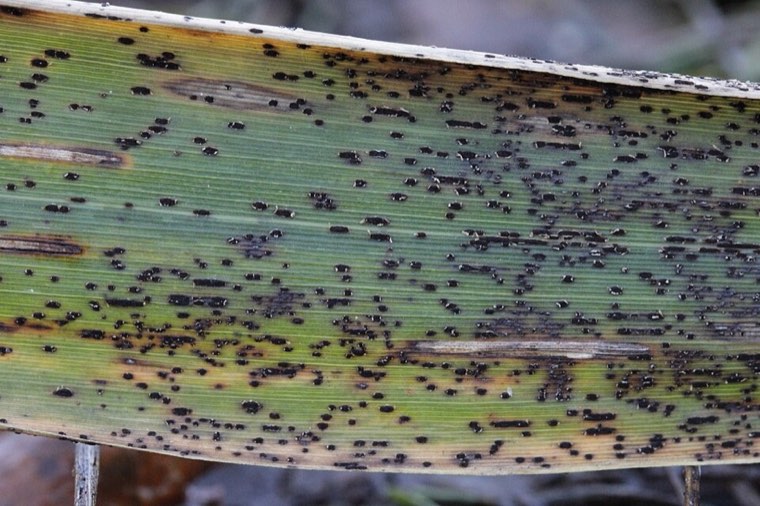
Stem rust of wheat is caused by Puccinia graminis f. sp. tritici Erikss. & E. Henn., 1894 (species Puccinia graminis Pers., 1794), a fungus (rust fungus, a basidiomycete) (order Pucciniales, family Pucciniaceae).
Found in every wheat-growing region. The Ug99 race group has been confirmed in East and southern Africa, Yemen, Iran and Egypt. Other new races caused the first major epidemics in decades in Sicily (2016) and outbreaks in Ethiopia, Central Asia and parts of Europe. Barberry eradication programmes in the twentieth century greatly reduced epidemics in North America and Europe.
| Region | Status |
|---|---|
| East and southern Africa | Widespread; Ug99 race group present |
| Middle East and Central Asia | Present; Ug99 lineage in parts of the Middle East |
| South Asia | Present; mainly in southern and central wheat zones |
| Europe | Re-emerging since the 2010s, especially in the Mediterranean |
| Americas and Oceania | Present; controlled largely by resistant varieties |
The fungus produces brick-red, powdery urediniospores in elongated pustules that burst through the plant surface. Late in the season the same pustules produce black, two-celled teliospores, which give the disease its name 'black rust'. On barberry leaves it forms orange cup-like aecia in spring.
| Crop stage | What you see |
|---|---|
| Tillering to stem elongation | Few early pustules on leaves and sheaths in warm regions; often unnoticed. |
| Heading to grain filling | Large, elongated, dark reddish-brown pustules on stems, leaf sheaths, leaves and ears, with torn, ragged edges of epidermis; spores rub off on hands and clothes; both sides of the leaf are pustuled. |
| Maturity | Pustules turn black; stems weaken and lodge or break; grain is shrivelled and light. |
On wheat the fungus multiplies asexually: urediniospores carried by wind land on wet plants, infect and produce new pustules in about 7-15 days. Spores can travel hundreds or thousands of kilometres on wind currents, so epidemics often start from spores blown in from warmer regions. Where barberry is present, teliospores overwinter on straw, germinate in spring and infect barberry, where sexual recombination creates new races.
| Stage | Duration | Notes |
|---|---|---|
| Urediniospore lands on a wet plant | Needs about 6-8 hours of free moisture | Wind-dispersed over long distances. |
| Infection and pustule development (latent period) | About 7-15 days | Shorter at warm temperatures. |
| Pustules release new urediniospores | Repeated cycles through the season | One pustule releases thousands of spores a day. |
| Telia (black stage) and survival | Late season; overwintering on straw | Teliospores infect barberry where it grows. |
| Sexual stage on barberry (optional) | Spring | Source of new races. |
The warmest-loving of the three wheat rusts: infection and spread are fastest at about 20-30 °C with dew or rain, and the disease is most damaging in late-maturing crops in warm, humid seasons.
Several asexual cycles in each wheat season; the fungus survives year-round on volunteer wheat and grasses in mild regions.
Warm days, dewy nights and rain during stem elongation to grain filling; late sowing; susceptible varieties grown over large areas; volunteer wheat and grasses that carry spores between seasons; and nearby barberry bushes.
There is no general numeric economic threshold, because stem rust can become severe within two or three infection cycles. Where fungicides are used, the decision is based on the variety's resistance, crop stage (protecting up to flowering and early grain fill gives the most benefit), first detection in the region, and surveillance alerts such as those of the Global Rust Reference Center and national rust surveys.
Thresholds are local. They depend on crop price, control cost, variety and natural-enemy activity, so use the figure your local extension service publishes where one exists.
Epidemics can cause yield losses of 50-70% and up to total loss of a susceptible crop, because the fungus destroys stem tissue that carries water and sugars to the grain and causes lodging. Historical epidemics in North America, Europe and Asia caused regional food shortages.
Control works best as a sequence: prevent, monitor, then act only when a threshold or a risk forecast says so, using the least disruptive option that works.
Fungicides are an emergency tool where susceptible varieties are grown and an epidemic threatens; they are most effective applied early, at first detection. What is registered differs by country and changes over time; follow the label and your local plant-protection authority.
| Scheme | Group | Mode of action | Notes |
|---|---|---|---|
| FRAC | 3 | Demethylation inhibitors (DMI) | Systemic; main group used against rusts. |
| FRAC | 11 | Quinone outside inhibitors (QoI, strobilurins) | Preventive; usually in mixtures. |
| FRAC | 7 | Succinate dehydrogenase inhibitors (SDHI) | Used in mixtures. |
Wheat (bread and durum) is the main host of this form; barley, triticale and some wild grasses are also infected. Common barberry (Berberis vulgaris) and some other Berberis and Mahonia species are the alternate hosts on which the fungus completes its sexual cycle.
How to grow the crop well is the first line of defence. Laisha's free grow guides cover each crop from sowing to harvest:
Written by Laisha from the sources above, in its own words. This page is general reference, not a prescription: confirm identification locally and follow the label and your plant-protection authority.