 Laisha
AI Operating System for Agriculture
Ask Laisha
Laisha
AI Operating System for Agriculture
Ask Laisha
Puccinia triticina Erikss., 1899 · formerly or also: Puccinia recondita f. sp. tritici
Leaf rust, or brown rust, is the most common and widespread rust of wheat. It scatters small orange-brown powdery pustules over the leaves, reducing the green leaf area that fills the grain. It rarely destroys a crop outright, but because it occurs almost every year in so many regions, it causes more total loss worldwide than the other rusts.
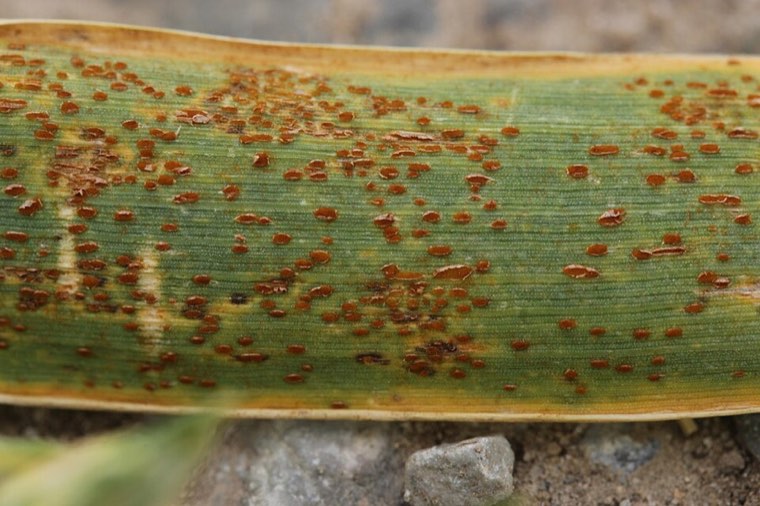
Leaf rust of wheat is caused by Puccinia triticina Erikss., 1899, a fungus (rust fungus, a basidiomycete) (order Pucciniales, family Pucciniaceae).
Older or alternative scientific names: Puccinia recondita f. sp. tritici.
Present wherever wheat is grown, from tropical highlands to temperate plains. It is particularly important in South America, South Asia, the Mediterranean, North America, China and Europe.
| Region | Status |
|---|---|
| South Asia | Widespread; recurrent in northern plains |
| Americas | Widespread; major in the Southern Cone and North American plains |
| Europe and the Mediterranean | Widespread |
| East and Central Asia | Widespread |
| Africa and Oceania | Widespread |
The fungus forms round to oval, orange-brown pustules (uredinia) about 1.5 mm across, mostly on the upper leaf surface, which release powdery urediniospores. Late in the season, black telia form under the epidermis, mostly on the lower leaf surface and sheaths.
| Crop stage | What you see |
|---|---|
| Seedling and tillering | Scattered, small orange-brown pustules on leaves of volunteer plants and early-sown crops. |
| Stem elongation to heading | Many scattered pustules on upper leaves, often with a pale halo; spores rub off on fingers. |
| Grain filling | Flag and upper leaves yellow and die early; black telia on lower surfaces; lighter grain. |
The fungus survives between crops on volunteer wheat and in green crops through mild winters, and its spores travel long distances on wind. Urediniospores infect leaves in the presence of dew and produce new pustules in about 7-10 days in warm weather, so many cycles occur during a season. Sexual reproduction on the alternate host is rare in most regions.
| Stage | Duration | Notes |
|---|---|---|
| Urediniospore lands on a wet leaf | Needs about 3-6 hours of dew | Wind-dispersed. |
| Latent period | About 7-10 days at 18-22 °C | Longer in cool weather. |
| Sporulation | Each pustule for 2-3 weeks | Repeated cycles. |
| Telia and survival | Late season to next crop | Mainly survives on green volunteer wheat. |
Infection occurs from about 10 to 30 °C, with an optimum near 15-22 °C combined with dew; it tolerates warmer conditions than yellow rust but is less heat-loving than stem rust.
Many asexual cycles in each wheat season.
Mild temperatures with dew, mild winters, early sowing, green volunteer wheat between seasons and widely grown susceptible varieties.
There is no universal numeric threshold. Some advisory services use a severity level on the upper leaves around flag-leaf emergence to heading to justify a fungicide in susceptible varieties; these levels differ between regions and depend on grain price and expected yield. Resistant varieties usually need no treatment.
Thresholds are local. They depend on crop price, control cost, variety and natural-enemy activity, so use the figure your local extension service publishes where one exists.
Annual losses are typically about 5-15% in affected areas, rising to 30-50% in susceptible varieties when infection is early and severe. Loss comes mainly from fewer and smaller grains due to early death of the flag leaf.
Control works best as a sequence: prevent, monitor, then act only when a threshold or a risk forecast says so, using the least disruptive option that works.
Fungicides are used on susceptible varieties when rust develops early on the upper leaves. What is registered differs by country and changes over time; follow the label and your local plant-protection authority.
| Scheme | Group | Mode of action | Notes |
|---|---|---|---|
| FRAC | 3 | Demethylation inhibitors (DMI) | Systemic; curative in the latent period. |
| FRAC | 11 | Quinone outside inhibitors (QoI, strobilurins) | Preventive; in mixtures. |
| FRAC | 7 | Succinate dehydrogenase inhibitors (SDHI) | Used in mixtures. |
Bread wheat, durum wheat and triticale; some wild relatives such as Aegilops species. Meadow rue (Thalictrum speciosissimum) and Isopyrum species are alternate hosts for the sexual stage, which is rare in most wheat regions.
How to grow the crop well is the first line of defence. Laisha's free grow guides cover each crop from sowing to harvest:
Written by Laisha from the sources above, in its own words. This page is general reference, not a prescription: confirm identification locally and follow the label and your plant-protection authority.