 Laisha
AI Operating System for Agriculture
Ask Laisha
Laisha
AI Operating System for Agriculture
Ask Laisha
Colletotrichum lindemuthianum Colletotrichum lindemuthianum (Sacc. & Magnus) Briosi & Cavara, 1889 · formerly or also: Glomerella lindemuthiana (sexual stage)
Bean anthracnose is a seed-borne fungal disease that causes dark red to black streaks along the veins on the undersides of bean leaves, and sunken, dark-edged spots on pods, often with pinkish spore masses in the centre. Infected seeds carry the fungus into the next crop. In cool, wet weather it can destroy whole crops, and it is one of the most important bean diseases in the highlands of Africa and Latin America.
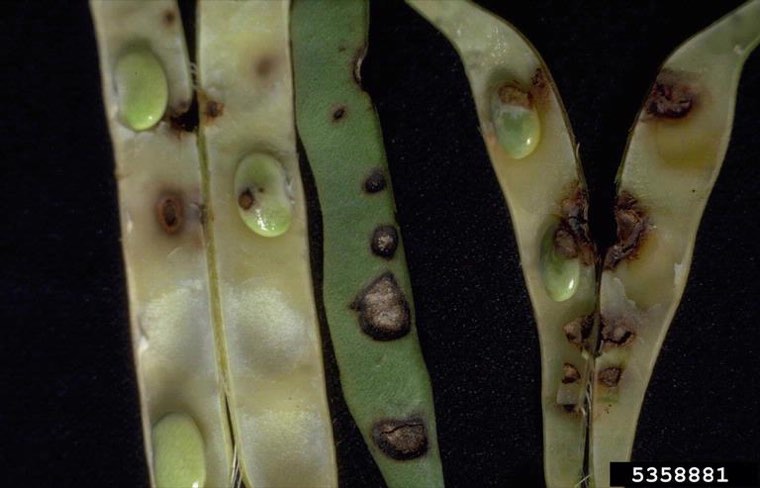
Bean anthracnose is caused by Colletotrichum lindemuthianum Colletotrichum lindemuthianum (Sacc. & Magnus) Briosi & Cavara, 1889, a fungus (ascomycete) (order Glomerellales, family Glomerellaceae).
Older or alternative scientific names: Glomerella lindemuthiana (sexual stage).
Found wherever beans are grown, most damaging in cool, humid regions and highlands of Africa and Latin America, and in temperate regions where uncertified seed is used.
| Region | Status |
|---|---|
| Africa | Widespread, especially in highlands |
| Latin America | Widespread, especially in highlands |
| Europe and North America | Present; controlled largely by certified seed |
| Asia | Present |
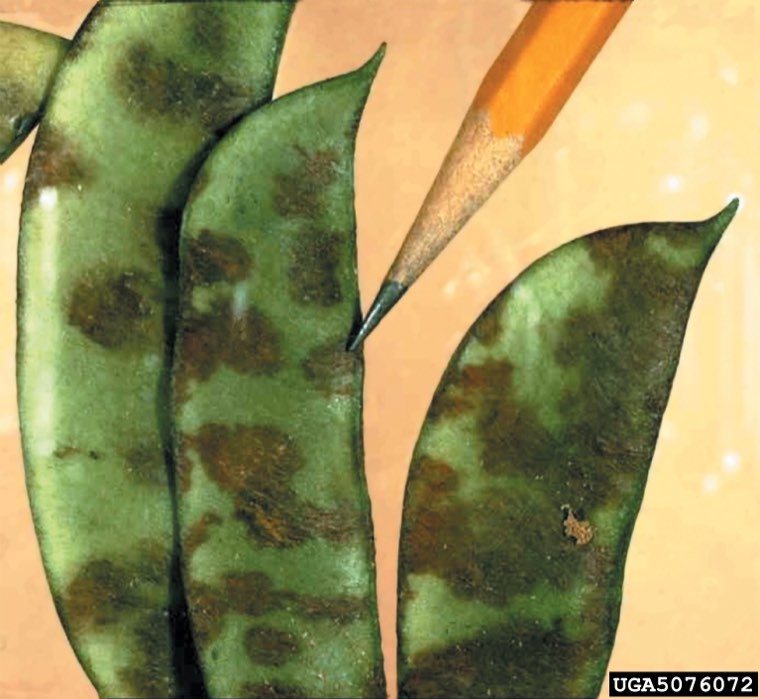
A fungus that forms small cushion-shaped fruiting bodies (acervuli) with dark bristles, producing pink to salmon-coloured spore masses in humid weather. More than 100 races differing in virulence are known, so resistance must be matched to the local races. The fungus can stay alive inside infected seed for several years, which is how it travels between regions and countries.
| Crop stage | What you see |
|---|---|
| Seedlings | Dark sunken lesions on seed leaves and young stems from infected seed; seedlings may collapse. |
| Leaves | Dark brick-red to black streaks along the veins on the undersides of leaves, later visible on top. |
| Pods and seed | Round, sunken, dark brown spots with dark borders on pods, often with pink spore masses; discoloured or spotted seeds. |
The fungus survives in infected seed and in crop debris. Seedlings from infected seed develop lesions that produce spores, which are spread by rain splash, wind-driven rain, insects, animals and people working among wet plants. Repeated cycles spread the disease through the crop, and infected pods pass it to the seed.
| Stage | Duration | Notes |
|---|---|---|
| Infected seed and debris | Between seasons | Seed is the main source. |
| Infection of seedlings and leaves | After several hours of wetness | Cool, wet weather. |
| Lesions with spore masses | About 6-10 days | Pink spores ooze in humid weather. |
| Pod and seed infection | Later in the season | Carries the fungus forward. |
Most severe at cool to moderate temperatures (about 13-26 °C) with high humidity and frequent rain.
Several cycles per season in wet weather.
Infected farm-saved seed, cool and wet weather, frequent rain and wind-driven rain, working in wet fields, continuous bean cropping and susceptible varieties. Rain at flowering and pod filling is especially important because it leads to pod and seed infection.
There is no numeric economic threshold; management is preventive, based on clean seed, rotation and resistant varieties.
Thresholds are local. They depend on crop price, control cost, variety and natural-enemy activity, so use the figure your local extension service publishes where one exists.
Losses can reach the whole crop when infected seed is planted and the weather is cool and wet; infected seed loses market and seed value. Seedlings from infected seed act as starting points, so even a small share of infected seed can lead to a severe epidemic when the weather favours the fungus.
Control works best as a sequence: prevent, monitor, then act only when a threshold or a risk forecast says so, using the least disruptive option that works.
Seed treatments reduce seed-borne infection, and foliar fungicides protect crops during cool, wet weather. What is registered differs by country and changes over time; follow the label and your local plant-protection authority.
| Scheme | Group | Mode of action | Notes |
|---|---|---|---|
| FRAC | 11 | Quinone outside inhibitors (QoI) | High resistance risk; use in mixtures. |
| FRAC | 3 | Demethylation inhibitors (DMI) | Medium resistance risk. |
| FRAC | M05 | Chloronitriles (multi-site) | Protectant. |
Common bean and other Phaseolus species, such as runner and lima beans; occasionally cowpea and other legumes.
How to grow the crop well is the first line of defence. Laisha's free grow guides cover each crop from sowing to harvest:
Written by Laisha from the sources above, in its own words. This page is general reference, not a prescription: confirm identification locally and follow the label and your plant-protection authority.