 Laisha
AI Operating System for Agriculture
Ask Laisha
Laisha
AI Operating System for Agriculture
Ask Laisha
Uromyces appendiculatus Uromyces appendiculatus (Pers.) Unger, 1836 · formerly or also: Uromyces phaseoli
Bean rust covers bean leaves with small, raised, reddish-brown pustules that release powdery, rust-coloured spores, usually on the undersides of leaves and often with a yellow halo. Heavily infected leaves dry and drop early, reducing yield, especially when infection begins before flowering. The rust has hundreds of races, so resistant varieties need several resistance genes to stay effective.
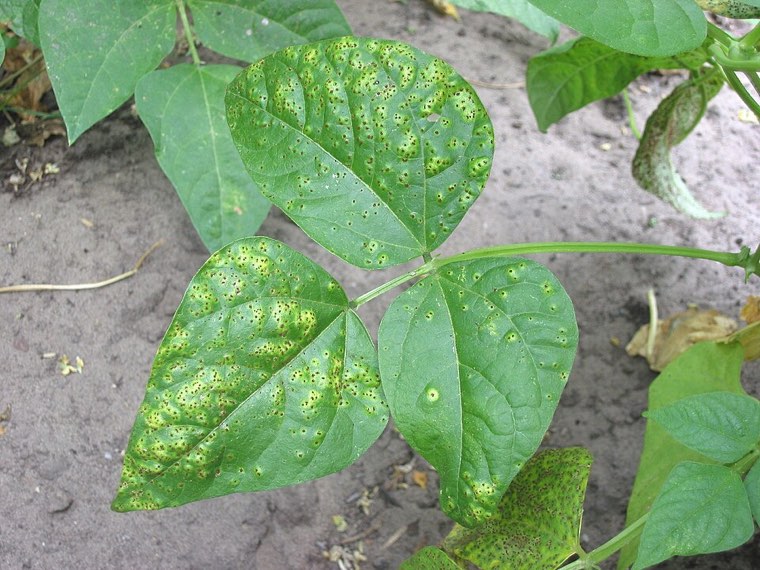
Bean rust is caused by Uromyces appendiculatus Uromyces appendiculatus (Pers.) Unger, 1836, a fungus (rust fungus, basidiomycete) (order Pucciniales, family Pucciniaceae).
Older or alternative scientific names: Uromyces phaseoli.
Found worldwide wherever beans are grown, most damaging in humid tropical and subtropical regions and in irrigated crops with dew.
| Region | Status |
|---|---|
| Africa | Widespread |
| Americas | Widespread |
| Asia | Widespread |
| Europe and Oceania | Present |
A rust fungus that completes its whole life cycle on beans. The main spreading spores (urediniospores) are produced in cinnamon-brown pustules; black teliospores form in older pustules late in the season and help it survive between crops in some regions. More than 250 races have been identified. Rust spores are blown long distances by wind, so infections can start even in fields where beans have not been grown recently.
| Crop stage | What you see |
|---|---|
| Early infection | Small white or pale yellow raised flecks, mainly on the undersides of leaves. |
| Pustules | Round, reddish-brown pustules up to about 2 mm across that burst to release powdery rust-coloured spores, often surrounded by a yellow halo; spores rub off on fingers. |
| Severe infection | Leaves turn yellow, dry and drop; pustules on pods and stems; black pustules (telia) late in the season. |
Urediniospores carried by wind land on leaves and infect when leaves stay wet for many hours. New pustules appear and release spores within about 10-14 days under good conditions, so the disease builds up quickly through repeated cycles. In some regions the fungus survives between crops as teliospores on debris, or carries on in continuous or volunteer bean plantings.
| Stage | Duration | Notes |
|---|---|---|
| Survival | Between crops | Teliospores on debris, or volunteer beans. |
| Infection | About 10-18 hours of leaf wetness | Moderate temperatures. |
| Pustule formation and sporulation | About 10-14 days | Many cycles per season. |
| Telia formation | Late season | Black resting spores. |
Favoured by moderate temperatures, below about 30 °C, with long dew periods; hot, dry weather slows it.
Many cycles per season.
Long periods of leaf wetness from dew, rain or sprinkler irrigation, moderate temperatures, dense canopies, nearby infected bean crops or volunteers, and susceptible varieties. Staggered plantings that keep young bean leaves in the area for months allow the rust to build up from crop to crop.
There is no numeric economic threshold; fungicides are used preventively or at the first pustules in susceptible varieties where rust is common, especially before flowering.
Thresholds are local. They depend on crop price, control cost, variety and natural-enemy activity, so use the figure your local extension service publishes where one exists.
Yield losses of 20-50% or more occur when rust becomes severe before or during flowering; pod infection lowers quality in green beans. In irrigated and dewy environments the rust can build up quickly from a few early pustules, so infection before flowering is the main risk.
Control works best as a sequence: prevent, monitor, then act only when a threshold or a risk forecast says so, using the least disruptive option that works.
Fungicides protect leaves when applied before or at the first pustules. What is registered differs by country and changes over time; follow the label and your local plant-protection authority.
| Scheme | Group | Mode of action | Notes |
|---|---|---|---|
| FRAC | 11 | Quinone outside inhibitors (QoI) | High resistance risk; use in mixtures. |
| FRAC | 3 | Demethylation inhibitors (DMI) | Curative activity. |
| FRAC | M05 | Chloronitriles (multi-site) | Protectant. |
Common bean and other Phaseolus species, including runner, lima and tepary beans; cowpea rust is caused by a different species (Uromyces vignae).
How to grow the crop well is the first line of defence. Laisha's free grow guides cover each crop from sowing to harvest:
Written by Laisha from the sources above, in its own words. This page is general reference, not a prescription: confirm identification locally and follow the label and your plant-protection authority.