 Laisha
AI Operating System for Agriculture
Ask Laisha
Laisha
AI Operating System for Agriculture
Ask Laisha
Prostephanus truncatus (Horn, 1878)
The larger grain borer is a small cylindrical beetle that tunnels through stored maize and dried cassava, turning them into dust far faster than ordinary weevils. Native to Central America, it was accidentally introduced to East and West Africa around 1980 and spread across much of the continent, where it became the most destructive pest of farm-stored maize on the cob. A predatory beetle from its home range, hermetic storage and shelling grain help control it.
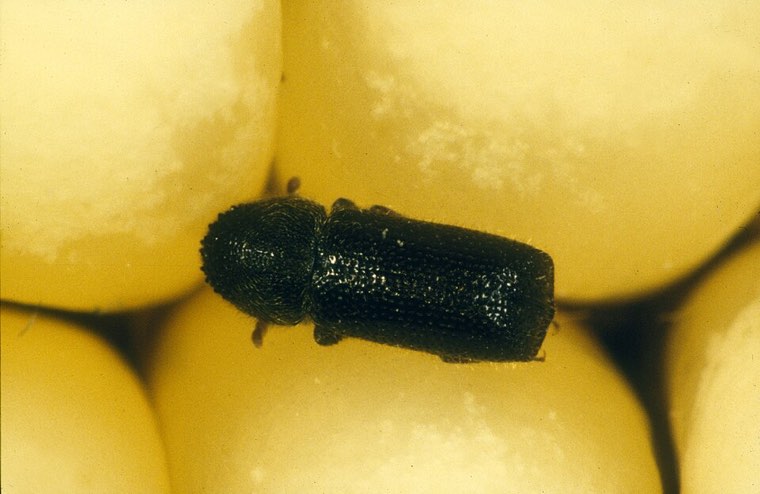
The scientific name of larger grain borer is Prostephanus truncatus (Horn, 1878), in the order Coleoptera, family Bostrichidae.
Native to Mexico and Central America. Introduced to Tanzania (reported in 1981) and Togo (1984), it has spread through much of East, West, Central and southern Africa. It is a quarantine pest in many other regions.
| Region | Status |
|---|---|
| Central America and Mexico | Native |
| East and southern Africa | Invasive since about 1980; widespread |
| West and Central Africa | Invasive since the mid-1980s; widespread |
| Other regions | Absent; regulated |
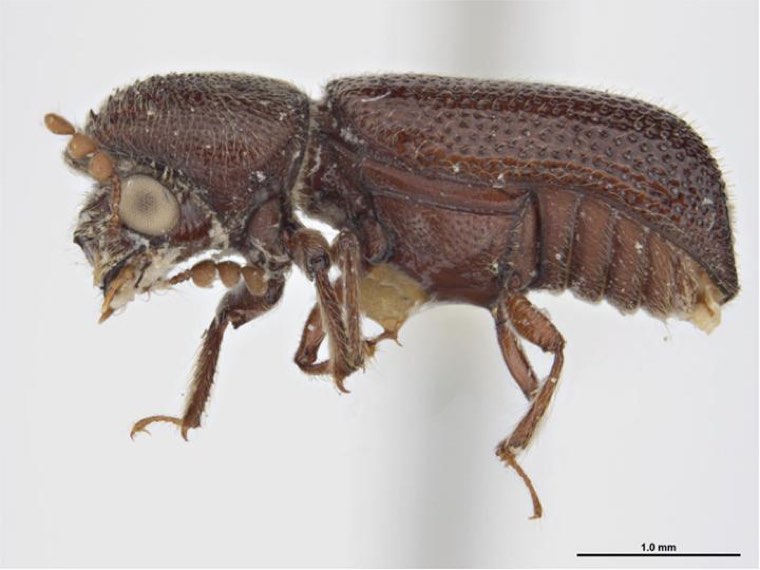
Adults are cylindrical, dark brown, about 3-4.5 mm long, with the head bent down under the hood-like thorax so it is not visible from above. The rear end of the wing covers is flattened and steep, edged with small bumps - a key feature. Larvae are C-shaped and white, living inside the tunnels.
| Crop stage | What you see |
|---|---|
| Field (shortly before harvest) | Adults may enter maize cobs in the field, especially if harvest is delayed. |
| Early storage | Round holes bored through husks and grain; fine, flour-like dust accumulating under stored cobs. |
| Later storage | Grain and cassava chips reduced to dust within months; beetles visible in large numbers. |
Adults bore into grain and lay eggs in chambers at the end of tunnels. Larvae develop in the dust and grain, pupate there, and the new adults continue boring. Males release an aggregation pheromone that attracts both sexes, which is used in monitoring traps. Adults fly between stores and to and from wooded areas.
| Stage | Duration | Notes |
|---|---|---|
| Egg | About 4-7 days | In chambers bored into grain. |
| Larva | About 3-4 weeks | Feeds in grain and flour dust. |
| Pupa | About 1 week | Inside grain or dust. |
| Adult | Several months | Bores continuously; flies. |
Development is fastest at about 30-32 °C and moderate humidity; it thrives in hot, relatively dry stores where maize weevils do less well.
Several generations a year in warm stores (a generation in roughly 4-6 weeks).
Storing maize on the cob with husks, long storage periods, warm conditions, stores near woodland where wild populations breed, and moving infested grain.
There is no numeric economic threshold for farm stores; any infestation spreads quickly, so stores are inspected regularly and protected from the start. Pheromone trap catches are used to monitor seasonal flights and spread.
Thresholds are local. They depend on crop price, control cost, variety and natural-enemy activity, so use the figure your local extension service publishes where one exists.
Weight losses of 30-40% of farm-stored maize on the cob within three to six months were reported after its arrival in Africa, far higher than losses from native storage pests; dried cassava chips can be destroyed.
Control works best as a sequence: prevent, monitor, then act only when a threshold or a risk forecast says so, using the least disruptive option that works.
Grain protectants registered for stored food grain are applied to shelled grain at storage; some groups that work well against weevils are weak against this beetle. Fumigation must be done only by trained, licensed operators. What is registered differs by country and changes over time; follow the label and your local plant-protection or food-safety authority.
| Scheme | Group | Mode of action | Notes |
|---|---|---|---|
| IRAC | 3A | Sodium channel modulators (pyrethroids) | Effective against this species as grain protectants. |
| IRAC | 1B | Acetylcholinesterase inhibitors (organophosphates) | Weak alone; used in combination products against weevils. |
| IRAC | 24 | Mitochondrial complex IV electron transport inhibitors (phosphides) | Fumigant; licensed operators only. |
Stored maize (especially on the cob) and dried cassava chips are the main hosts; it also attacks other stored products and wood, and breeds in dead wood of forest trees, which allows it to survive outside stores.
How to grow the crop well is the first line of defence. Laisha's free grow guides cover each crop from sowing to harvest:
Written by Laisha from the sources above, in its own words. This page is general reference, not a prescription: confirm identification locally and follow the label and your plant-protection authority.