 Laisha
AI Operating System for Agriculture
Ask Laisha
Laisha
AI Operating System for Agriculture
Ask Laisha
Sitophilus zeamais Motschulsky, 1855
A small brown weevil with a long snout whose larvae grow hidden inside individual grains of stored maize, rice, sorghum and wheat, hollowing them out. It is one of the most damaging storage pests in the tropics: in a few months of poor storage a smallholder can lose a large part of the harvest. Dry grain, clean stores and airtight (hermetic) storage are the most effective defences.
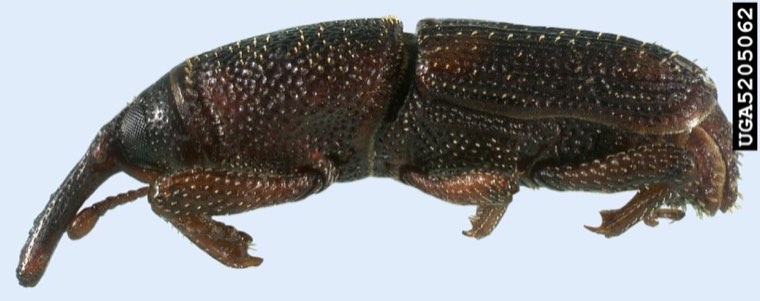
The scientific name of maize weevil is Sitophilus zeamais Motschulsky, 1855, in the order Coleoptera, family Curculionidae (Dryophthorinae).
Found throughout the warm, humid tropics and subtropics wherever maize is stored, and carried in grain trade to temperate regions, where it survives mainly in heated stores.
| Region | Status |
|---|---|
| Sub-Saharan Africa | Widespread; major smallholder storage pest |
| Latin America | Widespread |
| South and Southeast Asia | Widespread |
| East Asia | Widespread in the south |
| Temperate regions | In stored products; limited by cold |
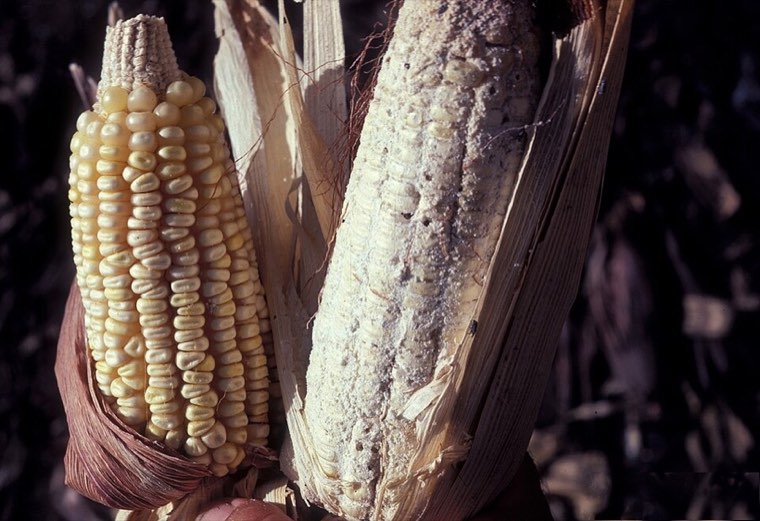
Adults are 2.5-4 mm long, dark reddish-brown to black, with a long narrow snout, elbowed antennae and four faint orange-red spots on the wing covers. The thorax is densely covered with round pits. Larvae are white, legless, C-shaped grubs found only inside grains. Maize weevil and rice weevil (S. oryzae) are almost identical and are separated reliably only by examining genitalia.
| Crop stage | What you see |
|---|---|
| Pre-harvest (maize in the field) | Weevils in cobs with poor husk cover, especially when harvest is delayed. |
| Early storage | Small round exit holes in grains; adults walking on grain and sacks; slight warmth and fine dust in the store. |
| Late storage | Hollowed, powdery grains; heating and moisture in bulk grain leading to moulds; grain unfit for food or seed. |
Females chew a small hole in a grain, lay a single egg and seal it with a plug. The larva feeds inside the grain, pupates there and the adult chews its way out. Adults live several months and can fly, which lets them move from stores to fields and back.
| Stage | Duration | Notes |
|---|---|---|
| Egg (inside grain) | About 4-6 days at 27 °C | One egg per grain; 300-400 eggs per female. |
| Larva (4 instars, inside grain) | About 2-3 weeks | Hidden; feeds on the kernel. |
| Pupa (inside grain) | About 5-8 days | Inside the hollowed grain. |
| Adult | Several months to a year | Flies; emerges through a round exit hole. |
At about 27 °C and 70% relative humidity a generation takes about 5 weeks; development stops below about 15 °C and in grain drier than about 10-11% moisture. Cooling and drying grain therefore slows or stops population growth.
Up to 6-7 generations a year in warm stores.
Grain stored with more than about 13% moisture, warm stores, carry-over of infested grain or residues from the last season, mixing new and old grain, delayed harvest of maize in the field, and porous bags or granaries.
There is no numeric economic threshold for smallholder storage: any live weevils mean the population will grow. Grain trade and food standards commonly specify zero or very low tolerance for live insects and limits on insect-damaged kernels, which are set nationally. Action is triggered by detection of live insects during regular inspection.
Thresholds are local. They depend on crop price, control cost, variety and natural-enemy activity, so use the figure your local extension service publishes where one exists.
Smallholder maize stored in traditional granaries or woven bags without protection commonly loses 10-30% of its weight over six to nine months in the tropics, with higher losses in humid lowlands. Damaged grain also loses germination, nutritional value and price, and moulds on infested grain can produce mycotoxins.
Control works best as a sequence: prevent, monitor, then act only when a threshold or a risk forecast says so, using the least disruptive option that works.
Grain protectants and fumigants must be used only as registered for stored food grain, with strict waiting periods; fumigation is dangerous and should be done only by trained, licensed operators in gas-tight conditions. What is registered differs by country and changes over time; follow the label and your local plant-protection or food-safety authority.
| Scheme | Group | Mode of action | Notes |
|---|---|---|---|
| IRAC | 3A | Sodium channel modulators (pyrethroids) | Used as grain protectants where registered. |
| IRAC | 1B | Acetylcholinesterase inhibitors (organophosphates) | Used as grain protectants where registered. |
| IRAC | 5 | Nicotinic acetylcholine receptor allosteric modulators, site I (spinosyns) | Grain protectant where registered. |
| IRAC | 24 | Mitochondrial complex IV electron transport inhibitors (phosphides) | Fumigant; licensed operators only; resistance widespread in stored-product insects. |
Cereal grains in store: maize, sorghum, rice, wheat, barley and millets; also dried cassava chips, pasta and processed cereal products. Adults can infest maize cobs in the field shortly before harvest.
How to grow the crop well is the first line of defence. Laisha's free grow guides cover each crop from sowing to harvest:
Written by Laisha from the sources above, in its own words. This page is general reference, not a prescription: confirm identification locally and follow the label and your plant-protection authority.