 Laisha
AI Operating System for Agriculture
Ask Laisha
Laisha
AI Operating System for Agriculture
Ask Laisha
Leucinodes orbonalis Guenée, 1854
The most destructive pest of eggplant (brinjal) in South and Southeast Asia. Its pink caterpillars bore into young shoots, which wilt, and into fruit, which become riddled with tunnels and unsaleable. Because larvae spend almost their whole life hidden inside plant tissue, farmers often spray very frequently with little effect; clipping infested shoots, pheromone traps, netting and, in some countries, Bt eggplant work far better.
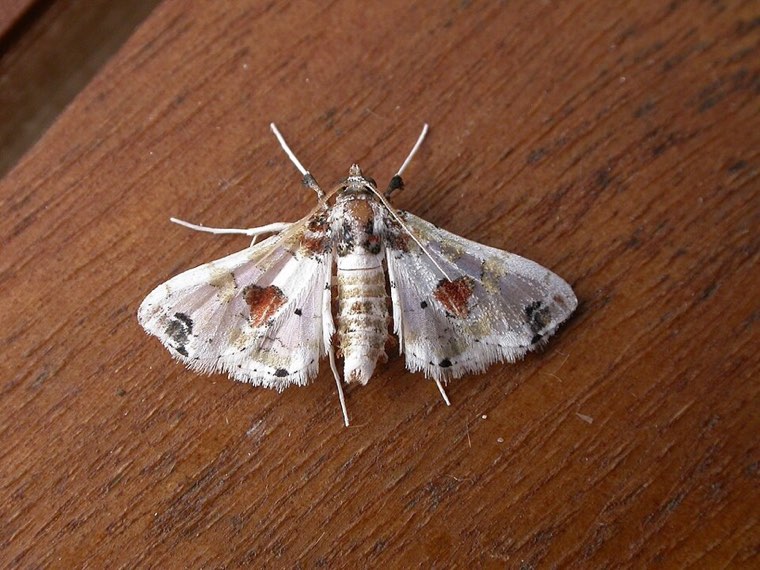
The scientific name of eggplant fruit and shoot borer is Leucinodes orbonalis Guenée, 1854, in the order Lepidoptera, family Crambidae.
Widespread in South and Southeast Asia and southern China. Records from Africa were shown in 2015 to belong mostly to other, related Leucinodes species, so the true distribution of L. orbonalis outside Asia is uncertain. It is regularly intercepted in exported eggplant fruit and is a quarantine pest in Europe.
| Region | Status |
|---|---|
| South Asia | Native; key eggplant pest |
| Southeast Asia | Widespread |
| East Asia | Present in the south |
| Africa | Related Leucinodes species cause similar damage; records of L. orbonalis need confirmation |
| Europe | Absent; quarantine pest intercepted on imported fruit |
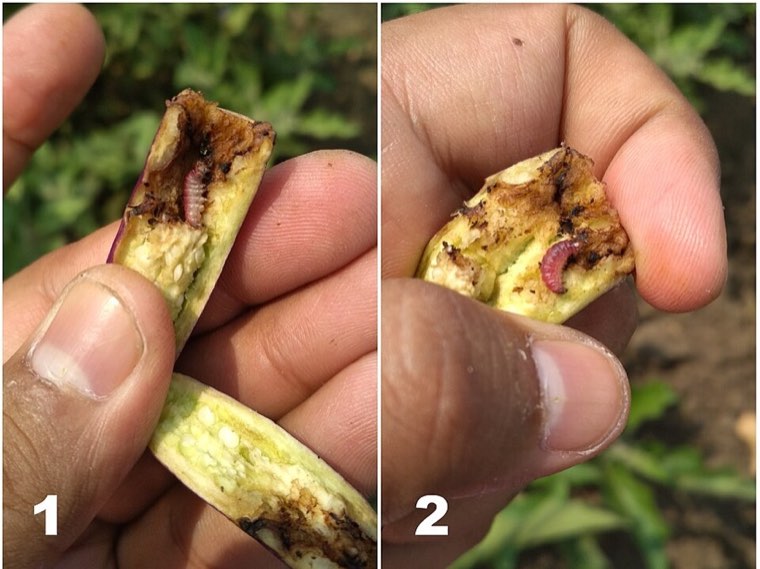
Eggs are creamy-white, flat and laid singly on leaves, shoots and flower buds. Larvae are creamy when young and turn pink, with a brown head, reaching about 15-20 mm. The moth is white with pink-brown and black patches on the forewings, about 2-3 cm across, resting with wings spread and the abdomen curved up.
| Crop stage | What you see |
|---|---|
| Vegetative (before flowering) | Drooping, wilting shoot tips with a small entry hole plugged with frass just below; the tip dries. |
| Flowering | Bored flower buds and petioles; flower drop. |
| Fruiting | Small, often frass-plugged holes in fruit; tunnels and rotting flesh inside; exit holes left by mature larvae; deformed fruit. |
Each female lays roughly 100-250 eggs. Newly hatched larvae bore into a shoot or fruit within hours. Mature larvae leave the fruit or shoot and pupate in a tough, boat-shaped cocoon on the plant, in debris or on the soil surface. A generation takes about 3-5 weeks in warm weather.
| Stage | Duration | Notes |
|---|---|---|
| Egg | About 3-5 days at 25-30 °C | Laid singly. |
| Larva (5 instars) | About 12-15 days at 25-30 °C | Inside shoots or fruit. |
| Pupa in cocoon | About 6-10 days | On plant or soil surface. |
| Adult moth | About 3-7 days | Nocturnal; strongly attracted to its sex pheromone. |
Development is fastest at about 25-30 °C; it slows sharply in cool winters, when generations lengthen to two months or more.
About 5-10 overlapping generations a year where eggplant is grown continuously.
Warm, humid weather; continuous and staggered eggplant cropping; leaving infested shoots, fruit and crop residues in or near fields; and calendar spraying, which kills natural enemies without reaching hidden larvae.
There is no widely validated numeric economic threshold; because larvae are hidden and fruit damage is directly marketable loss, management is preventive from transplanting. Some national programmes publish local action levels based on the percentage of damaged shoots or fruit; use those where they exist.
Thresholds are local. They depend on crop price, control cost, variety and natural-enemy activity, so use the figure your local extension service publishes where one exists.
Fruit damage of 30-70% is common in unprotected crops in South Asia, and higher in the hot, humid season; shoot damage reduces plant growth and yield. Farmers in some areas spray more than 50 times a season, which raises residues and costs.
Control works best as a sequence: prevent, monitor, then act only when a threshold or a risk forecast says so, using the least disruptive option that works.
Sprays reach only eggs, newly hatched larvae and adults; frequent calendar spraying is ineffective and leaves residues. Respect pre-harvest intervals carefully because fruit is picked every few days. What is registered differs by country and changes over time; follow the label and your local plant-protection authority.
| Scheme | Group | Mode of action | Notes |
|---|---|---|---|
| IRAC | 28 | Ryanodine receptor modulators (diamides) | Used in some programmes. |
| IRAC | 5 | Nicotinic acetylcholine receptor allosteric modulators, site I (spinosyns) | Used in some programmes. |
| IRAC | 6 | Glutamate-gated chloride channel allosteric modulators (avermectins) | Used in some programmes. |
| IRAC | 11A | Bacillus thuringiensis | Biological; young larvae. |
Mainly eggplant; occasionally potato, tomato, turkey berry (Solanum torvum), black nightshade and other Solanum species.
How to grow the crop well is the first line of defence. Laisha's free grow guides cover each crop from sowing to harvest:
Written by Laisha from the sources above, in its own words. This page is general reference, not a prescription: confirm identification locally and follow the label and your plant-protection authority.