 Laisha
AI Operating System for Agriculture
Ask Laisha
Laisha
AI Operating System for Agriculture
Ask Laisha
Septoria lycopersici Septoria lycopersici Speg., 1881
Septoria leaf spot covers tomato leaves with many small round spots that have grey centres, dark edges and tiny black dots inside. It starts on the lowest leaves after the first fruit sets and moves upward in warm, wet weather, stripping plants of their leaves. The fruit is rarely attacked, but defoliated plants give smaller fruit that is often scalded by the sun.
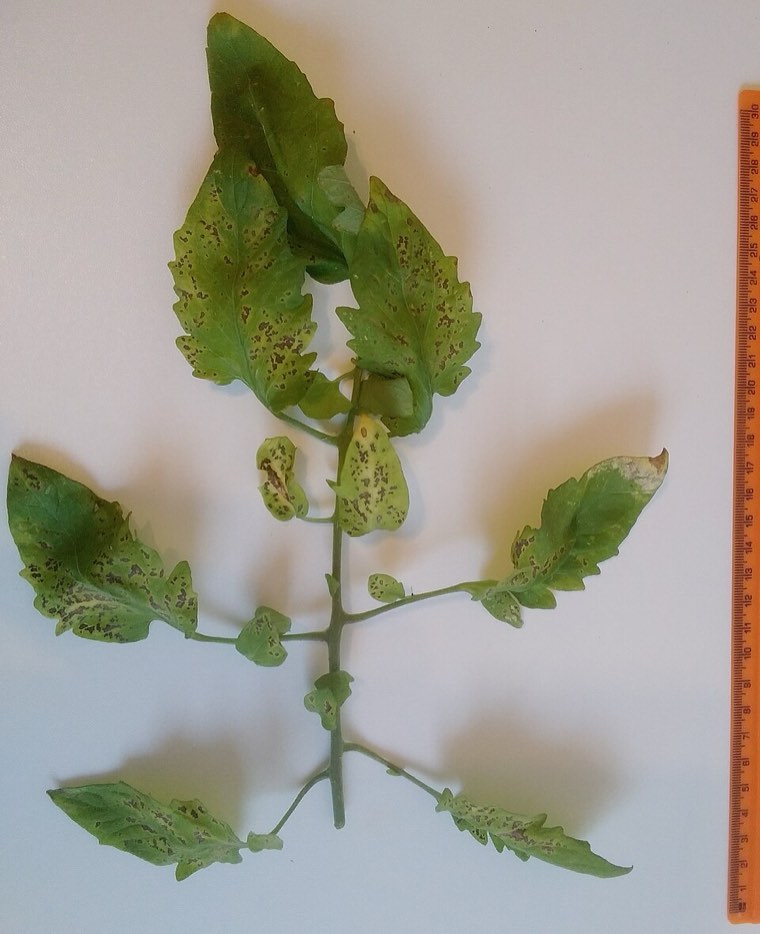
Septoria leaf spot of tomato is caused by Septoria lycopersici Septoria lycopersici Speg., 1881, a fungus (ascomycete) (order Mycosphaerellales, family Mycosphaerellaceae).
Found wherever tomatoes are grown in humid, rainy conditions; one of the most common tomato leaf diseases in field and garden crops.
| Region | Status |
|---|---|
| Americas | Widespread, especially in humid regions |
| Europe | Present; more common in wet summers |
| Asia and Africa | Widespread in rainy seasons and highlands |
| Oceania | Present |
A fungus that forms flask-shaped fruiting bodies (pycnidia), seen as black dots in the centre of spots; in wet weather they ooze long, thread-like spores that are splashed to other leaves. Spores spread only short distances by splash, so the disease usually starts in patches near infested debris or weeds and moves along rows.
| Crop stage | What you see |
|---|---|
| Lower leaves | Small, water-soaked spots that become round, 1.5-6 mm across, with grey or tan centres and dark brown margins; tiny black pycnidia in the centres. |
| Spread upward | Many spots per leaf; leaves turn yellow, then brown, and drop from the bottom of the plant upward. |
| Stems, calyx and fruit | Spots may appear on stems, leaf stalks and calyx; fruit spots are rare; defoliated plants expose fruit to sunscald. |
The fungus survives on infected tomato debris and on solanaceous weeds, and can be carried on seed. In wet weather spores ooze from pycnidia and are splashed by rain and overhead irrigation, by hands and tools, and by insects. New spots appear within about a week and produce spores in turn, so the disease repeats many times in a season.
| Stage | Duration | Notes |
|---|---|---|
| Survival | On debris and weeds between seasons | Debris in or on soil. |
| Infection | After leaves stay wet for many hours | Through stomata. |
| Spot development and pycnidia | About 5-10 days | Spores ooze in wet weather. |
| Repeated splash dispersal | Through the season | Moves up the plant. |
Most severe at about 20-25 °C with long periods of leaf wetness, rain and high humidity.
Many cycles in warm, wet seasons.
Frequent rain or overhead irrigation, long leaf wetness, dense unstaked plants with leaves touching the soil, tomato debris left from previous crops, and nightshade weeds nearby.
There is no numeric economic threshold; growers in humid regions start protection when the first spots appear or follow regional disease forecasts.
Thresholds are local. They depend on crop price, control cost, variety and natural-enemy activity, so use the figure your local extension service publishes where one exists.
Heavy defoliation reduces fruit size, yield and quality and exposes fruit to sunscald; field studies have measured yield losses of a third or more when the disease was not controlled. Losses are greatest when defoliation begins before or during fruit set.
Control works best as a sequence: prevent, monitor, then act only when a threshold or a risk forecast says so, using the least disruptive option that works.
Protectant fungicides applied before or at the first spots and repeated during wet weather keep the disease in check. What is registered differs by country and changes over time; follow the label and your local plant-protection authority.
| Scheme | Group | Mode of action | Notes |
|---|---|---|---|
| FRAC | M05 | Chloronitriles (multi-site) | Protectant. |
| FRAC | M03 | Dithiocarbamates and relatives (multi-site) | Protectant. |
| FRAC | 11 | Quinone outside inhibitors (QoI) | High resistance risk; limit applications. |
| FRAC | 3 | Demethylation inhibitors (DMI) | Medium resistance risk. |
Mainly tomato; also other solanaceous plants such as eggplant, potato and weeds including nightshades, jimsonweed and horsenettle.
How to grow the crop well is the first line of defence. Laisha's free grow guides cover each crop from sowing to harvest:
Written by Laisha from the sources above, in its own words. This page is general reference, not a prescription: confirm identification locally and follow the label and your plant-protection authority.